Gasgoo Munich- Data from Gasgoo Automotive Institute indicates that in the first two months of 2026, China’s NEV electrification sector saw the dominance of top players solidify even as competition among tiers intensified. Across six critical tracks—power batteries, battery packs, BMS, drive motors, motor controllers, and multi-in-one drive systems for pure electric vehicles—installation data reveals shifting industry dynamics. Resources are converging on leaders capable of full-chain integration, technical innovation, and large-scale production. Meanwhile, the divergence between automaker vertical integration and specialized supply chains is deepening, further cementing the local supply chain’s dominance. These figures offer a crucial window into the competitive landscape, technological direction, and the pace of localization in China’s core NEV components sector.
Power Battery Supplier Installation Rankings
CATL, 26,309 MWh installed in Jan-Feb 2026, 48.3% market share.
FinDreams Battery, 11,386 MWh installed in Jan-Feb 2026, 20.9% market share.
LG Energy Solution, 3,269 MWh installed in Jan-Feb 2026, 6.0% market share.
CALB, 2,754 MWh installed in Jan-Feb 2026, 5.1% market share.
Gotion, 2,112 MWh installed in Jan-Feb 2026, 3.9% market share.
Zhengli New Energy, 1,796 MWh installed in Jan-Feb 2026, 3.3% market share.
SVOLT, 1,577 MWh installed in Jan-Feb 2026, 2.9% market share.
Jiyao Tongxing, 1,385 MWh installed in Jan-Feb 2026, 2.5% market share.
Sunwoda, 1,068 MWh installed in Jan-Feb 2026, 2.0% market share.
REPT, 877 MWh installed in Jan-Feb 2026, 1.6% market share.
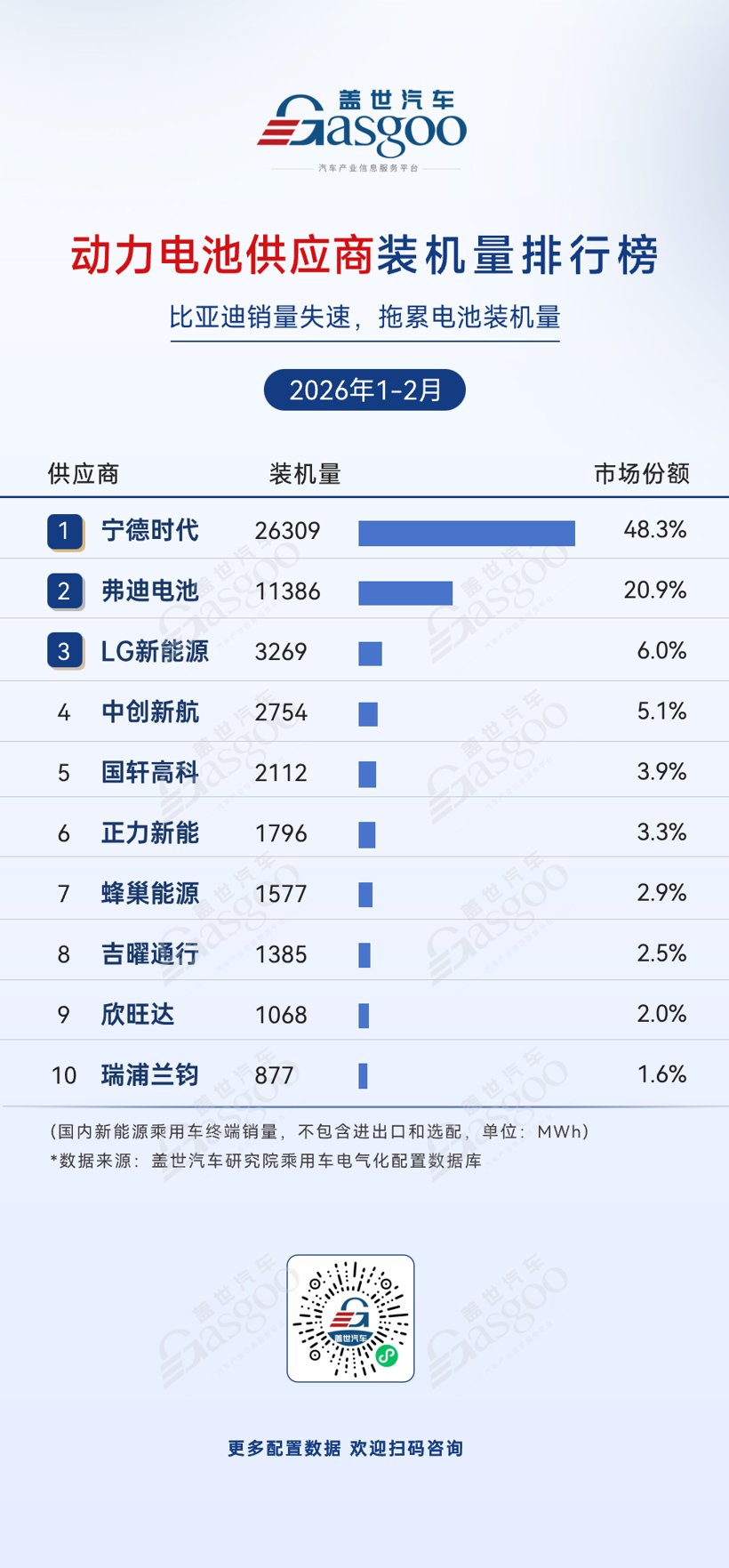
The data for Jan-Feb 2026 reveals a domestic market defined by "one dominant leader and several strong challengers," with top-tier players widening their lead. CATL remains the undisputed leader, holding 48.3% of the market with 26,309 MWh installed. Its full-chain integration, rapid tech iteration, and scale have cemented its status as the industry backbone. FinDreams Battery follows in second place with a 20.9% share and 11,386 MWh installed. While its deep ties to BYD and vertical integration ensure steady demand, its installation volume is under pressure year-on-year as BYD’s retail sales growth cools.
LG Energy Solution, CALB, and Gotion round out the pack, each topping 2,000 MWh. CALB, in particular, grabbed a 5.1% slice by diversifying its products and expanding its client base. While international players like LG Energy Solution have seen a modest rebound, their overall presence remains in retreat. This underscores the edge local battery makers hold in cost control, supply chain agility, and product adaptability, signaling that the localization of China's NEV supply chain is only accelerating.
Battery Pack Supplier Installation Rankings
CATL, 283,857 units installed in Jan-Feb 2026, 28.5% market share.
FinDreams Battery, 244,125 units installed in Jan-Feb 2026, 24.5% market share.
Jiyao Tongxing, 67,001 units installed in Jan-Feb 2026, 6.7% market share.
Tesla, 57,882 units installed in Jan-Feb 2026, 5.8% market share.
CALB, 46,166 units installed in Jan-Feb 2026, 4.6% market share.
Leapmotor, 38,056 units installed in Jan-Feb 2026, 3.8% market share.
SVOLT, 35,724 units installed in Jan-Feb 2026, 3.6% market share.
REPT, 30,948 units installed in Jan-Feb 2026, 3.1% market share.
Gotion, 28,833 units installed in Jan-Feb 2026, 2.9% market share.
Changan Automobile, 24,968 units installed in Jan-Feb 2026, 2.5% market share.
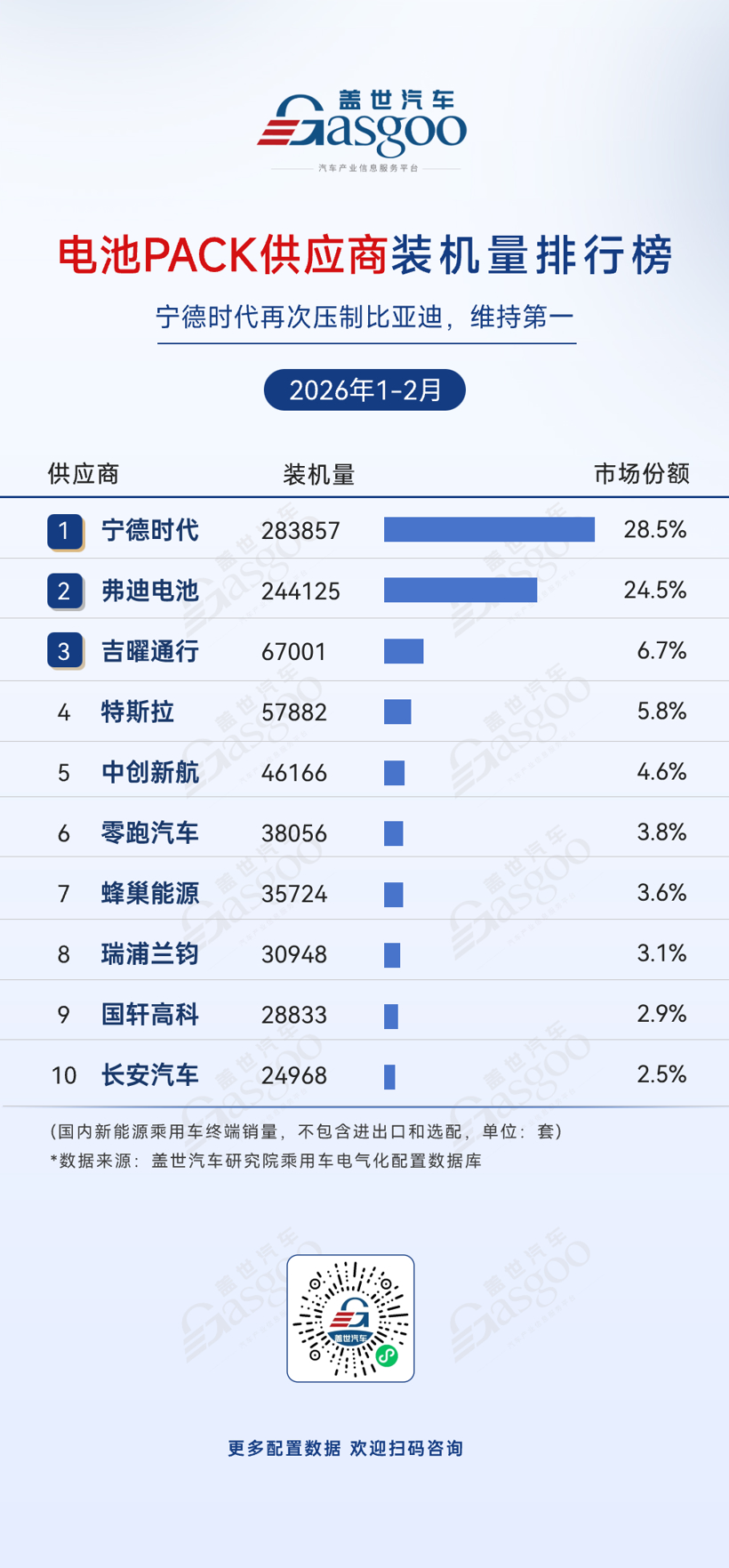
The pack installation data for Jan-Feb 2026 paints a picture of "two leaders racing ahead while the rest fragment." The top two suppliers control over 53% of the market, keeping concentration levels high.
CATL claimed the top spot with a 28.5% share and 283,857 units, holding off FinDreams Battery thanks to its standardized pack designs, technical versatility, and massive scale. FinDreams Battery followed closely with a 24.5% share and 244,125 units, fueled by BYD’s vertical integration model which guarantees steady internal demand.
Jiyao Tongxing, Tesla, and CALB occupy the second tier, with Jiyao Tongxing notably capturing 6.7% of the market through niche specialization. The presence of automakers like Tesla, Leapmotor, and Changan Automobile on the list underscores a strategic shift: top carmakers are increasingly building their own packs to control core tech and cut costs. Meanwhile, specialized firms like REPT and Gotion are gaining ground through differentiated strategies. The data confirms that the pack market is being driven by vertical integration, with resources flowing toward players who combine technological prowess with scale.
BMS Supplier Installation Rankings
CATL, 283,344 units installed in Jan-Feb 2026, 28.5% market share.
FinDreams Battery, 244,401 units installed in Jan-Feb 2026, 24.5% market share.
Li-Gao Technology, 85,263 units installed in Jan-Feb 2026, 8.6% market share.
UAES, 64,910 units installed in Jan-Feb 2026, 6.5% market share.
Tesla, 57,882 units installed in Jan-Feb 2026, 5.8% market share.
Leapmotor, 38,056 units installed in Jan-Feb 2026, 3.8% market share.
Jiyao Tongxing, 36,222 units installed in Jan-Feb 2026, 3.6% market share.
SAIC Jieneng, 34,544 units installed in Jan-Feb 2026, 3.5% market share.
Zhangyu, 28,174 units installed in Jan-Feb 2026, 2.8% market share.
Jinmai Electronics, 22,733 units installed in Jan-Feb 2026, 2.3% market share.
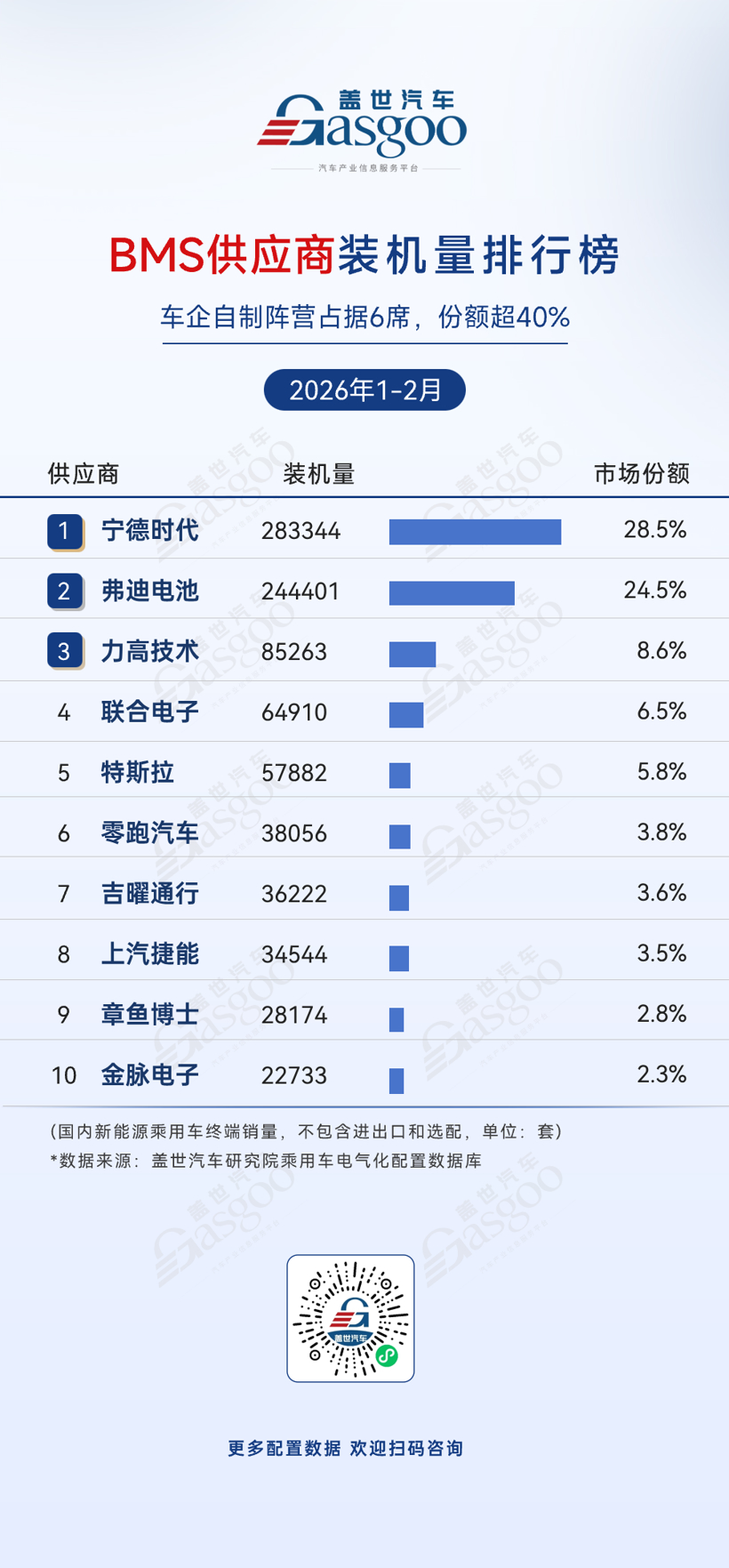
The BMS data for Jan-Feb 2026 shows a market characterized by "high concentration at the top, clear tiered divisions, and accelerating automaker self-sufficiency." CATL leads with a 28.5% share and 283,344 units, leveraging its deep expertise in battery management and full-chain capabilities to dominate the market. FinDreams Battery follows with a 24.5% share and 244,401 units, its proprietary BMS systems tightly integrated with BYD’s vehicles to drive internal growth.
Li-Gao Technology and UAES lead the second tier, with Li-Gao securing an 8.6% share that underscores its technical credibility. Notably, six automakers—including Tesla, Leapmotor, and SAIC Jieneng—appear in the top ten, collectively commanding over 40% of the market. This highlights the success of in-house BMS development strategies. The sector remains defined by vertical integration, with resources flowing toward innovators who can scale.
Drive Motor Supplier Installation Rankings
FinDreams Power, 235,461 units installed in Jan-Feb 2026, 18.6% market share.
Huawei Digital Energy, 124,726 units installed in Jan-Feb 2026, 9.8% market share.
Xingqu Technology, 116,037 units installed in Jan-Feb 2026, 9.1% market share.
Inovance United Power, 104,773 units installed in Jan-Feb 2026, 8.3% market share.
NIO Power Tech, 90,189 units installed in Jan-Feb 2026, 7.1% market share.
Tesla, 69,347 units installed in Jan-Feb 2026, 5.5% market share.
SVOLT E-creation, 45,238 units installed in Jan-Feb 2026, 3.6% market share.
UAES, 41,001 units installed in Jan-Feb 2026, 3.2% market share.
Zhixin Technology, 35,905 units installed in Jan-Feb 2026, 2.8% market share.
Lingsheng Power, 35,729 units installed in Jan-Feb 2026, 2.8% market share.
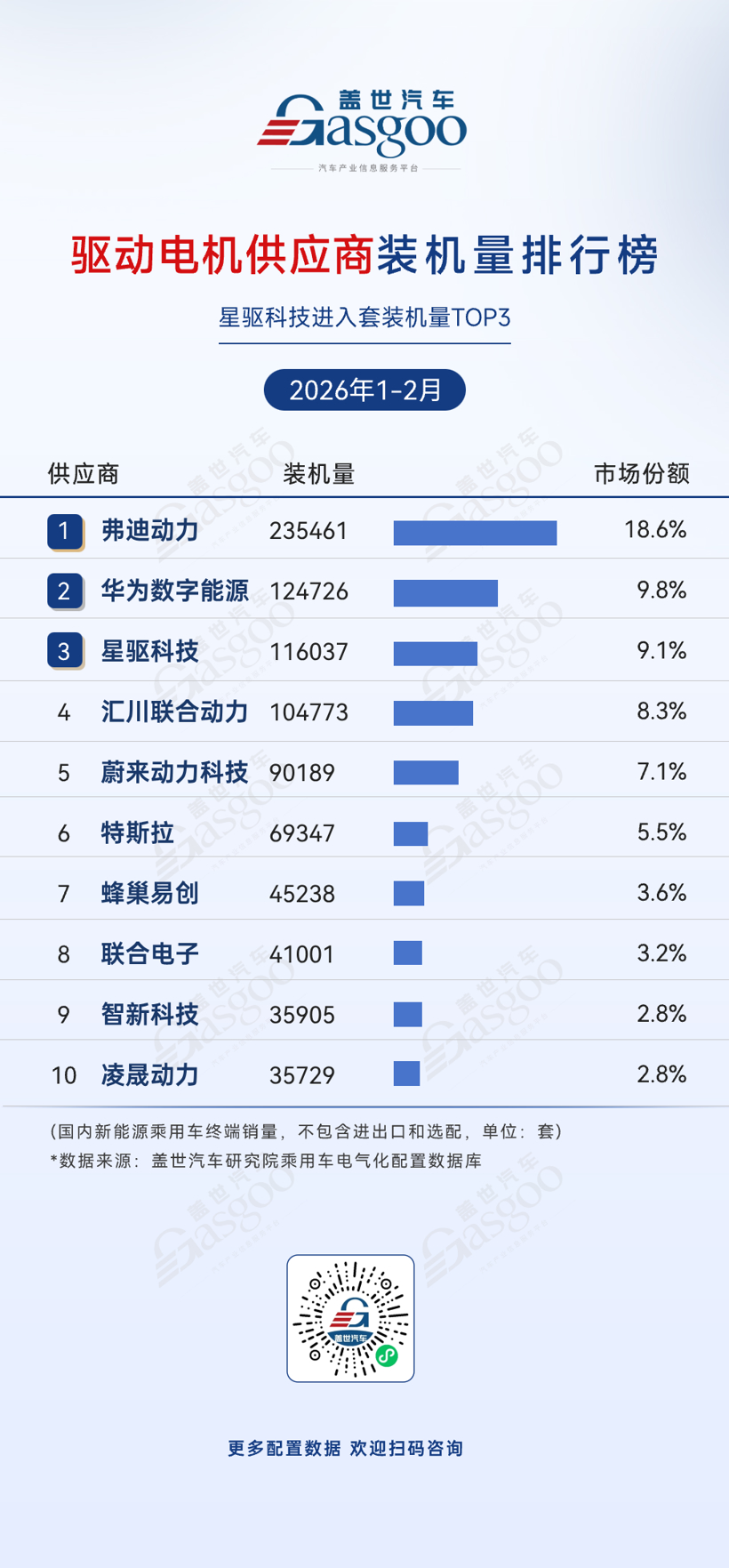
The drive motor market for Jan-Feb 2026 is defined by "fragmented tiers and a mix of in-house and specialized suppliers." FinDreams Power leads with an 18.6% share and 235,461 units, its motors deeply integrated with BYD’s platforms to maximize scale and cost efficiency. Huawei Digital Energy, Xingqu Technology, Inovance United Power, and NIO Power Tech make up the core chasing pack.
Huawei Digital Energy took second place with a 9.8% share, leveraging its expertise in motor efficiency and smart control to win business across the HarmonyOS Mobility ecosystem. Xingqu Technology surged into third with 9.1%, while Inovance United Power held fourth with 8.3%, proving its strength as a specialized supplier. NIO Power Tech grabbed 7.1%, underscoring the strategic importance of in-house motor production. Meanwhile, UAES, SVOLT, and Tesla are carving out their own niches, driving broader industry upgrades.
Motor Controller Supplier Installation Rankings
FinDreams Power, 235,484 units installed in Jan-Feb 2026, 18.6% market share.
Huawei Digital Energy, 129,440 units installed in Jan-Feb 2026, 10.2% market share.
Inovance United Power, 129,378 units installed in Jan-Feb 2026, 10.2% market share.
NIO Power Tech, 90,189 units installed in Jan-Feb 2026, 7.1% market share.
Xingqu Technology, 87,062 units installed in Jan-Feb 2026, 6.9% market share.
Tesla, 69,347 units installed in Jan-Feb 2026, 5.5% market share.
UAES, 47,535 units installed in Jan-Feb 2026, 3.7% market share.
Li Auto Drive, 43,942 units installed in Jan-Feb 2026, 3.5% market share.
CRRC Times Electric, 40,588 units installed in Jan-Feb 2026, 3.2% market share.
Leapmotor New Energy, 36,440 units installed in Jan-Feb 2026, 2.9% market share.
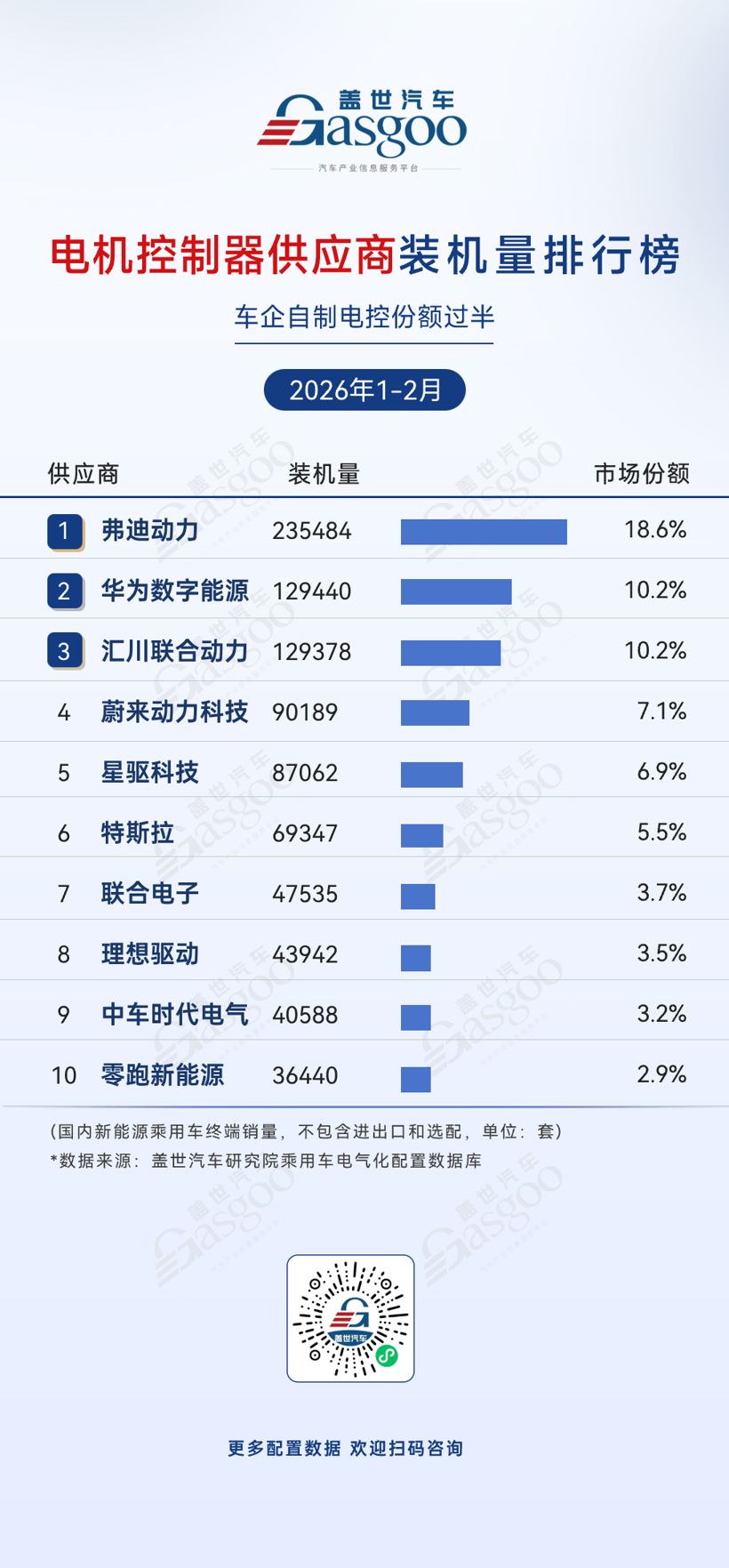
The motor controller market reflects a diverse contest between in-house production and specialized suppliers. FinDreams Power dominates with an 18.6% share and 235,484 units, its controllers tightly synced with BYD’s platforms to drive scale and cost leadership.
Huawei Digital Energy and Inovance United Power are locked in a close battle for second and third, each holding 10.2% of the market. Their deep expertise in power electronics and system integration makes them favored partners across the industry. Strikingly, six of the top ten players are automakers producing their own controllers—FinDreams Power, NIO Power Tech, Xingqu Technology, Li Auto Drive, Leapmotor, and Tesla. Together, they command over 44% of the market, a clear sign that OEMs are doubling down on in-house development for critical powertrain components.
Overall, industry leaders continue to dominate through technological moats, supply chain leverage, and scale. As specialized suppliers and in-house OEM divisions compete and complement each other, the market is poised for even fiercer battles centered on tech upgrades, customer expansion, and cost control.
Multi-in-One Main Drive System (BEV) Supplier Installation Rankings
FinDreams Power, 75,639 units installed in Jan-Feb 2026, 13.1% market share.
Inovance United Power, 58,572 units installed in Jan-Feb 2026, 10.1% market share.
Tesla, 57,882 units installed in Jan-Feb 2026, 10.0% market share.
NIO Power Tech, 50,707 units installed in Jan-Feb 2026, 8.8% market share.
Li Auto Drive, 35,119 units installed in Jan-Feb 2026, 6.1% market share.
Huawei Digital Energy, 33,747 units installed in Jan-Feb 2026, 5.8% market share.
Xingqu Technology, 30,394 units installed in Jan-Feb 2026, 5.3% market share.
CRRC Times Electric, 28,683 units installed in Jan-Feb 2026, 5.0% market share.
Lingsheng Power, 28,566 units installed in Jan-Feb 2026, 4.9% market share.
Grebo, 27,771 units installed in Jan-Feb 2026, 4.8% market share.
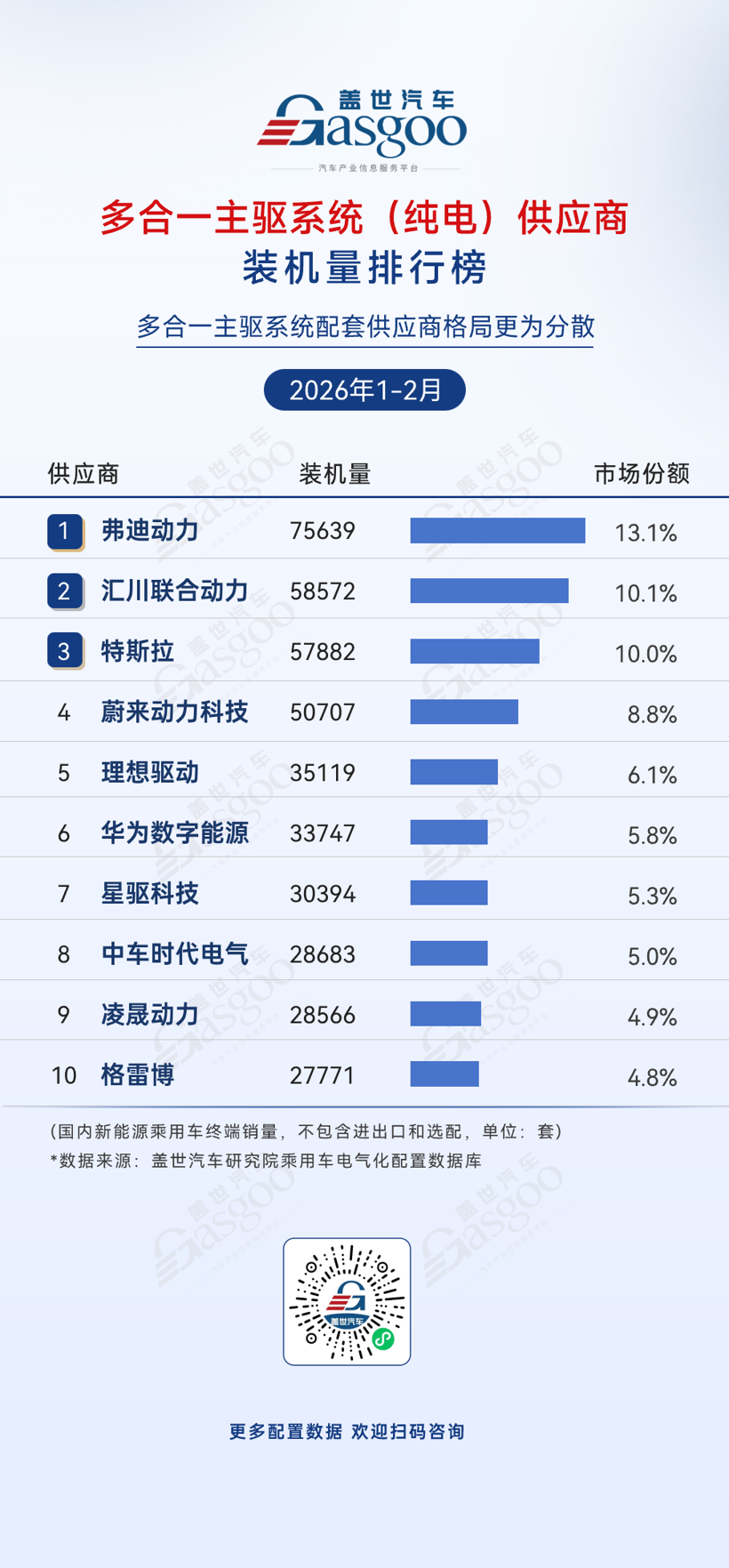
The market for multi-in-one drive systems is more fragmented than the standalone motor sector. FinDreams Power leads with a 13.1% share and 75,639 units, leveraging BYD’s vertical integration to deliver highly integrated, cost-effective systems at scale. Inovance United Power follows in second with 58,572 units and a 10.1% share, while Tesla takes third with 57,882 units and 10.0%. Together, these three account for over a third of the market.
NIO Power Tech, Li Auto Drive, and Huawei Digital Energy make up the second tier with shares between 5.8% and 8.8%. A pack of competitors—Xingqu Technology, CRRC Times Electric, Lingsheng Power, and Grebo—are bunched tightly between 4.8% and 5.3%, signaling intense rivalry. Once again, in-house players like FinDreams Power, Tesla, NIO, and Li Auto are proving the value of proprietary drive system development.
Overall, the first two months of 2026 reveal a highly fragmented landscape for pure-electric drive systems. As players battle it out on integration, efficiency, and cost, the industry is being pushed toward the next generation of high-performance, highly integrated powertrains.