Data from #Gasgoo Automotive Research Institute shows China's auto sector is navigating a pivotal shift in 2025 — moving beyond electrification into intelligence. Installation figures across LiDAR, front-view cameras, driving ADAS, automated parking assist (APA), and high-definition maps reveal a clear landscape: domestic supply chains are surging, market leaders are consolidating, and self-reliance is deepening. International giants, meanwhile, face fresh pressure to keep pace with rapid tech iteration and ecosystem battles.
These figures do more than tally market share; they reflect the industry's robust drive toward core technology autonomy, the democratization of high-end features, and the practical rollout of intelligent driving scenarios. They serve as a crucial reference point for gauging where the industry is headed next.
Air Suspension Supplier Installation Rankings
Tuopu Group, 475,941 units installed from Jan–Dec 2025, 37.4% market share.
KH Automotive Technologies, 364,512 units installed from Jan–Dec 2025, 28.6% market share.
Baolong Automotive, 291,493 units installed from Jan–Dec 2025, 22.9% market share.
Vibracoustic, 97,271 units installed from Jan–Dec 2025, 7.6% market share.
Continental, 34,865 units installed from Jan–Dec 2025, 2.7% market share.
Others, 8,246 units installed from Jan–Dec 2025, 0.6% market share.
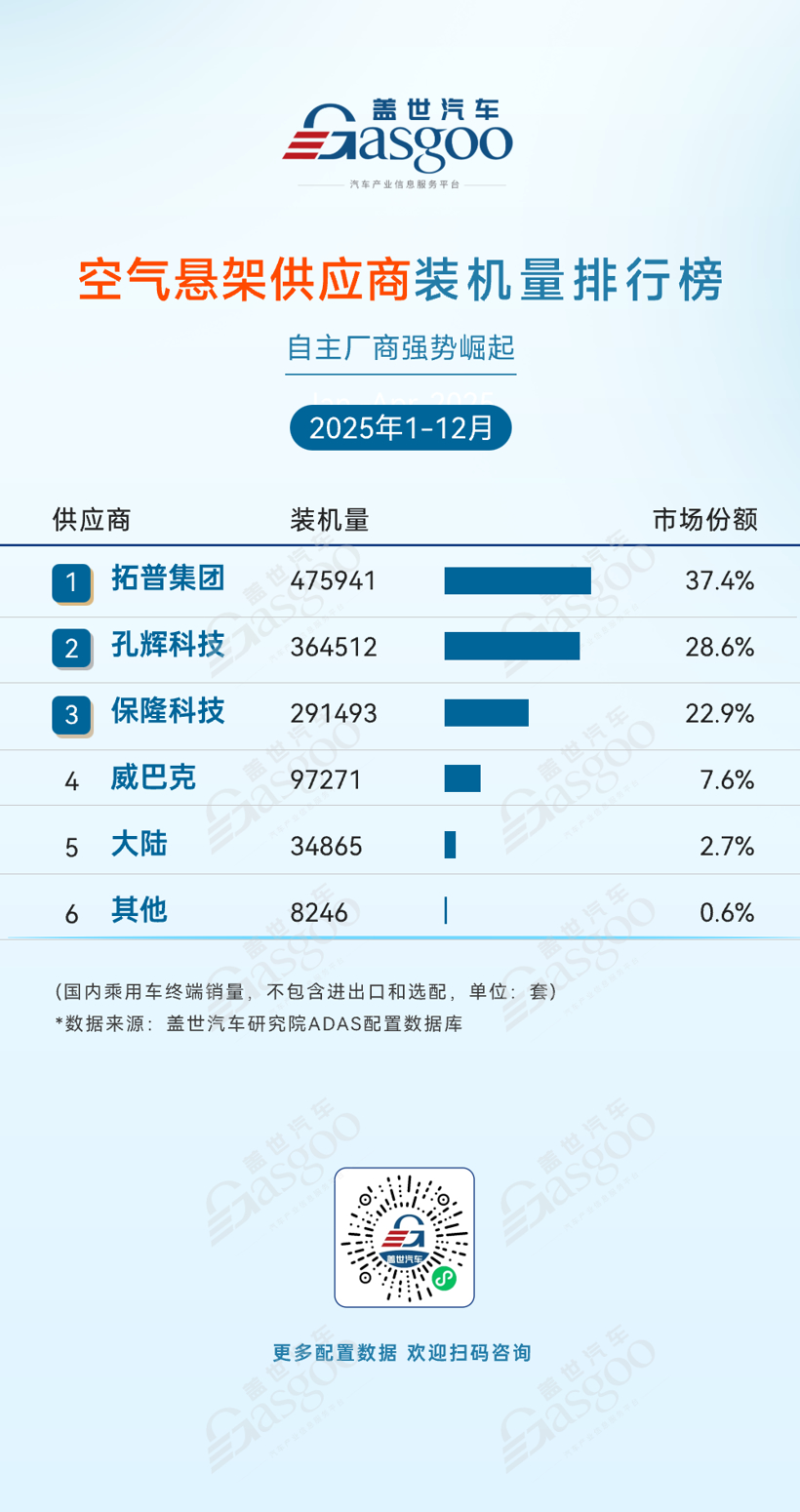
Air suspension installation data for January through December 2025 reveals a market dominated by domestic players, with high concentration at the top and notable technological breakthroughs. Tuopu Group holds the top spot with a 37.4% share — 475,941 units — followed closely by KH Automotive Technologies and Baolong Automotive. Together, these three local firms account for nearly 90% of the market, underscoring the rapid ascent of domestic suppliers. This dominance stems from local advantages in cost control, technical adaptation, and responsiveness, mirroring the surging demand for high-end chassis configurations among domestic NEV makers. Meanwhile, international giants like Vibracoustic and Continental have seen their combined share shrink to less than 11%, highlighting the technological and capacity strides of the local supply chain in high-end components.
LiDAR Supplier Installation Rankings
Huawei Technologies, 1,406,294 units installed from Jan–Dec 2025, 41.5% market share.
Hesai Technology, 1,143,162 units installed from Jan–Dec 2025, 33.8% market share.
RoboSense, 575,661 units installed from Jan–Dec 2025, 17.0% market share.
Seyond, 259,335 units installed from Jan–Dec 2025, 7.7% market share.
Others, 1,376 units installed from Jan–Dec 2025, 0.04% market share.
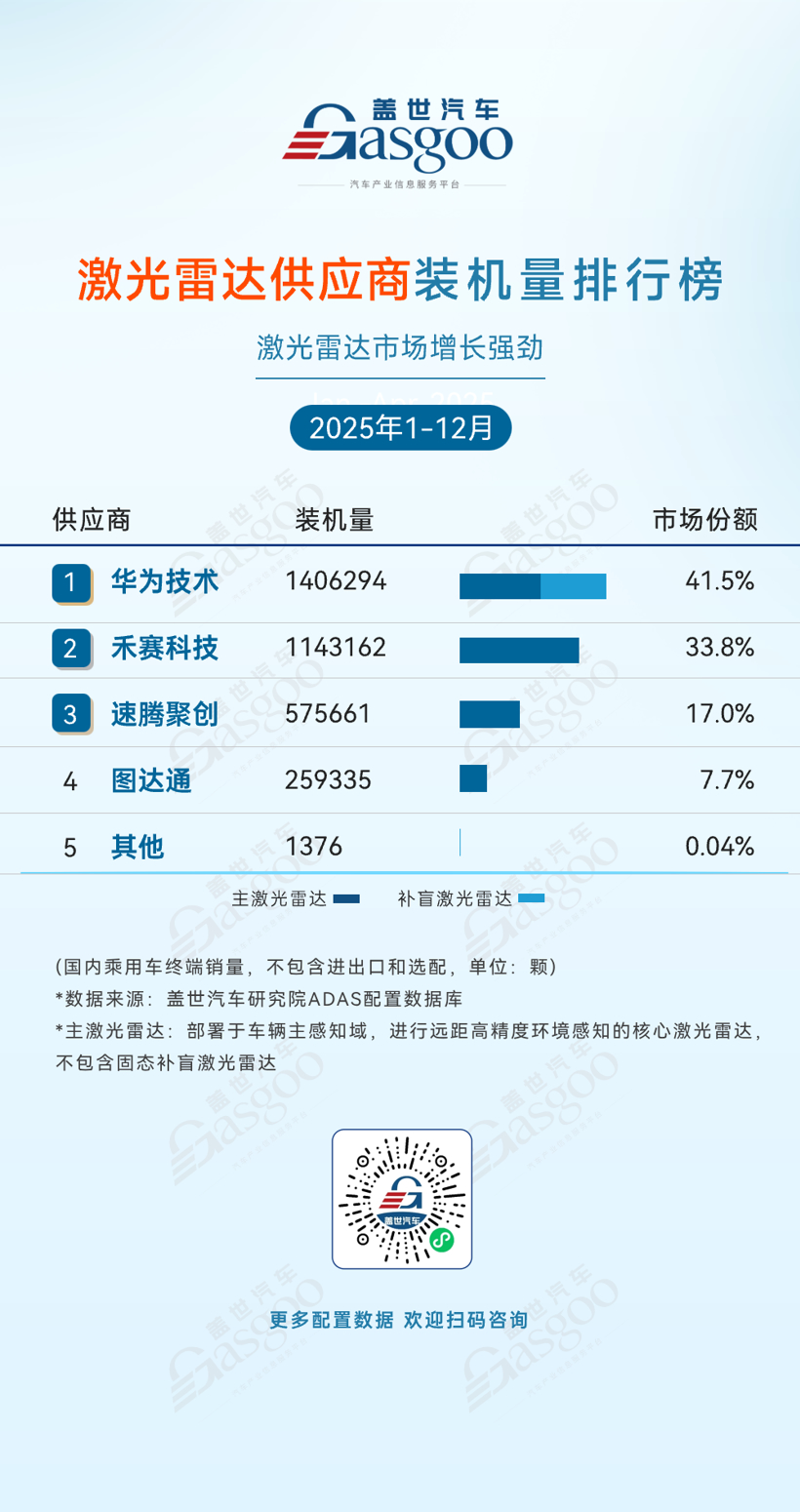
From January to December 2025, China's LiDAR market was defined by concentration at the top and leadership from local firms — a clear sign of robust growth. Huawei Technologies secured the No. 1 position with a 41.5% share, totaling 1,406,294 units. Its products have become a core choice for many automakers' high-end intelligent driving systems, thanks to advantages in perception precision, cost control, and automotive-grade reliability. Hesai Technology followed with a 33.8% share.
Driving ADAS Supplier Installation Rankings
Bosch, 2,311,647 units installed from Jan–Dec 2025, 14.5% market share.
BYD, 2,002,166 units installed from Jan–Dec 2025, 12.5% market share.
Denso, 1,268,267 units installed from Jan–Dec 2025, 7.9% market share.
ZF, 1,081,025 units installed from Jan–Dec 2025, 6.8% market share.
Freetech, 925,131 units installed from Jan–Dec 2025, 5.8% market share.
Huawei, 854,676 units installed from Jan–Dec 2025, 5.4% market share.
Tesla, 626,989 units installed from Jan–Dec 2025, 3.9% market share.
Valeo, 613,401 units installed from Jan–Dec 2025, 3.8% market share.
Veoneer, 582,434 units installed from Jan–Dec 2025, 3.6% market share.
Aptiv, 536,508 units installed from Jan–Dec 2025, 3.4% market share.
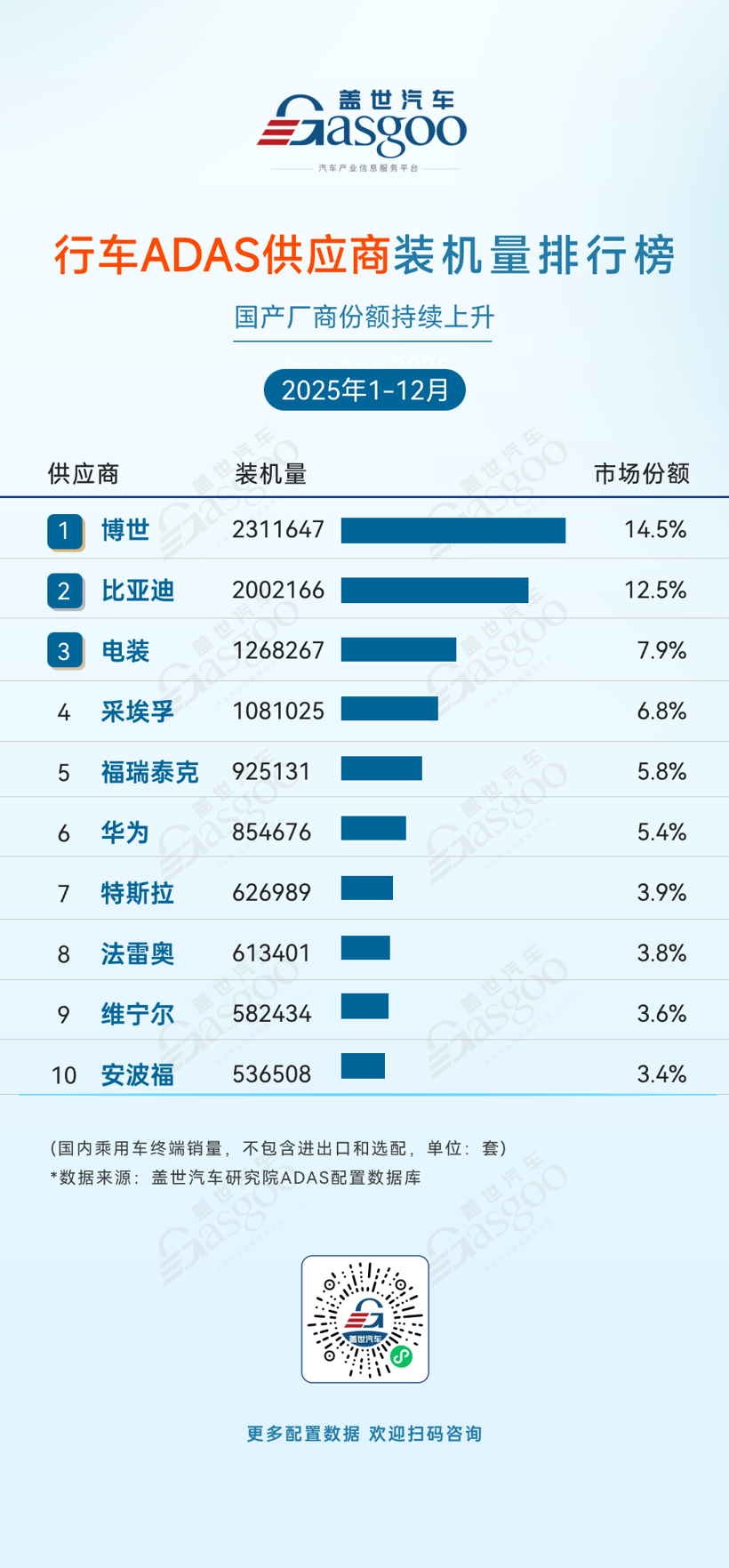
Driving ADAS Tier 1 rankings for January through December 2025 show a market where international giants still lead, but domestic players are closing in fast. Bosch holds the top spot with a 14.5% share and 2,311,647 units installed, relying primarily on front-view integrated solutions. BYD follows closely with a 12.5% share and 2,002,166 units. Its in-house "God's Eye" ADAS system is deeply integrated with its own vehicles, demonstrating the power of vertical integration and underscoring the rising share of domestic suppliers. Local firms like Freetech and Huawei have also cracked the top ranks, leveraging rapid algorithm iteration and cost control to become key partners for automakers, creating a differentiated competitive front against established giants like Bosch, Denso, and ZF.
Front-view Camera Supplier Installation Rankings
Bosch, 2,067,215 units installed from Jan–Dec 2025, 13.2% market share.
Sunny Smartlead, 1,447,724 units installed from Jan–Dec 2025, 9.2% market share.
BYD Semiconductor, 1,298,822 units installed from Jan–Dec 2025, 8.3% market share.
Denso, 1,271,680 units installed from Jan–Dec 2025, 8.1% market share.
ZF, 1,073,345 units installed from Jan–Dec 2025, 6.8% market share.
Baolong Automotive, 1,006,027 units installed from Jan–Dec 2025, 6.4% market share.
Freetech, 866,497 units installed from Jan–Dec 2025, 5.5% market share.
O-Film, 670,504 units installed from Jan–Dec 2025, 4.3% market share.
Veoneer, 628,260 units installed from Jan–Dec 2025, 4.0% market share.
Tesla, 626,989 units installed from Jan–Dec 2025, 4.0% market share.
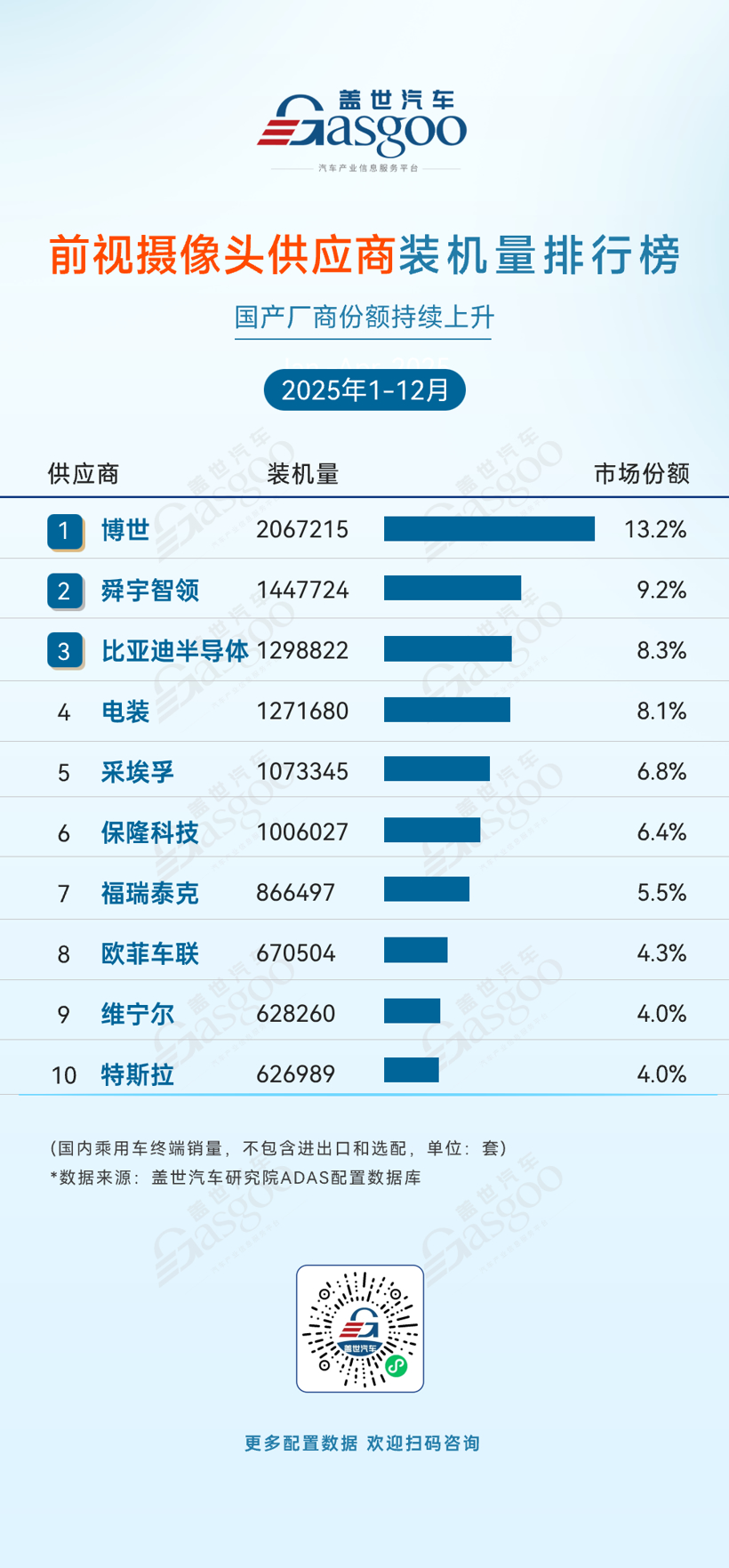
Front-view camera installation data for January through December 2025 depicts a market where international giants lead, but domestic players are rapidly gaining ground. Bosch remains the industry benchmark with a 13.2% share and 2,067,215 units, backed by deep technical expertise and global integration capabilities. Local firms like Sunny Smartlead and BYD Semiconductor follow closely, breaking into the top three and demonstrating technological breakthroughs and capacity strengths in optical perception. Other domestic players such as Baolong Automotive, Freetech, and O-Film hold significant positions on the list. They have become core suppliers for many automakers by leveraging cost control, algorithm iteration, and scenario adaptation, creating a differentiated competitive dynamic against giants like Bosch, Denso, and ZF. Tesla, meanwhile, continues to drive industry upgrades with its distinct vision-based approach.
Automated Parking (APA) Supplier Installation Rankings
BYD, 1,846,635 units installed from Jan–Dec 2025, 20.8% market share.
Bosch, 1,112,402 units installed from Jan–Dec 2025, 12.5% market share.
Huawei, 854,676 units installed from Jan–Dec 2025, 9.6% market share.
Valeo, 733,703 units installed from Jan–Dec 2025, 8.3% market share.
Momenta, 438,741 units installed from Jan–Dec 2025, 4.9% market share.
Leapmotor, 429,315 units installed from Jan–Dec 2025, 4.8% market share.
Xiaomi, 410,391 units installed from Jan–Dec 2025, 4.6% market share.
Li Auto, 407,986 units installed from Jan–Dec 2025, 4.6% market share.
XPENG, 382,753 units installed from Jan–Dec 2025, 4.3% market share.
NIO, 327,038 units installed from Jan–Dec 2025, 3.7% market share.
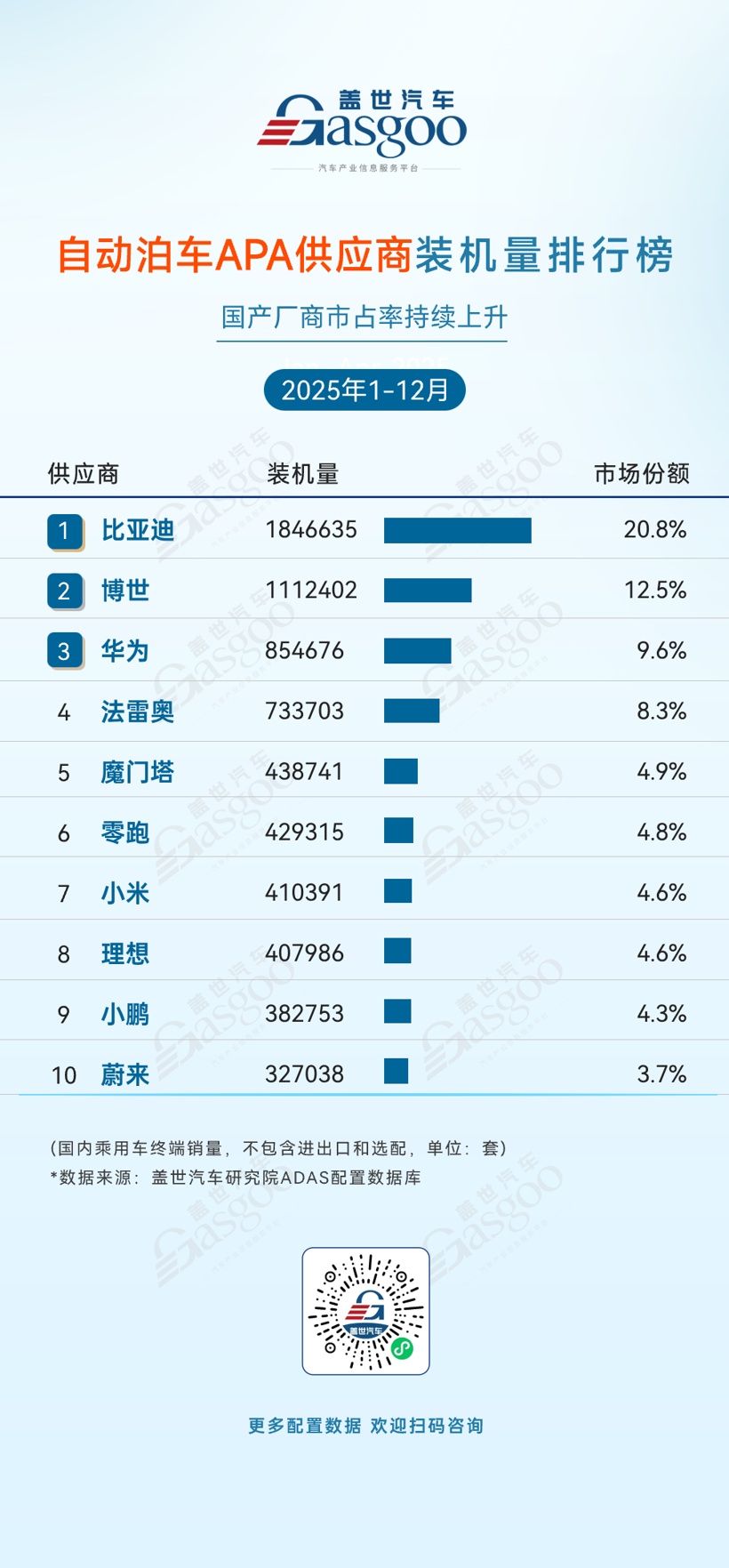
The automated parking (APA) supplier landscape from January to December 2025 highlights a market dominated by local automakers, with domestic vendors steadily expanding their share. BYD commands the lead with a 20.8% share and 1,846,635 units, as its in-house APA system is deeply integrated with its own vehicle lineup — a testament to the power of vertical integration. International giants like Bosch and Valeo retain significant market share thanks to their deep technical heritage. The market is highly concentrated, with the top three suppliers — BYD, Bosch, and Huawei — accounting for over 40% of the total, marking a strong head effect. Overall, competition in the APA sector has evolved beyond mere functionality into a comprehensive battle over scenario coverage, user experience, and algorithm iteration. The rapid rise of domestic vendors is propelling China's intelligent parking industry toward new breakthroughs in technological autonomy and ecosystem development.
High-Definition (HD) Map Supplier Installation Rankings
Amap, 1,329,230 units installed from Jan–Dec 2025, 51.1% market share.
Langge Technology, 351,491 units installed from Jan–Dec 2025, 13.5% market share.
Tencent, 327,038 units installed from Jan–Dec 2025, 12.6% market share.
NavInfo, 152,377 units installed from Jan–Dec 2025, 5.9% market share.
Others, 438,727 units installed from Jan–Dec 2025, 16.9% market share.
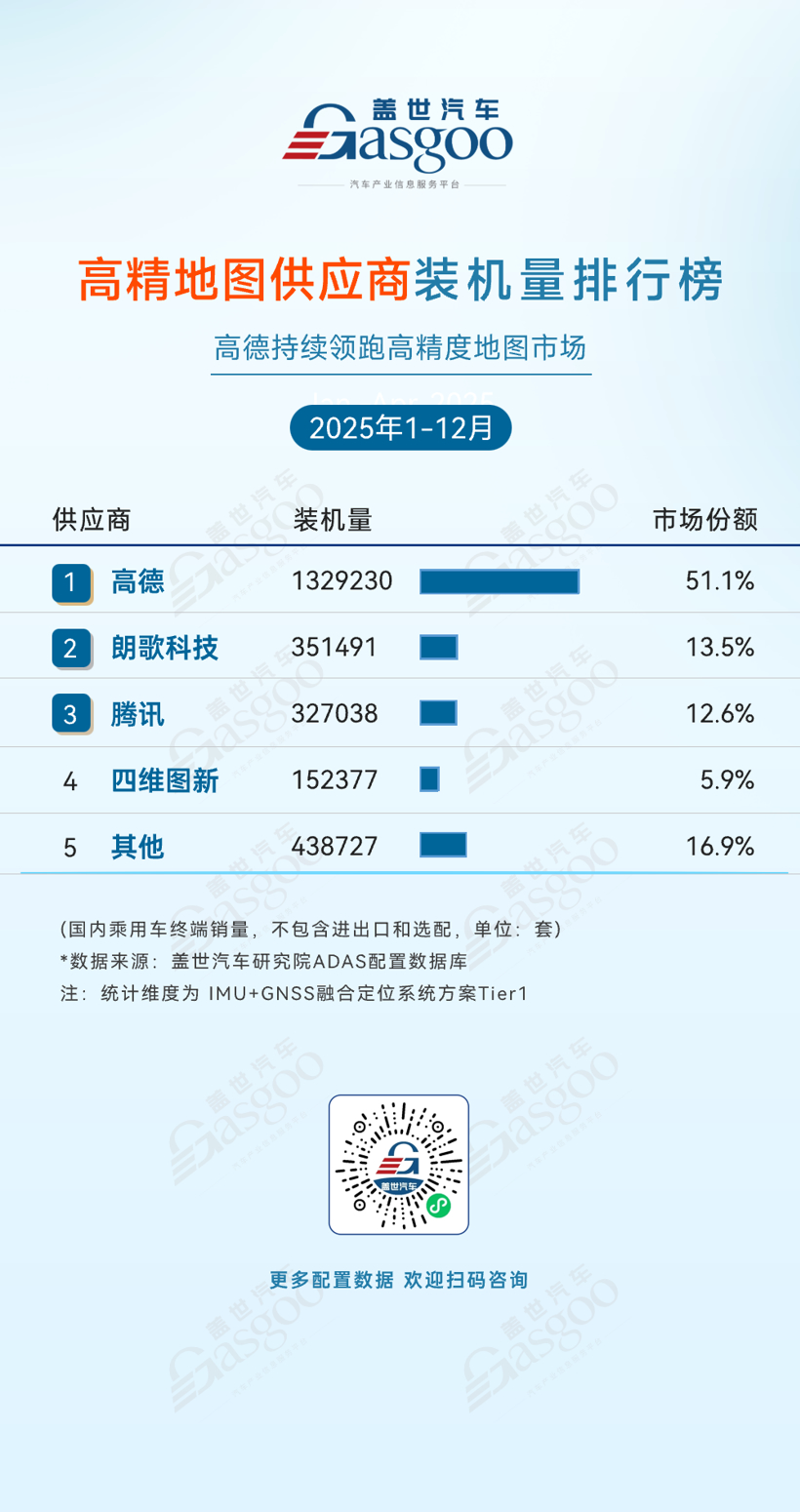
From January to December 2025, China's HD map market was characterized by high concentration and dominance by local enterprises. Amap holds the top position with a 51.1% share, totaling 1,329,230 units. It has become the core choice for many automakers' high-end intelligent driving systems, capturing over half the market thanks to advantages in data precision, update frequency, and automotive-grade compatibility. Local firms like Langge Technology, Tencent, and NavInfo follow, engaging in differentiated competition with Amap. Meanwhile, "Others" account for 16.9% of the market, indicating that a long-tail opportunity still exists. Leading players are solidifying their edge through continuous R&D investment, while the broad rise of the local supply chain provides a firm foundation for the autonomy and control of China's ADAS industry.
High-Precision Positioning Supplier Installation Rankings
ASENSING, 2,708,191 units installed from Jan–Dec 2025, 47.1% market share.
Huawei, 854,020 units installed from Jan–Dec 2025, 14.9% market share.
CHC Navigation, 410,736 units installed from Jan–Dec 2025, 7.1% market share.
XPENG, 279,486 units installed from Jan–Dec 2025, 4.9% market share.
MCT, 191,143 units installed from Jan–Dec 2025, 3.3% market share.
Others, 1,306,298 units installed from Jan–Dec 2025, 22.7% market share.
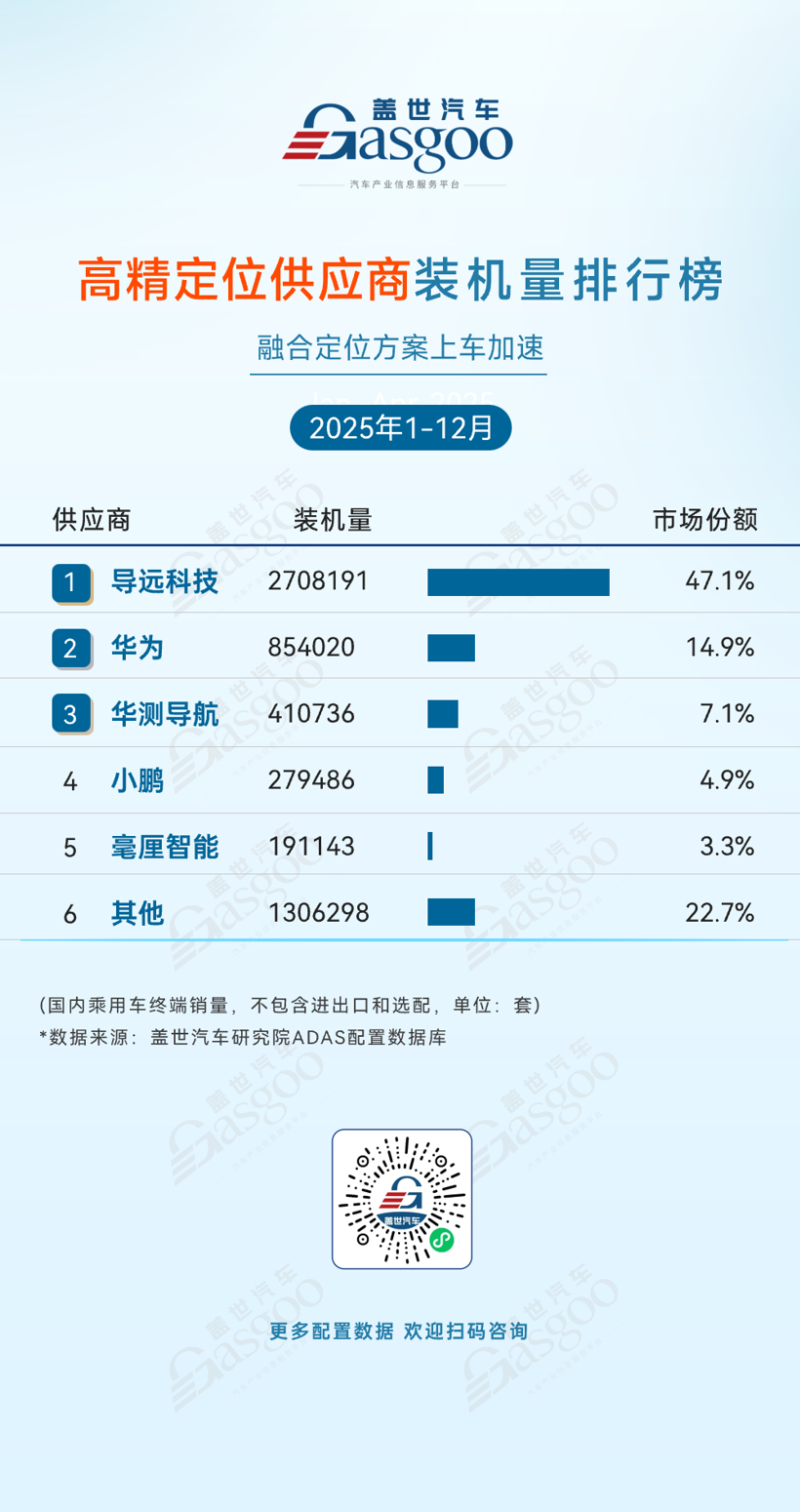
High-precision positioning installation data for January through December 2025 places Asensing at the forefront with a 47.1% market share — 2,708,191 units — capturing nearly half the market. This demonstrates its scale advantages and deep customer coverage in automotive-grade high-precision positioning. Domestic players like Huawei, CHC Navigation, XPENG, and MCT follow, carving out differentiated positions across various niche scenarios. At the same time, "Others" account for 22.7% of the market, suggesting that the high-precision positioning sector retains a diverse supply structure, leaving room for new entrants and specialized technological paths to develop.