



In 2025, FAW-Volkswagen retained its crown as the top-selling joint venture in China with sales exceeding 1.58 million units. Yet the broader Volkswagen Group saw its total sales in the country slip to about 2.69 million — marking a second consecutive year of decline. The Japanese camp faces similar headwinds: while Toyota posted a slight increase, Nissan and Honda fell by 6.3% and 24.3% respectively, extending their losing streaks to seven and five years.
A clear signal has emerged: even as former giants dig in, systemic erosion of the market is unavoidable. That stands in stark contrast to the confidence of two years ago, when major joint ventures unveiled their "In China, for China" strategies and kicked off a new "acceleration phase."
Over the past two years, nearly every mainstream joint venture — from Volkswagen, Toyota, and General Motors to BBA (an abbreviation for Mercedes-Benz, BMW and Audi) — has pursued a "In China, for China" shift toward new energy. They pledged heavy investment, dedicated platforms, and a flood of new models. Now, one or two full market cycles later, the question looms: How much of those strategic promises have been kept? What kind of report card have these joint ventures submitted for this costly transformation exam? Is there light at the end of the tunnel, or are they still stuck in the mud?
A Deep "China-centric" Reconstruction
If we turn back the clock to 2022 and 2023, it was a period of "strategic roaring" where joint ventures collectively pledged their allegiance.
General Motors, for instance, announced plans to pour over $35 billion into electrification and autonomous driving between 2020 and 2025, aiming to launch more than 15 Ultium-based EVs in China by late 2025. SAIC-GM added another 20 billion yuan to that, targeting 70 billion yuan in total new technology investment by 2025. Volkswagen made its largest single investment in four decades in China in 2023 — roughly 2.4 billion euros for a joint venture with Horizon Robotics to localize intelligent driving R&D. Nissan, meanwhile, unveiled an ambitious "Ambition 2030," pledging 2 trillion yen over five years and aiming for electrified models to account for 40% of its China sales by 2026.
Image Source: Nissan Motor
At their core, every foreign automaker's transformation strategy boils down to two keywords: "decentralization" and "ecosystem integration." These represent the most profound adjustments yet to China's unique and rapidly evolving smart EV landscape.
Historically, product definition, design, and core component choices were dictated by foreign partners, with Chinese sides handling production and marketing. But under mounting sales pressure, this decades-old rule is loosening. The most telling sign: the emergence of the "China Chief Engineer" system and the transfer of R&D decision-making power.
At the 2025 Shanghai Auto Show, Toyota announced that decision-making for future China-specific models would shift from Japanese headquarters to China, creating a "China Chief Engineer" (RCE) role held by a Chinese national for the first time. Toyota integrated its scattered Chinese R&D centers into a "ONE R&D" system, aiming to build a locally led, boundary-crossing research structure. Nissan followed suit. Yamaguchi, chair of Nissan China's management committee, noted that empowering local teams to lead development slashed R&D cycles, helping Nissan catch up to "China speed." BMW plans to integrate findings from its Chinese team on user habits directly into its next-generation models launching in 2026.
This shift from "headquarters-led" to "China-defined" means Chinese teams are no longer mere executors; they are now co-authors of the product rulebook.
Xu Changming, a senior economist at the State Information Center, put it bluntly: joint ventures must "define cars sold in China according to Chinese consumer demand" and "strengthen local R&D." Gao Zhenghao, deputy general manager of Dongfeng Nissan Passenger Company, echoed this sentiment, noting that joint ventures need to "release some market space and undergo transformation and upgrading."
To quickly close gaps in smart cockpits and high-level autonomous driving, joint ventures have adopted cooperation strategies that are far more open and aggressive than at any point in the past.
Image Source: XPENG
Take the deep collaboration between Volkswagen Group and XPENG as a prime example. In July 2023, VW announced a stake purchase in XPENG and plans to co-develop two EV models. By 2024, they signed a technology agreement and launched joint procurement. The core deepening lies in co-developing a leading "China Electronic Electrical Architecture (CEA)" for VW's China platforms. In 2025, the scope expanded to internal combustion and hybrid platforms, aiming for intelligent upgrades across the entire lineup.
The VW-XPENG partnership is viewed as a model where capital buys time, technology, and a complete R&D system — a blueprint for traditional giants leveraging China's smart ecosystem for a profound transformation.
Beyond strategic alliances, joint brands are directly purchasing or deeply customizing Chinese intelligent solutions to rapidly arm their products. Toyota's BoZhi 7(BZ7) became its first D-segment sedan featuring Huawei's HarmonyOS cockpit. The Toyota bZ5 uses a new smart driving system combining Momenta's Flywheel Big Model with Toyota's safety suite. Audi unveiled its Q6L e-tron at the 2025 Guangdong-Hong Kong-Macao Greater Bay Area Auto Show, featuring Huawei's Qiankun intelligent driving. BMW announced it is developing smart app systems with Huawei based on the HarmonyOS ecosystem and partnering with DeepSeek to integrate AI functions into its domestically produced next-generation models.
In product layout, joint ventures are pivoting to a more pragmatic "multi-energy parallel" approach. Range extenders (EREV), once dismissed as "transition technology," are now seeing strategic entry from giants like Volkswagen and BMW. VW showcased its ID.ERA, a full-size EREV SUV concept, at the Shanghai Auto Show. BMW plans to apply range-extender systems to the new generation X5, potentially extending to the X3 and X7.
Joint ventures are also rolling out "China-exclusive" models based on dedicated new platforms and deeply integrated Chinese tech. Examples include the N7, the first model under Dongfeng Nissan's locally developed "Tianyan" architecture, and Mercedes' long-wheelbase pure electric CLA, built specifically for China.
This deep "China-centric" reconstruction is unprecedented in the history of joint venture automobiles. It is no longer simple product localization adaptation, but a systemic transformation involving R&D sovereignty, tech ecosystems, product definition, and user relationships.
Yet, with the strategic blueprint drawn and the battle bugle sounded, the real test remains: how much of this thunderous change will actually reflect in the market's touchstone?
The Chasm Between High-Profile Transformation and a Cool Market
Despite clear strategies and frequent moves, the market's initial feedback is hard to describe as optimistic. Evaluating effectiveness requires looking at three dimensions: market performance, product competitiveness, and brand value.
In terms of market performance, joint ventures are facing "double decline" pressure in both share and voice. Their presence in the new energy market remains thin and growth is sluggish. Data from the CPCA shows that in 2025, the wholesale share of domestic brand passenger vehicles hit 70%, up 8 percentage points year-on-year, continuing to erode the living space of joint ventures. Additionally, in November 2025, total NEV sales for all overseas brands (including Tesla) accounted for only 10.43% of the market that month. Excluding Tesla, traditional joint ventures held a mere 4.5%. Despite a rebound from lows, the fact that nearly 90% of the NEV market is controlled by domestic brands signals a collective defeat for joint ventures in this transition phase.
This pressure is transmitting clearly up the supply chain. A source at a German parts supplier told Gasgoo bluntly: "To be honest, in the China market, foreign brands are now slightly weaker than local enterprises, whether in cost or technology." This speaks directly to the core ailment behind the joint ventures' sliding share.
Focusing on specific strategic models, performance is mixed but generally far from initial grand targets.
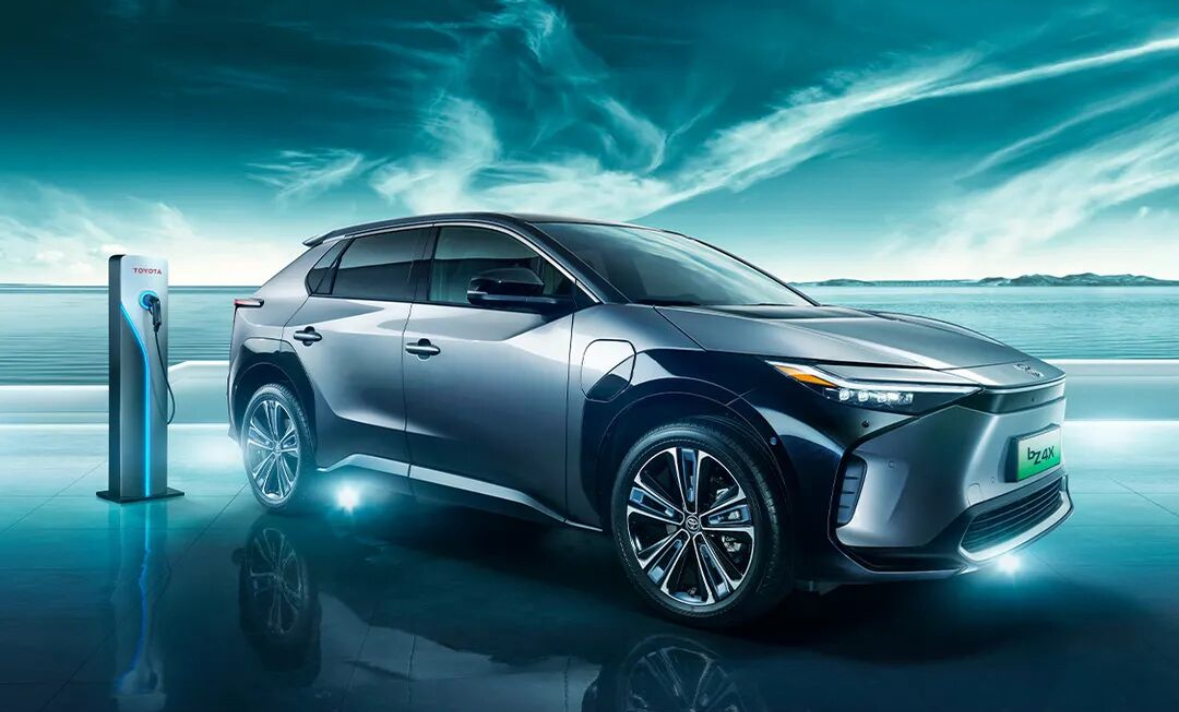
Image Source: Toyota China
Take Toyota. Its first global EV, the bZ4X, met a cold reception in China, with sales languishing. Data shows monthly sales for this model hit just 119 units in August 2025, a 79% plunge year-on-year. In sharp contrast, the BoZhi 3X (bZ3X), developed by Toyota's local team specifically for China, quickly gained traction. With a competitive starting price of 109,800 yuan, the BoZhi 3X precisely cut into the market, with monthly sales climbing to the thousands, demonstrating strong appeal.
The divergent fates of these two models reveal a clear truth in today's Chinese NEV market: only "China-exclusive" products led by local teams and deeply aligned with local needs can gain acceptance. The old mindset of "oil-to-electric" conversion or "global cars" has proven to be a dead end.
Nissan's transformation also hinges on a "China-centric" strategy. Its first strategic pure electric sedan, the N7, is the flagship result of granting "joint venture authorization" to its Chinese team, and high hopes are pinned on its performance.
Initial market feedback shows it sold nearly 10,000 units a month at its peak, with 50,000 deliveries in half a year, viewed by the market as a "life-saving straw" for Nissan's electrification. The N7's performance will determine the success or failure of Nissan's NEV transition in China. It has achieved a "steady start," but to remain "worry-free," the subsequent product matrix starting with the N7 must continue to win market approval.
If 2024 was about joint venture models chasing "visible parameters" like range and computing power, then 2025-2026 sees a batch of "hybrid" new cars, deeply integrating top Chinese technology, attempting to "leapfrog" in hardware.
From the 2026 joint venture lineup, we can see this "technology crowdfunding" style counterattack:
For instance, the Volkswagen ID. ERA, the brand's first EREV model, features a 1.5T range extender and 350 kilometers of pure electric range. The Toyota BZ7 will debut with Huawei's HarmonyOS cockpit and Drive One electric drive system, adopting Momenta's high-end smart driving solution. The Dongfeng Nissan NX8 offers both pure electric and range-extender power, based on an 800V silicon carbide platform supporting 5C supercharging. Even luxury EVs like the Audi E7X and Cadillac VISTIQ are deeply binding with Chinese top-tier suppliers for intelligent solutions.
However, keeping up in hardware does not equate to leading in experience. The real "generation gap" lies in deeper system capabilities. Top Chinese brands, through full-stack self-development or deep customization, have achieved deep integration and rapid iteration of smart cockpits, driving assistance, chassis control, and electronic architecture. Their vehicle OTA updates bring optimized experiences. Joint ventures, meanwhile, are largely "procuring" and "integrating" excellent modular solutions. They still lag in integrating underlying architecture, data-driven rapid iteration, and soft-hardware integrated experience innovation. An analyst noted that the core of 2026 intelligence competition is a paradigm shift to "the car adapting to the human." Whether joint ventures can achieve this remains to be seen.
In the past, joint ventures built a strong brand moat on reliability and durability. But in the new energy era, this value system is facing scrutiny.
This is especially true for luxury brands. The high-profit business model built on brand premiums in the ICE era is becoming unsustainable in the smart EV era. They must find new value anchors in electrification and intelligence that can persuade consumers — a task that cannot be accomplished overnight.
This drastic shift in profit models has forced players across the supply chain to rewrite their survival rules. At a Gasgoo Research Institute salon, many foreign supplier representatives admitted that foreign companies are now very pragmatic. One was blunt: "Basically, we no longer chase sales revenue. Instead, we pursue a relatively healthy profit margin and cash flow. We want to survive first, then return to focusing on product technology." When "survival" becomes the goal, the profound challenges facing the entire joint venture system become clear.
Second Half Battle: Solving Structural Contradictions and Finding New Growth
The fact that joint venture transformation results have fallen short of expectations is not due to a single error, but to the interweaving of multiple structural contradictions.
First, the efficiency clash between "global systems" and "China speed." Joint ventures, especially multinational giants, possess mature, rigorous, but complex global R&D, validation, and supply chain systems. This was an advantage in the ICE era, which prioritized stability and scale. But in China's smart EV market, which demands "small steps, fast runs, and rapid iteration," it becomes a burden. Long decision chains and cumbersome localization processes make it hard to react to market demand with lightning speed like Chinese brands.
Second, the growing pains of "soul" versus "body" integration. In deep cooperation models like VW and XPENG, differences in corporate culture, decision-making mechanisms, data ownership, and tech preferences are inevitable. This "friction" is costly and fraught with uncertainty. Poor coordination can drag down product launch schedules and market performance.
Third, the "resource allocation" dilemma of Chinese partners. Industry insiders have raised a sharp point: joint venture transformations may face skepticism over "badge engineering." When Chinese automakers operate both self-owned brands and joint ventures with limited resources, they naturally tend to prioritize the most cutting-edge tech and competitive products for their "biological sons" — the self-owned brands. Joint ventures may sometimes only receive adjusted or non-core technical solutions. This internal game of thrones restricts the possibility of joint ventures receiving top-tier tech transfusions.
Fourth, shortcomings in user operations and marketing models. New force brands have established deep, direct links with users through direct sales, community operations, and continuous OTA service. Most joint ventures still rely heavily on traditional dealer networks, leaving them weak in full-lifecycle user operations and building brand fan culture.
Yet the contradictions go further. Transformation pressure is transmitting up the supply chain, pushing many foreign parts suppliers into deeper trouble. "Foreign OEMs in China have woken up, but many foreign parts manufacturers' European headquarters haven't." noted a source in automotive seating and interiors. "The core issue isn't just price, it's reaction speed. When OEM development cycles compress to 12-18 months, if a supplier's decision process still moves at an overseas pace, they'll be replaced even if the price is right." Behind the joint venture transformation, the entire foreign auto supply chain faces a life-or-death test of "system speed" mismatch.
Standing at the new starting line of 2026, joint ventures continue to sound the counterattack horn.
Despite the pressure, their fighting spirit is undimmed. The German parts source told Gasgoo: "Traditional foreign brands are accelerating their NEV layout. For example, VW's Electrification 2.0 will launch a large number of range-extender, hybrid, and pure electric models... Mercedes and BMW will also have new electrification platform products gradually launching and scaling up in 2026." This counterattack posture suggests industry competition in 2026 will enter a deeper dimension.
Following the lead of BBA in retreating from radical full-electric timelines to a more pragmatic "ICE-electric synergy, multi-line" strategy may become the common choice for more joint ventures. Surviving and stabilizing the base is far more important than a pretty but radical electrification slogan. Pan Jianxin, executive deputy general manager of Dongfeng Honda, stated clearly that the company will "persist in not giving up on both fuel and hybrid markets" while accelerating pure electric layout.
Facing future competition, joint brands are not simply introducing Chinese suppliers; they are deeply localizing R&D, decision-making, supply chains, and even corporate culture. Examples include Volkswagen establishing an EV-focused R&D center in Anhui, and SAIC Volkswagen announcing that 15 of its 18 new models by 2030 will be developed specifically for China. Ma Qiancheng, founder of the Diancheren, believes opportunities "only belong to a few" joint ventures that can make localization "more thorough."
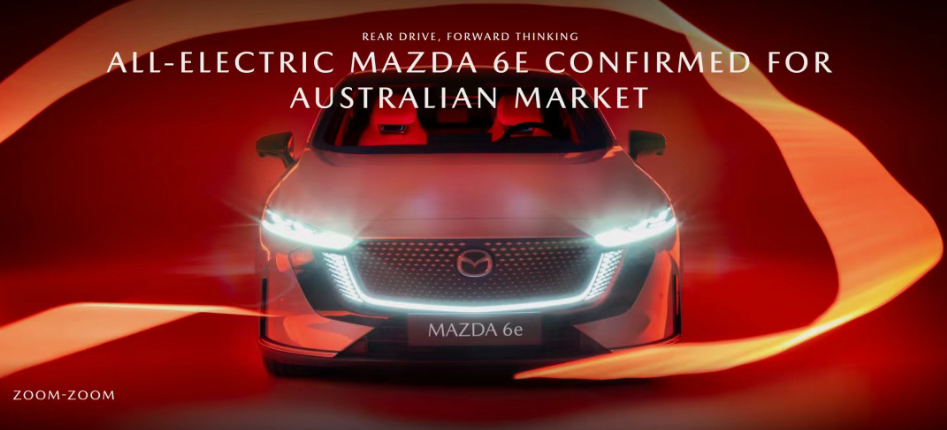
Image Source: Changan Mazda
Additionally, some joint ventures have begun switching roles, leveraging China's manufacturing and supply chain advantages to transform into "global export bases." Changan Mazda's MAZDA 6e pure electric sedan has been shipped in bulk from Shanghai Port to Europe, with its Nanjing plant positioned as Mazda's global NEV export base. Meanwhile, FAW-Volkswagen, established 34 years ago, started vehicle exports for the first time in 2025, with models like the Magotan and Sagitar heading to the Middle East. This opens a "Made in China, Supplying the World" second battlefield for joint ventures.
Conclusion
The new energy transition for joint ventures is a "Normandy landing" with no retreat. Over the past two years, they completed a cognitive subversion and the initial assembly of troops — shifting from "global cars sold in China" to "made in China, for China." The early skirmishes of this campaign have been brutal, with market share loss and growing pains clearly visible.
Yet, this is far from the endgame. They still hold rich chips: brand heritage, scale manufacturing, and global systems. The real test lies in whether they have the courage to turn "localization" from a slogan into "muscle memory" permeating R&D, production, marketing, and organization; and whether they can reshape their unique electrification brand value while integrating into China's ecosystem.
The road of transformation is long and arduous. 2026 will be a pivotal year to test whether this group of "transformers" has truly found its rhythm. The time China's market allows for trial and error is truly running out.


