



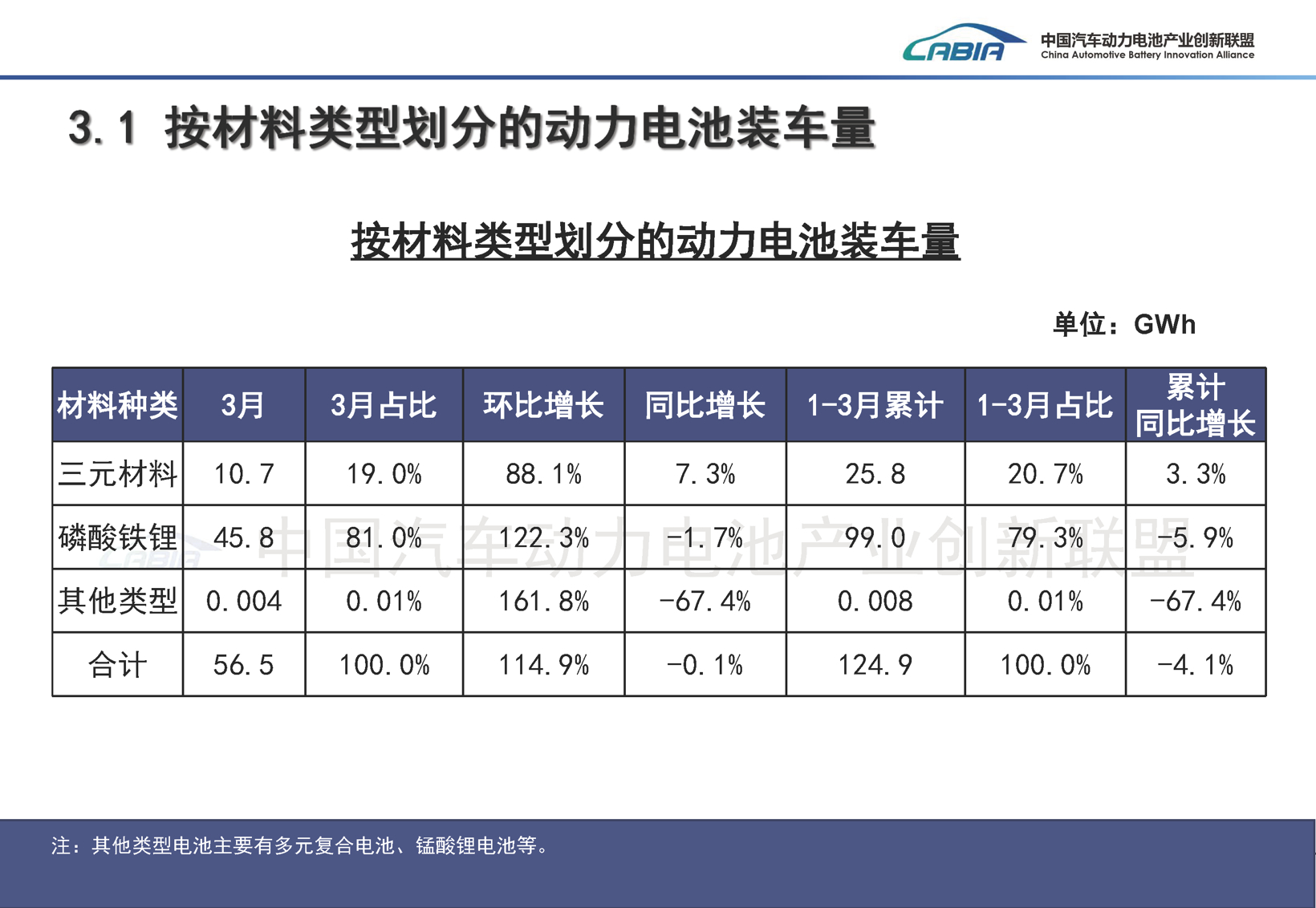
Gasgoo Munich- After enduring the traditional lull and deep inventory drawdown of January and February, China’s power battery market staged a definitive “strong rebound” in March 2026. Latest data from the China Automotive Power Battery Alliance (CABIA) shows that domestic power battery installations surged back to 56.5 GWh in March — a massive 114.9% jump from the previous month.
Beneath the headline-grabbing monthly surge, however, a structural signal has emerged that warrants attention: March installations slipped 0.1% year-on-year, while cumulative installations for the first quarter reached 124.9 GWh, down 4.1% from a year ago. This suggests that after years of breakneck expansion, China’s power battery industry is shifting gears into a new phase defined by slower growth, share redistribution, and faster technological iteration. Even so, exports continue to serve as a core growth engine, while the “Matthew Effect” and fierce battles within the second tier are playing out simultaneously.
Monthly Doubling, Slight Annual Decline: Demand Recovery and Growth Shift
On a monthly basis, market activity roared back to life in March. Power battery installations hit 56.5 GWh, climbing 114.9% to effectively double from February. This recovery was driven by a wave of new model launches, end-of-quarter sales pushes, and a release in pent-up restocking demand from automakers.
Technologically, the dominance of lithium iron phosphate (LFP) batteries further solidified. LFP installations jumped 122.3% to 45.8 GWh, lifting its market share to 81%. Meanwhile, nickel-cobalt-manganese (NCM) battery installations reached 10.7 GWh, up 88.1%, capturing a 19% share.
Source: China Automotive Power Battery Alliance (same below)
On an annual basis, March installations dipped just 0.1% — essentially matching the 56.6 GWh recorded in March 2025 — demonstrating the market’s underlying resilience. But the 4.1% cumulative decline for the first quarter demands closer attention.
This isn’t a structural downturn, but a cyclical adjustment shaped by overlapping factors. First, the monthly penetration rate of new energy vehicles has stabilized around 50%, marking the transition from an explosive growth phase to a period of steady expansion, which naturally eases the intensity of battery demand. Second, automakers have adopted more agile inventory management after the previous cycle of rapid price declines, making just-in-time purchasing the new norm. Finally, the first quarter is typically a slow season for commercial vehicles — which carry higher battery capacities — dragging down overall installation figures. Notably, cumulative year-on-year data could well turn positive as new models flood the market in the second and third quarters, bolstered by trade-in policies and overseas expansion.
Notably, NCM batteries displayed short-term resilience: March NCM installations rose 7.3% year-on-year, while LFP dipped 1.7%. The trend held for the first quarter as well (NCM +3.3%, LFP -5.9%). This likely reflects a higher sales mix of premium models — which typically use NCM batteries — even as overall market growth slows. Yet, LFP’s combined advantages in cost and safety remain difficult to displace over the long haul.
Dual Leaders, Shifting Landscape: Market Consolidation Meets Fierce Competition
The March rankings reveal a critical shift underway. While the “dual king” status of CATL and BYD remains unshaken, their market shares experienced subtle fluctuations, and competition in the second tier has entered a white-hot phase.
Concentration metrics show the top two players accounted for 35.8 GWh of installations, or 63.3% of the total, down 3.23 percentage points from a year earlier. The top five claimed 45.4 GWh, representing 80.3% of the market, a slight dip of 0.24 percentage points. Although the top ten captured 93.6% — a marginal increase of 0.73 percentage points — the slight erosion at the very top indicates that market resources are dispersing among a broader group of capable players.
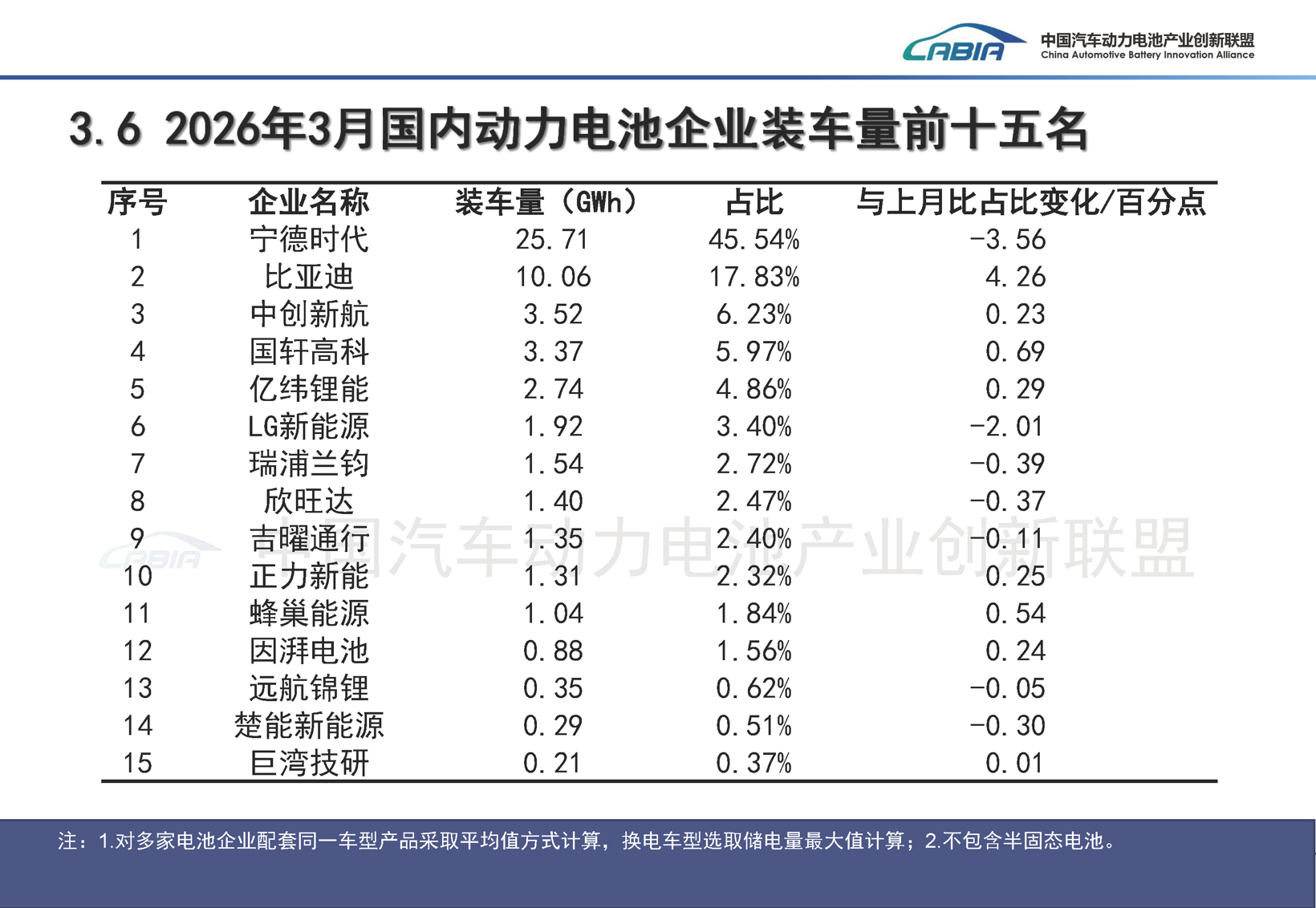
Breaking down the corporate results, CATL retained the top spot with 25.71 GWh installed, but its market share retreated from 49.79% in February to 45.54% — a 3.56 percentage point monthly drop. BYD followed in second place with 10.06 GWh, as its share rebounded to 17.83%, surging 4.26 percentage points month-on-month and demonstrating the resilience of its vertically integrated system.
The battle for third through fifth place was exceptionally tight. CALB posted 3.52 GWh (6.23% share), Gotion High-Tech recorded 3.37 GWh (5.97%), and EVE Energy reached 2.74 GWh (4.86%). The gap between these three is razor-thin. Gotion High-Tech stood out with a 0.69 percentage point gain, showing steady performance. A notable variable is LG Energy Solution, which climbed to sixth with 1.92 GWh, though its share slipped 2.01 percentage points month-on-month, highlighting the continued pressure on foreign firms in the domestic market.
Several “new faces” appeared in the sixth-to-tenth bracket. REPT (1.54 GWh), Sunwoda (1.40 GWh), Jiyao Tongxing (1.35 GWh), and Zhengli New Energy (1.31 GWh) are locked in a tight contest within the 1–2 GWh range. Jiyao Tongxing, in particular, is a new entrant to the top ten, reflecting the market’s dynamic shifts. SVOLT, Yinpai Battery, Yuanhang Jinli, Chuan Energy, and GWT ranked eleventh to fifteenth, respectively.
It is worth noting that only 31 companies achieved installations in March, 10 fewer than a year ago. The cumulative count for the first quarter was 36, also down by 10 year-on-year. This indicates that under the dual pressures of a price war and economies of scale, smaller players at the tail end are being forced out, while resources continue to concentrate among the market leaders.
On the export front, March shipments reached 22.3 GWh, jumping 31.9% month-on-month and 60.2% year-on-year — a growth rate far outpacing domestic installations, cementing exports as the industry’s core engine. Cumulative exports for the first quarter hit 56.8 GWh, up 50.3%. For second-tier players like CALB, Gotion High-Tech, and EVE Energy, overseas markets have become a critical strategic direction to escape domestic hyper-competition and secure profit margins.
The power battery market roared back in March with a doubling of volumes, yet the flat year-on-year figures and quarterly decline expose the reality of a “growth shift.” The challenges ahead remain steep for industry players. Domestically, they must fight for every fraction of market share through technological innovation — such as fast-charging and large-format cylindrical batteries — and extreme cost optimization. Abroad, they must navigate geopolitical headwinds and localize production to convert export capabilities into sustainable global market share. The 2026 power battery race is no longer a simple contest of scale, but a comprehensive battle over technological leadership, global layout, and supply chain resilience.


