



On Jan. 6, NIO's 1 millionth mass-produced vehicle rolled off the line at the NIO Advanced Manufacturing Xinqiao Second Plant in Hefei. The all-new ES8 marked the milestone. Pressed by media on profitability, founder, chairman and CEO William Li offered a brief but firm reply: "I'm still confident."
At the briefing for the 1 millionth vehicle, Li's remarks carried a different tone from past years: fewer grand narratives, more concrete pathways.
Integrated stores moving downmarket, tie-ups with legacy automakers, and a slate of cost-cutting measures aimed at fourth-quarter profit — the pragmatic moves suggest NIO is shifting from strategic expansion to a stage centered on efficiency, synergy and financial health.
Li's "confidence" and NIO's coming-of-age
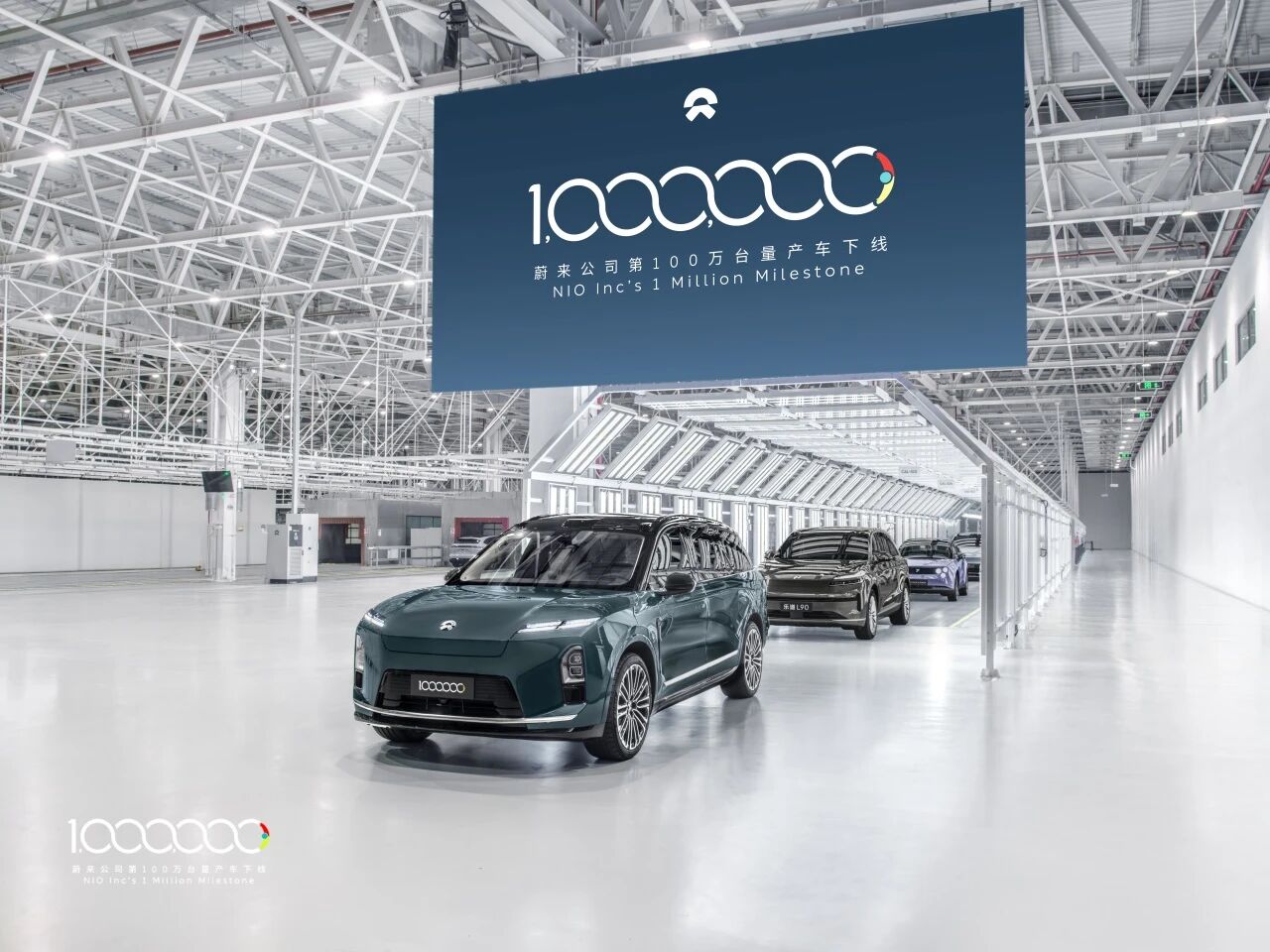
Image credit: NIO
Li's statement that he is confident about achieving profitability in the fourth quarter of 2025 was the day's weightiest line, addressing long-standing concerns about NIO's path to profit.
In an internal meeting in October 2025, Li cast the quarterly profit target as the exam the entire team must pass to prove operating efficiency and execution. This isn't for show, he stressed — it's the foundation for long-term sustainability.
The confidence stems from record deliveries in late 2025. In December, NIO delivered 48,135 vehicles — a monthly high, up 54.6% year on year.
Across the fourth quarter, NIO handed over 124,807 vehicles, up 71.7%, also a quarterly record. For the full year, 2025 deliveries reached 326,028, a 46.9% increase.
Alongside volume gains, high-margin models are steadily taking a larger share. Li acknowledged a third-quarter loss of 2.7 billion yuan, but noted that "we delivered more high-margin models in Q4," improving the profit mix.
To achieve quarterly profitability, NIO has launched sweeping reforms focused on raising operating efficiency and controlling costs.
According to multiple sources, early in 2025 Li rolled out a CBU mechanism internally, splitting all operations into independent, non-overlapping business units and requiring each unit to set clear input-output metrics along with performance incentives and penalties.
Internally viewed as a "rewrite the OS" last stand, the overhaul came with Li's sharp criticism of teams masking business issues with value-talk. "Every yuan spent must echo back," he emphasized, urging a "million-times cost mindset" for all expenses. The push freed resources from low-efficiency projects and refocused them on top priorities.
The impact is starting to show. On the second-quarter earnings call, Li said comprehensive cost-down, efficiency-up measures based on the basic business units narrowed operating losses by more than 30% quarter on quarter. Operationally, NIO merged resources across its multi-brand portfolio and promoted flatter management to reduce layers and internal friction, enabling resource reuse.
Integration has delivered visible results. At the Future Auto Pioneers Conference in May 2025, Li revealed that with ONVO's frontline sales staff down 40%, the brand's monthly deliveries still rose by at least 40% — a direct lift in per-capita productivity from channel consolidation.
NIO also made decisive cuts to non-core or still-unprofitable businesses. Since late 2024, it has adjusted the smartphone program, merging the software team into the digital cockpit unit and trimming overlapping roles. Li set a clear resource principle: projects unlikely to yield returns within three years should not receive primary resources.
In the supply chain — the most critical lever for vehicle margins — Li personally led cost control, demanding precision to four decimal places. NIO carved the cost team out of procurement to report directly to the CFO and set strict price ceilings requiring special approvals to exceed. On the tech side, platformizing components has boosted scale effects; switching seat frames from model-specific designs to a platform-wide solution cut costs by 10%. Accumulated details like these put Li's "million-times cost mindset" into practice and underpin the profit goal.
In short, Li's confidence rests on reforms already in place and showing early results — all pointing squarely to "profit in Q4." It's NIO's coming-of-age, a shift from survival to healthy growth that demonstrates a viable, sustainable cash-generation model.
From pricey NIO Houses to cost-diluting integrated stores
Nio President Qin Lihong said the 2026 sales push will lean on mid- to high-end large vehicles, and NIO will extend its sales network into lower-tier markets. The first integrated stores are due to open around Lunar New Year, selling models from NIO, ONVO and Firefly under one roof.
The plan marks another efficiency leap after rounds of channel diversification and internal consolidation.
NIO is moving from passively bearing high cost pressure to actively building a high-efficiency, coordinated system. In sales channels, it's shifting from high-cost mall stores to more flexible, efficient formats.

Image credit: NIO
The mall-store model once fashionable across NEVs is hitting a cost wall. Industry surveys show annual operating costs for a mall outlet in a Tier-1 city can reach about 5 million yuan. Reports put annual rent for NIO's Wangfujing NIO House in Beijing at 80 million yuan.
Rent and staffing drive the bulk of the expense. In Tier-1 malls, annual rent typically runs 2 million to 3.6 million yuan, while a 7–10 person team pushes annual labor costs beyond 1 million yuan. As competition normalizes and companies pursue healthier financial models, a format where "showcase outweighs sales returns" is hard to sustain.
Confronted with that reality, NIO began exploring new channel models. At the end of 2025, it introduced a "User Co-op Store" concept.
The model allows NIO users or partners to open physical stores on their own. NIO doesn't provide capital support, but stations professional sales advisors to handle display, guidance and sales services — a light-asset approach to expanding offline touchpoints.
Now, Qin says NIO will build integrated stores in lower-tier markets. A single store can span price bands from 300,000 to 600,000-plus yuan, maximizing conversion per location while sharply cutting channel build-out and operating costs — a direct response to the "cost down, efficiency up" strategy.
As penetration steadies in Tier-1 cities, lower-tier markets are becoming the core growth engine. Integrated stores can more intensively establish brand presence and experience touchpoints in promising cities.
The move is backed by a three-brand matrix with NIO, ONVO and Firefly advancing together. By the end of 2025, cumulative deliveries reached 829,609 for NIO, 128,569 for ONVO and 39,414 for Firefly.
Previously, the three brands operated relatively independently — clearly positioned but costly. With sales, delivery and service teams now integrated, the comprehensive store format becomes a natural product of resource synergy.
Mid-2025, NIO carried out a deep, "trim the fiefdoms" organizational consolidation. The core was systematically folding the formerly independent ONVO and Firefly sales, delivery and service teams into the main NIO system.
Under adjustments in May 2025, ONVO's marketing planning department and all regional sales companies were merged into NIO's User Service & Experience cluster (UE), creating a "two-in-one" sales system. Organizationally, the ONVO and Firefly business units were dissolved and their functions split and integrated.
Regionally, NIO implemented a "one person, two roles" approach — the existing NIO regional general manager also serves as ONVO's regional lead. Piloted in Harbin and Urumqi, the model has been rolled out nationwide. NIO House (牛屋), the company's signature user center, also opened to ONVO and Firefly owners, unifying the service entry.
Early on, opening NIO House to ONVO and Firefly drew criticism — some feared it would dilute the premium experience for NIO owners. Yet several NIO customers interviewed by Gasgoo said they didn't feel much dilution; some even voiced support, saying "a crowd makes it lively."
From light-asset "User Co-op Stores" to coordinated "integrated stores," NIO is searching for the optimal balance among brand strength, user experience, expansion speed and cost structure. It's moving from an early phase of brand-building through high-touch experiences to a more cultivated operational stage.
Open collaboration: NIO aligns with the "Anhui group"
Alongside the 1 millionth vehicle rolling off the line, NIO signed a Framework Agreement on Co-building a Collaborative Innovation Platform for Auto Industry Development with Chery Automobile and JAC Group, and inked a vehicle-chip collaborative industrialization project with Lontium Semiconductor — further "huddling for warmth" within the industry.
The cooperation focuses on joint R&D for vehicles and key components, shared manufacturing resources and supply-chain cost reductions. Notably, all three automakers and the chip firm are based in Anhui, forming a "provincial OEMs + local chipmaker" combo.
NIO's tie-up with Lontium aims at autos' heavy reliance on semiconductors. NEVs now carry close to 1,000 chips per vehicle, and highly intelligent cars can exceed 1,500, making chips a core determinant of delivery capacity and product functions.
NIO once had to adjust production plans amid tight chip supply; Chery likewise cut output for lack of chips. As automotive intelligence and electrification advance, that vulnerability is ever more pronounced.
In an "involution" market, going it alone is no longer optimal for new-energy challengers like NIO. Over the past two years, NIO has actively pursued industry partnerships — deep alignment with CATL and technology output to McLaren among the notable moves.
Image credit: CATL
On Jan. 6 in Hefei, Anhui, NIO and CATL formally signed a five-year comprehensive strategic cooperation agreement to deepen their partnership, centering on long-life batteries and swap-compatibility technologies, joint standard-setting and network resource sharing to build an open battery-swap ecosystem. Back in March 2025, CATL announced a strategic investment of up to 2.5 billion yuan in NIO Energy.
Another breakthrough is technology licensing to British supercar brand McLaren. Facilitated by shared shareholder CYVN Holdings, NIO authorized its EV platform and related technologies. The collaboration generated hundreds of millions of yuan in technology service revenue in the second quarter of 2025, opening a new profit stream.
NIO also aims to build a broad "battery-swap alliance," signing with Changan, Geely and Chery, and achieving charging-network interoperability with ZEEKR and Avatr. The moves reveal NIO's intent to share costs and expand its ecosystem through open cooperation.
NIO's partnerships with Chery and JAC, and the wider open network, aren't outliers — they mirror the broader sector shift from competition to "coopetition."
By 2025, China's NEV industry had entered a white-hot elimination round. In an intensely crowded market, automakers building circles of allies to bolster supply-chain resilience has become the new normal.
XPENG, for instance, is partnering with Volkswagen Group, supplying E/E architecture and smart-platform technology and earning ongoing technology service revenue; Leapmotor, likewise, struck a deal with Stellantis, which invested in the company and is using its overseas channels to sell Leapmotor models globally…
These "huddle for warmth" cases reflect a change in logic. In smart EVs, technology iteration and R&D costs far outstrip the combustion era; no single company can dominate every domain. Sharing risk and outcomes through cooperation is the rational choice.
Scale and cost control have become existential — especially in core components like batteries and chips. Joint purchasing and co-development can strengthen bargaining power and command over the supply chain. Amid global uncertainty, building secure, resilient local supply chains is both national strategy and corporate necessity.


