



Gasgoo Munich- PATEO recently released its 2025 financial results, showing annual revenue and core business income both climbed year-over-year. The company significantly boosted R&D spending, made headway in the high-end market and global expansion, and narrowed its adjusted net loss.
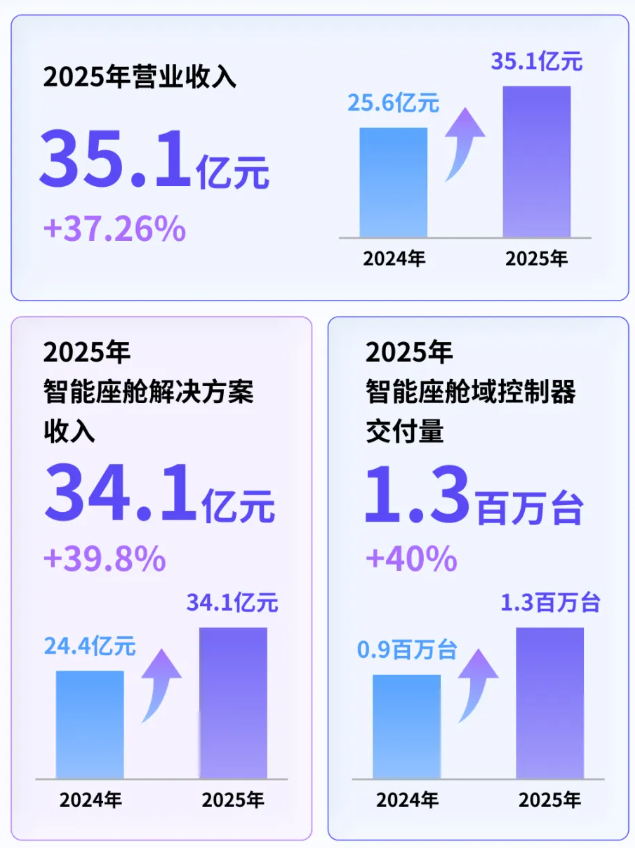
Image Source: PATEO
Financial data reveals PATEO generated 3.51 billion yuan in revenue for 2025, a 37.26% jump from 2.56 billion yuan in 2024. Revenue from its core smart cockpit solutions surged 39.8% to 3.41 billion yuan — accounting for over 90% of total revenue and serving as the primary growth engine. During the same period, deliveries of smart cockpit domain controllers reached 1.3 million units, climbing 40% from 900,000 units in the prior year.
AI operations emerged as a new growth highlight, with revenue approaching 100 million yuan in 2025 — a nearly 210% surge from the previous year. This confirms the commercial viability of AI applications in the vehicle sector. On profitability, PATEO's gross margin rose to 12.4%, up 0.6 percentage points from 11.8% in 2024, while the adjusted net loss narrowed by more than 30%.
On the R&D front, PATEO invested 379 million yuan in 2025 — an 83% increase from 207 million yuan in 2024. The company also made significant strides in chip platform partnerships. Design wins for products based on Qualcomm's QAM8295P platform continued to grow, moving toward mass production. Meanwhile, products using the QAM8397P platform secured orders from leading domestic automakers and EV startups, with mass production slated for 2026. Collaboration on the Kirin 9610A premium chip platform also deepened, significantly expanding the range of compatible models.
Global expansion is accelerating. PATEO is deepening its partnership with a European luxury automaker, delivering cockpit products that feature various AI functions, with full delivery expected in 2026. Additionally, a major international OEM has secured orders for multiple new models; these vehicles have obtained certification in over 100 countries, with initial rollouts planned for Australia, Southeast Asia, South America, and the Middle East.


