



Elon Musk has once again thrust Tesla into the eye of the storm.
Musk has been doubling down on his radical pivot. As reported by international media, he insists Tesla's future lies entirely with the Optimus humanoid robot. He projects this shift will transform the company into a robotics giant valued at $25 trillion. In his vision, the robot business would account for more than 80% of the company's total market cap.
Yet, behind this grand vision lies a stark reality. Reports indicate that while 2025 was supposed to mark a critical year for scaled trial production of Optimus, a massive gap remains between actual output and targets.
How Does Musk Arrive at His "$25 Trillion" Figure?
A $25 trillion valuation from Musk is nearly half the combined market cap of every major U.S. company. What gives him the confidence to float such a number?
First, by replacing human labor. Musk envisions a world where, with a population of 8 billion, demand for robots could hit 10 billion units or more by 2040. If these machines can perform factory work or household chores like humans—and sell for roughly $20,000 each—the market's economic potential becomes limitless.
Musk views robots as "general-purpose labor," arguing the economic value they create will fundamentally reshape human society.
Image Credit: Tesla
Second, by porting autonomous driving technology into robots. Tesla has long maintained it is not a conventional automaker, but an artificial intelligence company.
Musk's logic is straightforward: a self-driving car is a robot on wheels, while Optimus is a robot on legs. Both rely on the same visual recognition algorithms and AI chips. By leveraging this technology reuse, he aims to convince investors that a breakthrough in autonomous driving will automatically make the robots "smarter."
A major driver for this pivot is the slumping car business. Tesla's global sales slipped 8.6% in 2025, marking the first time its volume was surpassed by Chinese rival BYD. With its core business under pressure, Musk is eager to slap a new label on the company—and the humanoid robot sector is the niche he's betting on.
Across social media and public interviews, Musk has repeatedly emphasized that Tesla's true future value lies not in selling cars, but in its Optimus humanoid robots.
The Reality Is Far Leaner, and Promises Were Broken Last Year
Musk may have painted a beautiful picture, but the results for 2025 fall short of passing marks.
Tesla's goal to build 5,000 humanoid robots last year completely missed the mark. According to foreign reports, the company had set a target of producing 5,000 units of Optimus in 2025, but actual output for the year was only in the hundreds. These robots remain largely confined to Tesla's own laboratories for "internships," lacking the capability to enter factories and replace workers on a large scale as Musk claimed.
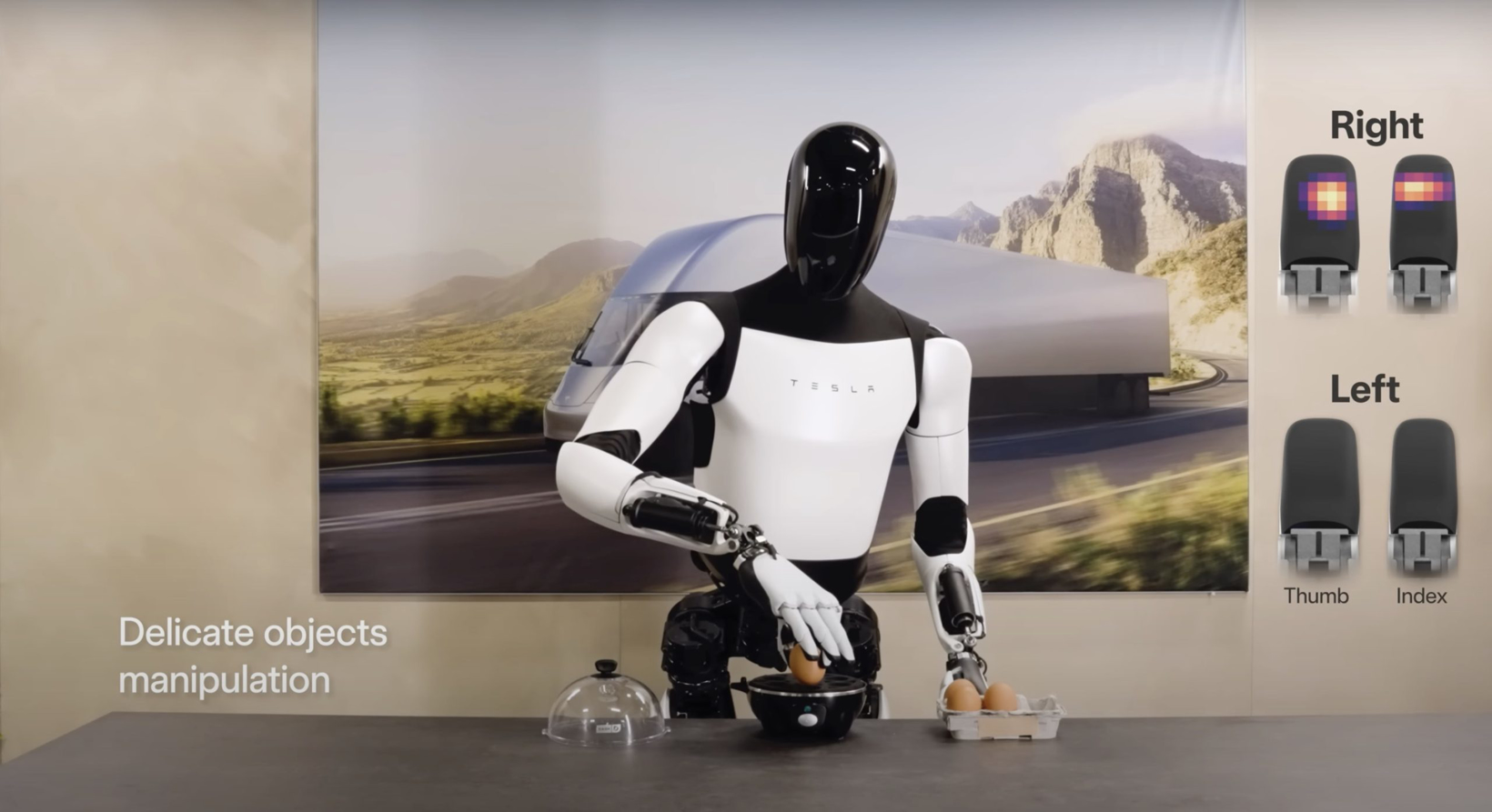
Image Credit: Tesla
Another core challenge lies in a pair of hands that simply won't obey. The biggest headache for Tesla's engineers right now is the robot's dexterous hands. Making a robot's hands as flexible as a human's requires extremely intricate components. Reports suggest the current supply chain cannot keep up; many parts are not only expensive but also prone to failure.
Moreover, building cars is not the same as building robots. The auto industry boasts over a century of accumulated expertise, while the humanoid robot supply chain is just getting started. Tesla has to develop and customize a vast array of precision parts from scratch. The difficulty of this "starting from zero" approach was clearly underestimated in Musk's earlier optimistic predictions.
To crack the robot problem, Tesla has executed a massive internal reshuffle, pulling top engineers away from new vehicle development to staff the robotics division. While this may accelerate the robot program, it raises concerns outside the company: will this diversion of focus cause Tesla to fall even further behind competitors in its core business of building cars?
Tesla's current pivot feels less like a strategy and more like an "all-in gamble" following setbacks in its automotive foundation. Right now, Tesla's stock price is largely propped up by Musk's "vision." If the robot project can demonstrate consistent, impressive progress, investors may buy in. But if mass production targets continue to slip, the cost of market trust in Musk will rise significantly.
Looking back at Musk's entrepreneurial history, he prefers to toss out an astonishing goal first, then close the gap through frantic overtime and R&D. But this time, he is facing the dual challenges of the laws of physics and manufacturing processes.
The figure of $25 trillion sounds staggering, but the current Optimus is merely a "toddler" stumbling around a laboratory. It still has a long way to go before it can actually work and generate a profit. For context, Tesla's current market capitalization is $1.46 trillion—a vast distance from that $25 trillion target.
For Tesla, the immediate priority may not be refreshing valuation figures, but solving the mass production problem for those "dexterous hands." After all, a robot that can independently walk off the production line is far more persuasive than a thousand words on social media.


