



Gasgoo Munich- In 2025, Chinese vehicle exports shattered the 7 million mark for the first time, with the deserts of the Middle East contributing a staggering 1.39 million units—nearly 20% of the total.
As a brutal price war rages at home, the vast blue ocean of the Middle East has become a "cash cow" and "growth engine" for Chinese automakers.
Yet, the sudden escalation of geopolitical conflict in the Middle East in late February 2026 hit like an emergency brake. The Strait of Hormuz—the world’s energy and trade chokepoint—ground to an instant halt.
With the "oil route" to the Persian Gulf severed, the global auto industry—then advancing aggressively along this shipping lane—faced more than a simple logistics delay. It was an extreme stress test of strategic resilience, supply chain security, and the very rules of global survival.
As conflict ignited across the strait, car-carrying RoRo vessels were left drifting at sea, putting the global auto industry to a severe test. Amid the hostilities, the globalization story of Chinese automakers is enduring a brutal "coming of age." How will the industry’s grand export plans stop the bleeding? And how will they pivot?
Under the Chaos: Automakers’ "Stress Index"
On this hot Middle Eastern soil, Chinese automakers do not share the same fate. When risks materialize, differences in business structure determine their individual stress levels.
Zhou Xiaoying, CEO of Gasgoo, notes that the impact on any given player can be assessed through a core logic formula: Impact ≈ (Middle East export share/scale) × (dependence on Gulf ports/transit hubs) × (presence of local "aftermarket/turnover parts" systems) × (financial settlement and insurance exposure).
This logic clearly quantifies the potential impact facing different players.
Meanwhile, Zhou identifies three categories of common direct losses that have already occurred or are most likely to emerge:
First, delayed or canceled in-transit deliveries. With the strait effectively paralyzed, shipping companies have suspended or drastically adjusted routes, completely disrupting dealer arrival schedules. Multiple logistics and shipping agencies have warned that commercial transit is currently at a standstill, with relevant bookings suspended.
Second, a surge in freight and insurance costs. VLCC rates on the Middle East–China route have hit extreme levels of $400,000 per day. Risk premiums have inflated the entire transport cost structure, often accompanied by hikes or cancellations of war risk insurance, further squeezing operating costs.
Third, the risk of spare parts shortages. This damages a brand far more than delayed vehicle deliveries. While delays merely affect pickup times, a cutoff in critical aftermarket parts—such as collision repair components, consumables, or electronics—can shatter brand reputation and cause irreversible harm to brand image.
Analysis by the Gasgoo Automotive Research Institute shows that major Chinese automakers exporting to the Middle East include Chery, BYD, SAIC, Changan, and Geely.
According to Gasgoo data, from January to November 2025, Chery held the top spot on the "Top 10 Chinese Passenger Vehicle Exporters to the Middle East" list with 263,679 units exported.
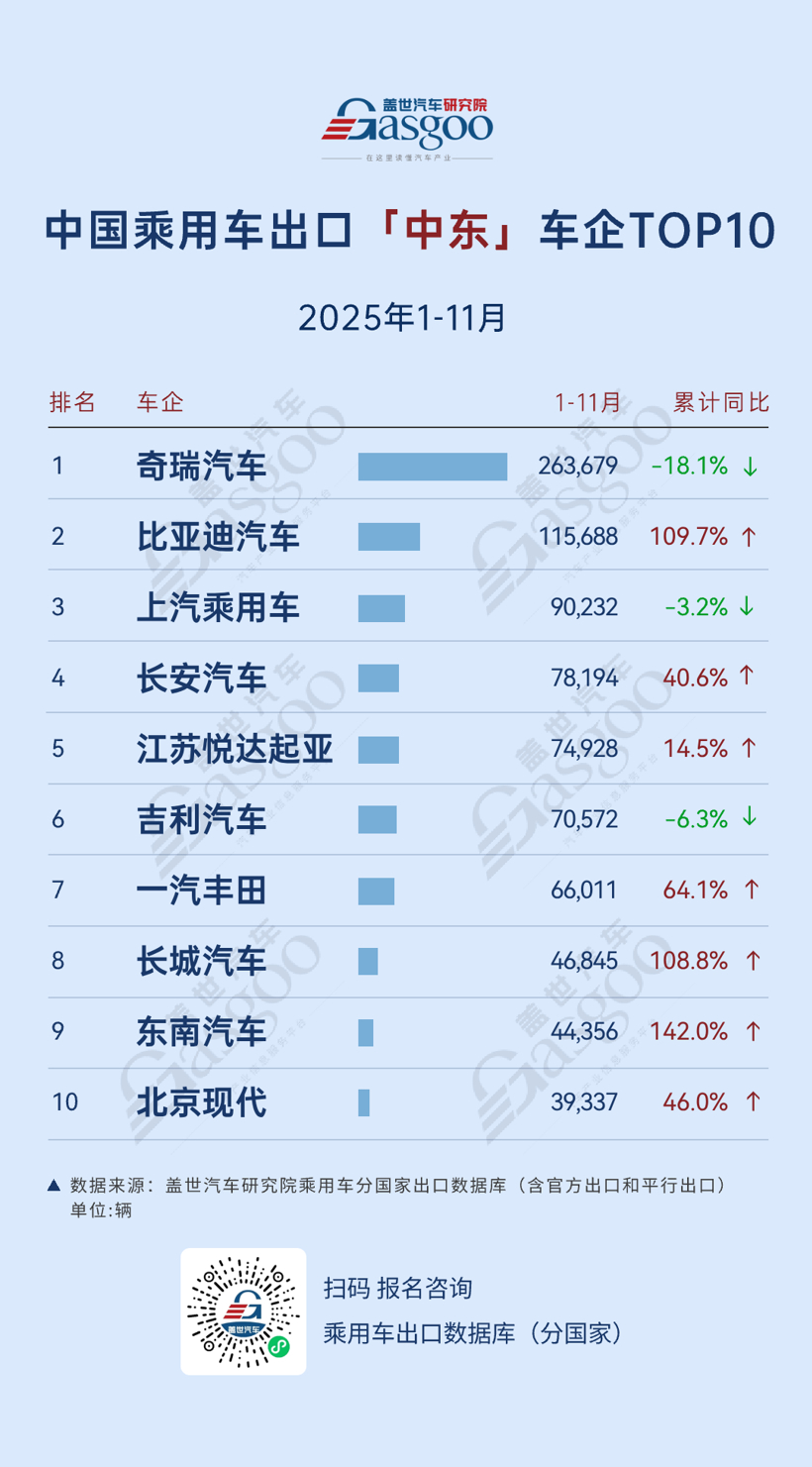
In terms of this industry shift, Chery’s situation serves as a typical reference point.
Chery is the Chinese automaker with the largest business scale in the Middle East, and its operations are highly concentrated in Iran.
"Chery has the largest footprint in the Middle East, and it is heavily concentrated in Iran," says Chen Weiwei, an analyst at the Gasgoo Automotive Research Institute. Chery operates in Iran primarily by supplying KD (knocked-down) kits to local partners for assembly. After the outbreak of war, foreign exchange quotas previously approved by the Central Bank of Iran for automotive supply chains are likely to be tightened to prioritize the war effort, leading to a reduction in business scale.
He adds that the blockade of the Strait of Hormuz will also obstruct Chery’s KD kit shipments and complete vehicle exports to the UAE, preventing them from arriving in the short term.
Routes to Saudi Arabia, however, are only partially obstructed. Changan, SAIC, and Geely have more extensive operations in Saudi Arabia and can bypass the Red Sea entirely by shipping through Jeddah Port on the kingdom’s west coast, which handles two-thirds of Saudi auto imports. While local land transport costs may rise, this can offset the impact of the Hormuz blockade to some extent.
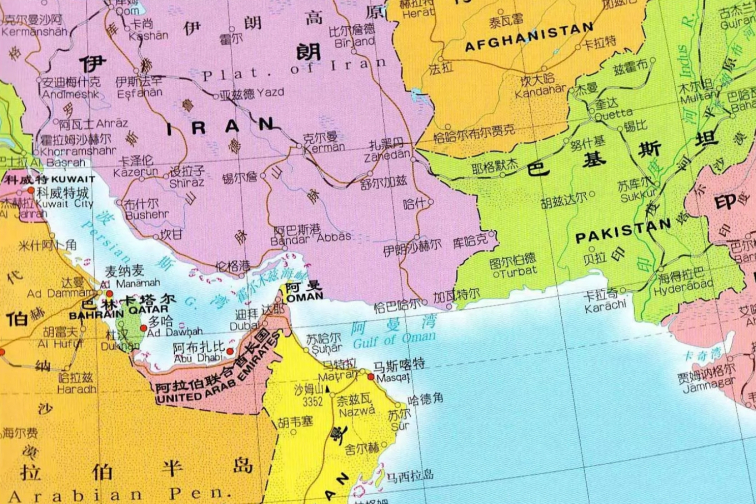
Map of the Strait of Hormuz; Image source: Baidu Baike
SAIC’s MG faces a dilemma centered on logistics dependence and inventory imbalance. As a top-ranking Chinese brand in UAE and other Gulf markets, MG’s performance relies heavily on regional logistics order. Its "port-to-store" chain is tightly integrated, creating extreme dependence on core transit hubs like Dubai’s Jebel Ali Port.
Jebel Ali Port is a deep-water port located in Jebel Ali, Dubai, UAE, and is the largest and busiest port in the Middle East. As a key hub for the New International Land-Sea Trade Corridor, Beibu Gulf Port has actively promoted the launch of trade routes to the Middle East.
Zhou emphasizes: "Once transit hubs are blocked, delivery delays and inventory imbalances will manifest much faster."
For Great Wall Motor (GWM), the focus on SUVs and pickup trucks—larger and heavier vehicles—means higher sensitivity to shipping and insurance costs. When freight and insurance surge, the rising landed cost per vehicle directly erodes its price-performance advantage. More critically, users of these off-road models demand high after-sales support; a shortage of "key parts" would instantly shatter brand reputation.
Compared to the "growing pains" of its peers, BYD faces a different kind of loss: a misalignment of time and strategic rhythm.
According to Zhou, in a November 2025 interview, BYD executives mentioned that they were discussing or advancing plans to establish a distribution center for the GCC in Saudi Arabia. They called it a "huge investment" expected to land the following year (the 2026 window) and proposed expanding the dealer network in Saudi Arabia to 10 outlets by 2026.
For BYD, short-term "absolute sales volume" may not be the biggest concern, but the conflict could shake dealer confidence in store openings and slow the pace of new model introductions.
"The disruption of the strategic window’s rhythm will affect its globalization development, particularly the overall planning for the Middle East market," Zhou admits.
Oil Over $100, Freight Soaring, Strontium Carbonate Doubling: Rewriting the Cost Formula for Chinese Automakers Abroad
If losses at the corporate level are the visible tip of the iceberg, the transmission effects from the upstream supply chain are the submerged ice shelf capable of grounding a giant ship.
Methanol: 55% Dependence and a "Skeleton Material" Crisis
Iran is the world’s second-largest methanol producer, with an annual capacity of 17.16 million tons, accounting for 9.2% of global capacity. Since its methanol facilities are highly concentrated along the Persian Gulf coast and exports rely heavily on sea transport, supply is vulnerable to shock once conflict escalates.
China happens to be Iran’s largest buyer. In 2025, China imported over 7.92 million tons of methanol from Iran, representing more than 55% of total imports.
Methanol is not just fuel; it is a foundational raw material for synthetic polymers and chemical products. From dashboard interiors and seat foams to engineering plastics, adhesives, and coatings on the body, the entire production chain is deeply bound to the stable supply of methanol.
The chemical team at TF Securities notes that as a key methanol producer in the Middle East, uncertainty in Iran’s geopolitical situation could transmit directly to China’s domestic methanol import market, subsequently rippling down to the automotive sector.
Celestite: 85% of Reserves and the "Achilles' Heel" of EVs
Compared to methanol, the name celestite may be obscure to the general public, but its role in new energy vehicles is critical. Celestite is the primary source of strontium, which is essential for manufacturing high-performance permanent magnet ferrites—materials widely used in automotive motors, sensors, and braking systems.
Iran holds the dominant position in global high-grade celestite reserves and supply. It accounts for approximately 85% of the world’s proven high-grade reserves, giving it absolute supply dominance. About 60% to 70% of China’s celestite imports come from Iran.
This means that any disruption to Iran’s celestite supply poses a risk of raw material shortages for the domestic strontium salt industry and, further downstream, automotive motor production.
Even more worrying is the inventory situation. Some analysts believe that due to shipping disruptions, domestic celestite stocks are sufficient for only three months.
In fact, the port shutdown caused by the explosion at Iran’s Bandar Abbas port in June 2025 already exacerbated the global celestite supply shortage. The price of strontium carbonate surged from 8,000 yuan per ton in September 2024 to 16,000 yuan per ton in June 2025—a 100% jump.
Analysts suggest that with the Strait of Hormuz shipping now fully obstructed, supply chains for permanent magnet materials and EV models—highly dependent on high-grade celestite—may face production cuts or delivery delays in the future.
Oil: 1.5 Million Barrels/Day in Imports and Cost Transmission
Iran is China’s third-largest oil supplier, trailing only Russia and Saudi Arabia. Industry estimates put China’s crude oil imports from Iran in 2025 at approximately 1.5 million barrels per day, totaling about 550 million barrels (75 million tons) for the year.
With shipping through the Strait of Hormuz hindered, Iran’s crude exports face further restrictions. News of the conflict triggered an immediate reaction in international oil prices, with Brent crude surging nearly 13% to around $82 per barrel. Bernstein raised its 2026 Brent crude price forecast to $80 per barrel.
Analysts predict that if the situation in Iran continues to escalate and spreads to energy facilities in the Arab Gulf states, international oil prices could break $150 per barrel.
This deals a heavy blow to internal combustion engine vehicles.
Huatai Securities, applying historical oil price patterns, calculates that at crude prices of $80 and $100 per barrel, the corresponding retail prices for No. 92 gasoline would be 7.1 yuan and 7.6 yuan per liter, respectively.
Reviewing oil price and passenger car sales fluctuations between 2013 and 2018, they found that a 1 yuan per liter change in gasoline price affects ICE vehicle sales by 750,000 to 850,000 units. Consequently, we estimate that if oil prices stabilize at $80 or $100 per barrel between March and September 2026, the marginal price increase will lead to an annualized decline of 170,000 or 680,000 units in China’s ICE vehicle sales.
But the flip side is an opportunity for new energy vehicles.
Huatai Securities calculates that a crude price rise to $100 per barrel is equivalent to an effective price cut of 1.7% to 3.7% for NEVs. This could lift sales by 1.7% to 4.5%, shifting 100,000 to 360,000 units of purchasing demand toward the new energy market.
The "Standstill" of Logistics Hubs
As soon as the blockade order was issued, international shipping giants swiftly made risk-averse adjustments.
MSC, the world’s largest shipping line by capacity, suspended bookings for cargo heading to the Middle East globally; France’s CMA CGM paused all Suez Canal transits, diverting vessels around the Cape of Good Hope; and Germany’s Hapag-Lloyd announced a pause on all vessels transiting the Strait of Hormuz.
Peter Sand, chief analyst at shipping data firm Xeneta, points out that the closure of the Strait of Hormuz has completely dashed hopes for a large-scale return of container shipping to the Red Sea in 2026. Rerouting around the Cape of Good Hope has become the only option for Asia–Europe and Americas routes, adding 10 to 14 days to voyages.
Multiple shipping companies have explicitly stated they are not accepting car transport orders for Middle East routes. Dealers are hesitant to place orders, leaving the entire export chain in a passive state.
In this moment, Chinese automakers are realizing a hard truth: the so-called cost advantage of new energy vehicles is built not only on technological innovation but also on a fragile logistics line stretching across the Strait of Hormuz.
From a "Found Market" to "Baptism by Fire"; From "Price War" to "Systemic War"
Crisis is not just a touchstone for testing corporate mettle; it is a catalyst for driving industrial evolution.
Facing this "gray rhino" event that could drag on, the logic behind Chinese automakers’ expansion is being reshaped.
Pessimists see sales losses; optimists see a reshaping of the landscape.
In terms of competitive landscape, while Japanese automakers dominate the Middle East (Toyota holds about 17% market share), they are also hurting. Toyota has announced a cut of 40,000 units in domestic production destined for the Middle East, and its high-margin Land Cruiser faces delivery pressure. When supply contracts, a "delivery gap" inevitably appears in the market.

Image source: Toyota Motor
Cui Dongshu, secretary-general of the China Passenger Car Association (CPCA), believes this event presents an "opportunity within crisis." "China’s shipping capacity and industrial system resilience are world-leading. No other country has our level of cost resilience."
Having lived through the chip shortage, the Red Sea crisis, and now the Hormuz blockade, a consensus is gradually emerging: the era of extreme efficiency in global supply chains is over, and the era of regional resilience has begun.
But this does not mean "regionalization" is safer than "globalization."
Zhou points out that regionalization merely swaps the risk of trans-oceanic decoupling for the risk of regional concentration. True security comes from "triple redundancy": route redundancy (multiple ports/channels), supplier redundancy (dual sourcing/cross-region), and inventory redundancy (safety stock for key parts).
She believes that in concrete overseas layouts, Chinese automakers’ future strategies will follow a dual logic: "capacity follows barriers, supply chain follows security."
When this core logic is applied to specific corporate layouts, a clear strategy of regional differentiation emerges:
In South America (e.g., Brazil), demand is robust but tariffs and localization requirements are strict, making a "local production for market access" strategy suitable. In Southeast Asia, Japanese automakers have deep roots, so Chinese firms can find breakthroughs using a combination of "new energy/smart features + local partners + financial solutions." In Europe, compliance barriers are high but brand premium is large, making it suitable for "high-certainty investment + compliance system capability export."
At the same time, the prioritization of overseas layouts has shifted. It is no longer planned solely based on "where growth is fastest," but rather scientifically arranged according to a four-quadrant standard: "market return/policy barriers/geopolitical risk/logistics value."
Conclusion
Standing in the spring of 2026, the smoke over the Strait of Hormuz may eventually dissipate, but the reflection it leaves for the Chinese auto industry is far from over.
This is not just a logistics crisis; it is a coming-of-age ceremony regarding survival capability.
It forces Chinese automakers to face a reality: the path of globalization is never smooth. When black swans turn into gray rhinos, what truly protects you is not low prices, but the systems that can weather storms and the supply chain resilience that keeps operating even through the fire of conflict.
For the Chinese automotive industry, currently racing at full speed, only by learning to temper itself in fire can it truly sail into the deep blue.


