Gasgoo Munich- Here are the key developments in embodied intelligence and driver assistance this week:
Figure livestreams package sorting, clocking 200 hours of continuous operation
On May 14, U.S. robotics firm Figure revealed in a livestream that three Figure 03 humanoid robots were sorting packages on a factory production line, operating on a rotating shift basis.
The livestream showed the robots scanning barcodes, grasping parcels, reorienting them, and placing them barcode-down onto a conveyor belt. When a robot’s battery dropped to 20%, it autonomously moved to a charging station while a fully charged unit seamlessly stepped in—requiring no human intervention throughout the process.

Image source: Screenshot from Figure livestream
By the time the livestream concluded on the evening of May 21, Figure’s humanoid robots had been running continuously for 200 hours, sorting nearly 250,000 packages.
Figure reportedly planned an 8-hour stream, but few expected it to span several days—turning the event into a historic public stress test for the humanoid robotics sector.
The Figure 03 is powered by Figure’s latest in-house system: Helix-02. Unlike the layered stacks used by most industrial robots, Helix-02 is a unified end-to-end neural network that integrates vision, touch, proprioception, and whole-body control into a single model.
Xiaozhi Comment: With this “marathon livestream,” Figure has provided the industry with a high-value public case study for developing and deploying practical humanoid robots.
Tesla Swaps Model S/X Line for Humanoid Robots
On May 21, 2026, the final Model S and Model X units rolled off the line at the Fremont factory, marking the line’s official retirement. The production track that helped spark the global EV revolution will be dismantled within four months. It will be retooled into a dedicated humanoid robot line with an annual capacity of 1 million units. Meanwhile, a second-generation line under construction in Texas is targeting a capacity of 10 million.
Tesla’s humanoid robot is positioned as a general-purpose machine for homes, factories, and healthcare. It is designed to replace humans in repetitive, dangerous physical labor with industrial-grade reliability and low cost. Elon Musk predicts global long-term demand could reach 10 billion units—a market potential that would surpass electric vehicles.
Xiaozhi Comment: Once again, Tesla is using its capacity planning to accelerate the competitive tempo of the humanoid robot race to a new level.
Leju Intelligent’s IPO Application Accepted
On May 19, the Shenzhen Stock Exchange published the prospectus for Leju Intelligent (Shenzhen) Co., Ltd., confirming that the company’s IPO application has been formally accepted.

Image source: Leju Robot
Founded in 2016, Leju Intelligent initially entered the market with basic programming education and a small humanoid robot. By 2018, it had expanded into full-size humanoid robots. Its current portfolio includes the Kuavo, Roban, and Aelos series.
According to the prospectus, Leju sold 577 units of its full-size Kuavo series in 2025—a 17-fold jump from the 32 units sold in 2024.
That sales surge propelled Leju into the top tier of the embodied intelligence sector. Both Omdia and Counterpoint Research ranked Leju fourth globally in their 2025 sales reports, trailing only Unitree, Zhiyuan, and UBTECH.
From 2023 to 2025, Leju recorded revenue of 53.99 million yuan, 55.50 million yuan, and 258 million yuan, respectively. Net profit attributable to shareholders showed losses of 41.12 million yuan, 59.23 million yuan, and 69.78 million yuan, while non-GAAP net losses came to 48.97 million yuan, 63.97 million yuan, and 77.64 million yuan.
Xiaozhi Comment: With 258 million yuan in revenue and a 70 million yuan loss, the prospectus lays bare the reality that embodied intelligence is currently more hype than earnings.
Hangzhou Kerlin Takes Controlling Stake in Kepler Robot
On the evening of May 19, Hangzhou Kerlin (688611.SH) announced it plans to spend up to 300 million yuan in self-raised funds to acquire a 41.57% stake in Kepler Robot from founder and controlling shareholder Yang Hua and other investors.
Prior to this, Hangzhou Kerlin had already acquired a 9.43% stake in Kepler for 100 million yuan on December 31, 2025, becoming a minority shareholder.
Upon completion of this deal, Hangzhou Kerlin will hold 51.00% of Kepler. Kepler will be consolidated into Hangzhou Kerlin’s financial statements and managed as a subsidiary. Based on this transaction, Kepler’s implied valuation is approximately 720 million yuan.
Xiaozhi Comment: This cross-border acquisition reveals the raw logic of industrial capital scrambling for position during a valuation window.
Qingtianzu Closes Two Consecutive Funding Rounds
Gasgoo has learned that Qingtianzu recently closed Series A and A+ rounds worth hundreds of millions of yuan. The funding values the company at 7 billion yuan, officially elevating it to unicorn status.

Image source: Qingtianzu
Qingtianzu noted that unlike its previous focus on display and interactive scenarios—such as tourism, events, and marketing—this funding will target RaaS (Robot as a Service) infrastructure and industrial expansion. The goal is to move robots from “event venues” into frontline operational settings like manufacturing, industrial parks, warehousing, and commercial services.
This marks Qingtianzu’s evolution from a “robot rental platform” to a “scaled robot application service platform.”
Since its official launch on December 22, 2025, Qingtianzu has deployed over 4,000 dispatchable robots across a nationwide network, accumulating extensive delivery experience in sectors ranging from tourism and events to retail and education.
Xiaozhi Comment: While rivals obsess over technical specs, Qingtianzu has cracked open the narrow path to scale with 4,000 dispatchable robots and a “rent first” model.
Tesla Announces Supervised FSD Launch in China
On May 21, Tesla posted on X outlining the latest expansion of its Supervised FSD system, confirming availability in China.
Supervised FSD is currently available in the U.S., Canada, Mexico, Puerto Rico, China, Australia, New Zealand, South Korea, the Netherlands, and Lithuania.
Previously, Tesla revealed during its first-quarter earnings call that it is in close discussions with Chinese regulators, aiming to secure formal approval for its Full Self-Driving system in the third quarter of this year.
To accelerate compliance, Tesla has initiated several key steps domestically. These include establishing a local AI training center in Shanghai. The company ensures all data collected from Chinese roads is stored and trained locally, adhering to national data security regulations. Additionally, the system has been deeply adapted to China’s unique traffic conditions. Scenarios include dense non-motor vehicle traffic and intersections without traffic lights.
Xiaozhi Comment: Whether FSD’s on-the-ground performance can truly adapt to local driving conditions remains to be seen.
XPENG’s Fully Self-Developed Robotaxi Rolls Off Production Line
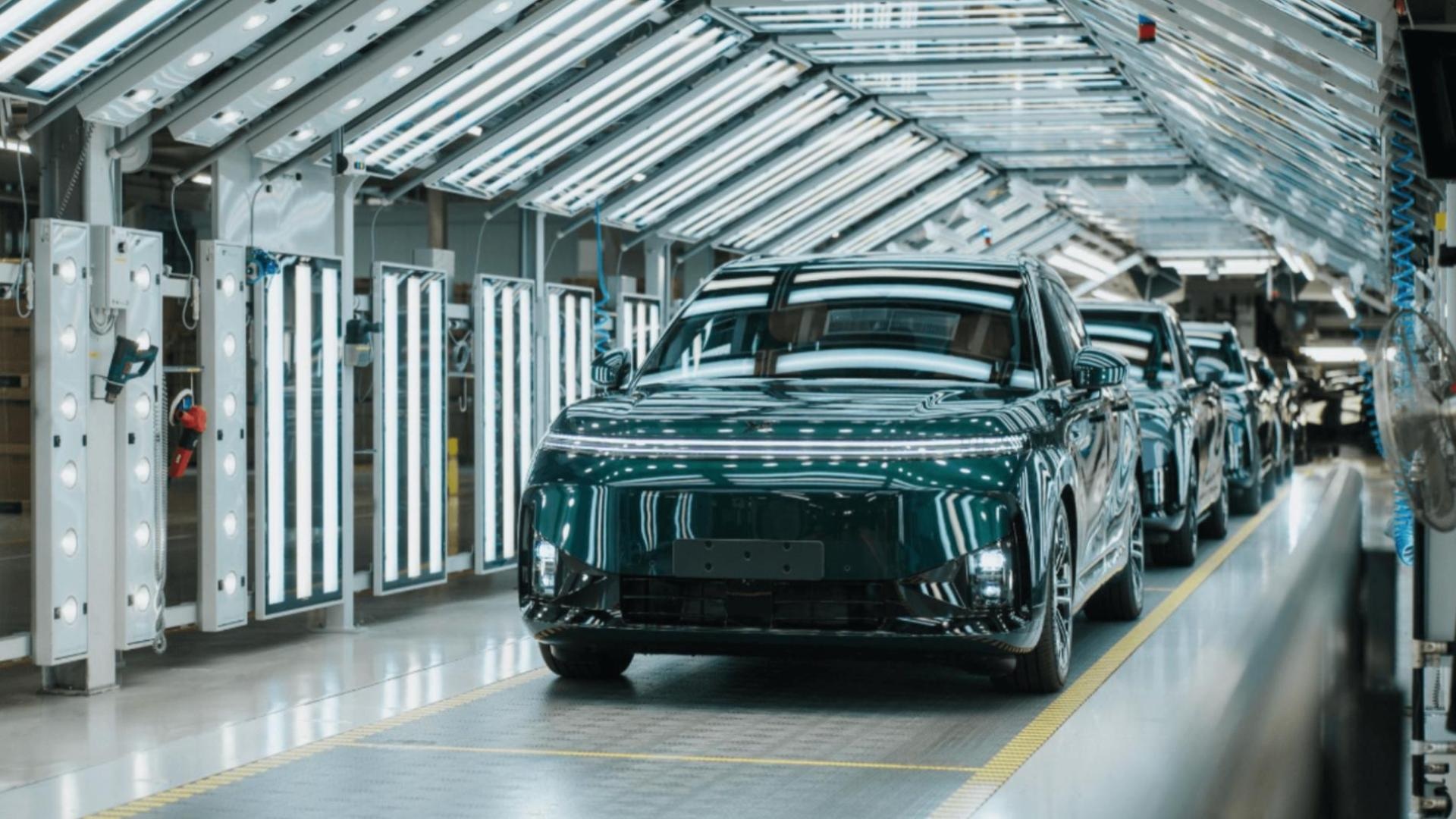
On May 18, the first mass-produced XPENG Robotaxi rolled off the line in Guangzhou. This marks the first time a Chinese automaker has achieved mass production of a Robotaxi using entirely in-house, full-stack technology.
A head of XPENG’s Robotaxi division revealed that the vehicle is expected to begin pilot operations in the second half of this year.

Image source: XPENG Motors
Built on XPENG’s flagship GX model, the vehicle is the first mass-produced Robotaxi to be fully self-developed and pre-installed from the factory. It features four in-house Turing AI chips delivering 3,000 TOPS of computing power and utilizes XPENG’s second-generation VLA large model to achieve Level 4 autonomous driving.
In January, XPENG obtained a road testing license for intelligent connected vehicles in Guangzhou, officially commencing regular L4 testing on public roads. In March, the company established a dedicated Robotaxi division to oversee product definition, R&D, and operations, accelerating the path to commercialization.
The launch of this pre-installed mass-produced model marks a critical step for XPENG. It moves Robotaxi from technical verification to commercial realization, outlining a new growth curve for the group.
Xiaozhi Comment: When an automaker builds its own full-stack Robotaxi, the boundaries tech giants spent billions defining suddenly blur.
UiSense Technology Officially Lists on Hong Kong Stock Exchange
On May 20, UiSense Technology (01511.HK) began trading on the Hong Kong Stock Exchange with an opening price of 56 HKD, giving it a market capitalization of approximately 9.09 billion HKD.
For the IPO, UiSense issued 14.46 million shares globally at a final offer price of 60.3 HKD per share, raising over 870 million HKD.
UiSense focuses on developing and deploying Level 4 autonomous driving solutions, particularly for commercial vehicles in closed environments like airports and factory zones. It is also expanding its solutions into diverse sectors including cities, ports, mines, farms, and ranches.
According to the prospectus, UiSense has partnered with 17 airports in China and three overseas as of the latest practicable date. In 2025, it ranked as the top L4 autonomous driving solution provider in Greater China for both airport and factory scenarios, with market shares of 90.5% and 31.7%, respectively.
From 2023 to 2025, UiSense reported revenue of 161 million yuan, 265 million yuan, and 328 million yuan; gross profit of 78.82 million yuan, 116 million yuan, and 168 million yuan; and gross margins of 48.8%, 43.7%, and 51.1%. Annual losses were 213 million yuan, 212 million yuan, and 230 million yuan, respectively.
Xiaozhi Comment: Holding 90.5% of the market share in airport autonomous driving while recording an annual loss of 230 million yuan highlights the difficulty niche scenarios face in supporting a public company valuation.