Gasgoo Munich- Data from Gasgoo Automotive Information Platform reveals that Zhejiang Province has built a modern automotive landscape defined by comprehensive coverage, targeted breakthroughs, and efficient collaboration. Bolstered by a vibrant private sector and a robust supply chain, the province is rapidly emerging as a key growth engine for China's new energy vehicle sector.
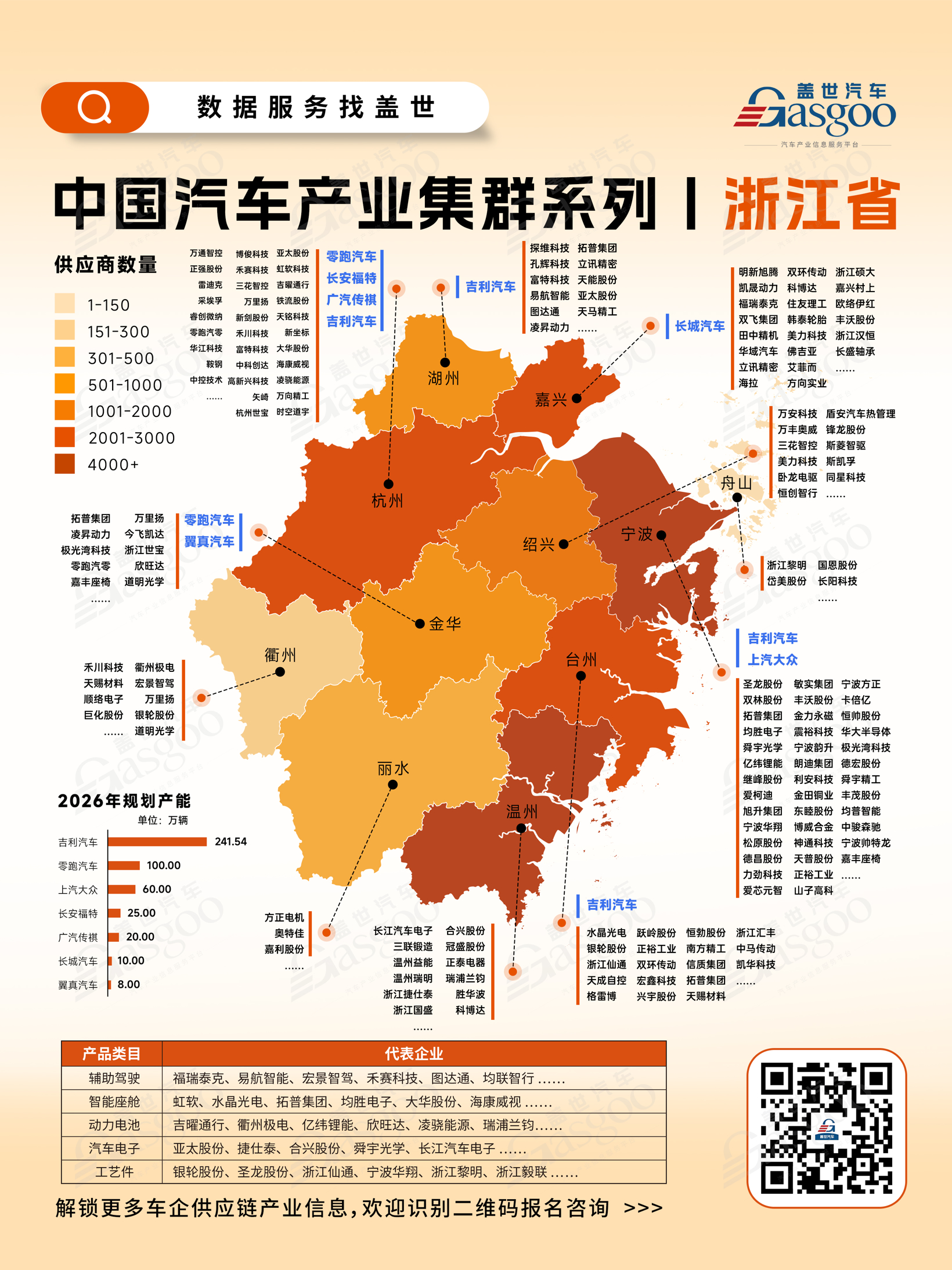
Spatially, the province follows a pattern of coastal clustering, core leadership, and tiered differentiation. An industrial axis anchored by Ningbo, Taizhou, and Hangzhou is taking shape, with these three cities creating a synergistic support network in vehicle manufacturing, parts supply, and intelligent technology. At the same time, local municipalities are leveraging their unique resources to pursue distinct development paths. This approach is driving the industry's expansion from isolated hubs to a broad, collaborative network, steadily elevating the province's overall competitiveness.
Ningbo stands out as a pivotal core city in Zhejiang's automotive sector. The data shows its supplier count sits in the province's top tier (4,000+), highlighting significant industrial agglomeration. On the vehicle manufacturing side, Geely and SAIC Volkswagen have established operations, laying a stable production foundation. The parts sector, meanwhile, hosts competitive supply chain players like Shenglong Automotive, Tuopu Group, and Joyson Electronics. Leveraging its port advantages and manufacturing base, Ningbo has built a system dominated by auto components. Furthermore, its proximity to Shanghai allows it to absorb spillover from OEMs and international supply chains, giving the city a highly export-oriented profile.
Wenzhou represents another major hub, with its supplier count also ranking high (4,000+). The city boasts highly active enterprises that have carved out strong positions in auto electronics, precision manufacturing, and components. Supply chain firms such as Changjiang Automotive Electronics, Sanlian Forging, Hexing, and REPT have further solidified this foundation. Characterized by a "specialized and refined" supply chain, Wenzhou is home to numerous small and medium-sized enterprises that offer agile market responses and cost advantages—making it an indispensable force in Zhejiang's automotive network.
Hangzhou, for its part, embodies a model of "technology-driven plus industrial collaboration." With a supplier count in the first tier (2,001–3,000), the city holds a distinct edge in intelligence and software. On the OEM front, a diversified lineup has formed through Leapmotor, Changan Ford, GAC Trumpchi, and Geely. The supply chain side features ZF and Hesai, which focus on intelligent sensing, core components, and cutting-edge technologies to deepen local technical expertise. Beyond manufacturing, Hangzhou serves as a hub for resource integration and innovation incubation, exerting a strong radiating influence on neighboring cities.
In terms of vehicle production capacity, public data indicates Zhejiang is targeting a planned capacity exceeding 4.64 million units by 2026. Geely dominates this landscape with roughly 2.42 million units planned, anchored by facilities in Ningbo and Taizhou. Leapmotor and SAIC Volkswagen provide key supplements, creating a diverse ecosystem where domestic leaders coexist with foreign joint ventures and emerging startups.
Overall, Zhejiang's automotive industry has shifted from a purely manufacturing-focused model to a dual-drive approach combining intelligence with production. This multi-polar collaboration has forged a regional industrial cluster with notable resilience and competitiveness. As the province accelerates its transition, it faces headwinds from intense new-energy competition and supply chain pressures. Yet, there remains significant room to bolster core capabilities in areas like key chips and operating systems.