



On February 24, Hubei Province convened a meeting to accelerate its role as a strategic pivot for the central region's rise. At this flagship "First Meeting of the New Year," four eVTOLs (electric vertical takeoff and landing aircraft) built in Hubei took center stage, drawing significant attention.
eVTOLs are popularly known as "flying cars." Developed independently in Hubei, these aircraft handle both cargo and passenger transport, outlining a future where citizens can hail an air taxi or pilot their own flying vehicles.
The low-altitude economy has emerged as one of the most promising future industry tracks. Featured in government work reports for two consecutive years and highlighted in the recommendations for the 15th Five-Year Plan, it is now receiving strategic support at the national level.
Leveraging deep supply chain integration, China's eVTOL industry is leading globally in commercialization and has already launched manned pilot flights. Data from Qichacha shows that as of February 24, the number of domestic flying car-related companies reached 547, with related patents exceeding 1,707 — more than 70% of which were filed within the past five years.
"Hubei-Made" Flying Cars Take Flight
Drawing on its deep aviation heritage, Hubei is accelerating its push into the low-altitude economy. The four eVTOLs showcased at the "First Meeting of the New Year" serve as a concentrated display of the province's industrial achievements.
Hubei has long prioritized the low-altitude economy in its regional development strategy. By using the "First Meeting of the New Year" to showcase eVTOLs, the province is signaling that this sector is a key direction for industrial upgrading, with follow-up policies expected to facilitate implementation.
Hubei boasts unique industrial advantages, hosting over 200 key aviation enterprises. Its capabilities in R&D and manufacturing for special aircraft and aviation lifesaving equipment, as well as aircraft maintenance, lead the nation. In 2025, the province's aviation industry revenue hit 27.9 billion yuan — a 13.9% year-on-year increase. Concentrated primarily in Wuhan, Jingmen, and Xiangyang, this cluster provides solid support for eVTOL development.
On the corporate front, Hubei has gathered a group of key players, including E-HAWK, Shi Yun Aviation, Wuhan Xunqi Technology, and Fusheng General Aviation. This emerging cluster is driving the rapid deployment of "Hubei-made" eVTOLs.
The four "Hubei-made" eVTOLs unveiled this time feature differentiated positioning and cover diverse application scenarios, demonstrating the region's robust R&D capabilities.
Shi Yun Aviation's SW-one, the world's first electric multi-rotor aircraft capable of vertical takeoff from water, ditches traditional aircraft controls. Instead, it uses a steering wheel and throttle-and-brake pedals, mimicking car logic so that "anyone who can drive can fly." Designed for personal experiences and water sports, it is slated to open for trials in designated waters by 2027.
E-HAWK's fully ducted, ton-class "flying saucer" eVTOL employs a world-first design that conceals the motors and blades within ducts. Requiring just four parking spaces for takeoff and landing, it can carry four passengers and is suited for urban short-haul commuting. Its flight duration has already been extended to over 20 minutes.
The V1000 from Wuhan Xunqi Technology is the country's first tilt-rotor hybrid eVTOL to receive formal type design acceptance from the Civil Aviation Administration of China (CAAC). Using a hybrid powertrain, it achieves a single-flight range exceeding 1,000 kilometers, enabling direct flights from Wuhan to most of China's tier-1 cities. The company plans to deploy distributed landing sites for operations.
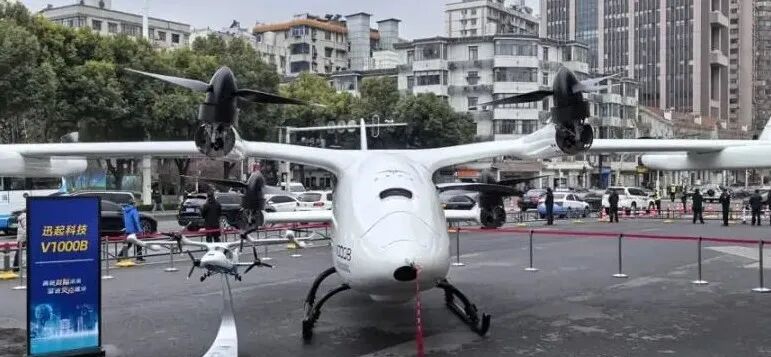
Image Source: Wuhan Xunqi Technology
Fusheng General Aviation's Sparrow-X2 focuses on medical emergency response, positioning itself as an "airborne mobile ICU." It ranks first among domestic products of similar configuration in payload, range, and safety. Equipped with professional medical gear and offering significantly lower rescue costs than traditional helicopters, it has already signed agreements with multiple medical institutions to buy critical time for patients in need.
Currently, Hubei has nine eVTOL models under development, four of which have already commenced test flights. Moving forward, the province will continue its "open bidding" initiatives, aiming to launch more than four "Hubei-branded" eVTOL products within the year. It also plans to refine the supply chain and deepen the integration of the low-altitude economy with sectors such as tourism, healthcare, and logistics.
Domestic Flying Car Patents Surge as Commercialization Accelerates
Backed by favorable national policies, China's flying car industry has entered a golden era of development. It is showing positive momentum across the board — intensifying policies, corporate clustering, a patent boom, and faster commercialization — marking a steady rise from the startup phase.
Continuous top-level policy support is laying a solid foundation. The low-altitude economy has been incorporated into the national strategic layout, appearing in government work reports for two consecutive years and listed as a strategic emerging industry cluster in the 15th Five-Year Plan recommendations.
In terms of commercialization, China's eVTOL industry holds a global lead, having moved from concept verification to pilot implementation and initiated manned test flights. Following the industry path of "information first, cargo second, passengers third," breakthroughs are being made across multiple scenarios. eVTOLs are expected to launch commercial operations in the tourism sector by the end of 2027.
A significant advantage of the domestic eVTOL industry is its integrated supply chain. According to Guosen Securities, 75% of eVTOL components are an extension of the new energy vehicle (NEV) supply chain, with high synergy in technology and manufacturing. The "three-electric" systems (battery, motor, control) of NEVs can be directly transferred to eVTOL power systems, and mass production experience can empower aircraft manufacturing. Currently, multiple automakers are entering the fray or partnering with general aviation firms, leveraging NEV technology and capacity to cut R&D and production costs and accelerate growth.

Image Source: E-HAWK
Qichacha data indicates that as of February 24, 2026, there are 547 domestic flying car-related companies, characterized by distinct regional concentration and capital intensity. Geographically, nearly 70% of these firms are located in new tier-1 and tier-1 cities. Beyond Wuhan, Shenzhen, Shanghai, and Guangzhou serve as key hubs, leveraging the industrial, talent, and policy advantages of these core metropolises.
Regarding registered capital, 42.96% of enterprises have 50 million yuan or more, highlighting the industry's high-investment, long-cycle nature, which demands ample capital to support R&D and capacity. In terms of longevity, over 40% of companies were established more than a decade ago, suggesting that the industry is maturing after long-term accumulation, with entry barriers steadily rising.
Patent and technological developments underscore the sector's vitality. As of February 2026, domestic flying car-related patents reached 1,707, with over 70% filed in the past five years. Patent applications exceeded 300 for both 2024 and 2025, reaching 412 in 2025 — a 20.12% year-on-year increase.
Patents cover core fields such as power systems, aerodynamic layouts, and intelligent control. Domestic companies have built advantages in compound wing configurations and electric propulsion systems, while also focusing on enhancing safety to drive technology adoption that meets commercialization requirements.
Objectively speaking, the domestic flying car industry still faces multiple challenges: local supporting policies remain incomplete, and the airspace management system suffers from poor coordination and cumbersome approval processes. Additionally, the promotion of application scenarios is insufficient, while R&D costs are high and return cycles long. The airworthiness certification system also requires refinement, and market acceptance will take time to cultivate.
Yet the prospects remain broad. As policies intensify, technology matures, and commercial scenarios take root, eVTOLs are poised to achieve large-scale operations across multiple settings, with supply chain synergy becoming increasingly pronounced. Regions with robust industrial foundations like Hubei are expected to maintain their lead, positioning China as a core hub for the global eVTOL industry.


