



Gasgoo Munich- A-shares faced broad pressure during morning trading on February 13, yet the autonomous driving sector bucked the trend to chart an independent course.
More than 70 A-share companies involved in the autonomous driving supply chain saw their shares climb an average of 1.03% that morning.
Xingmin Intelligent Transportation Systems (Group) Co., Ltd. (Xingming ITS), for its part, told investors it is partnering with BAIC Group on technical breakthroughs, platform synergy, and scenario innovation. The collaboration includes joint development of 5G and vehicle-mounted satellite communication technologies, tackling multi-domain fusion controller platforms, and deepening the application of Beidou high-precision positioning—all designed to fully support the deployment of autonomous driving features.
This surge is no accident. As policy signals align with fundamental performance, the autonomous driving sector is shifting from speculative hype to a new phase defined by earnings verification.
L3/L4 Mass Production Access Thaws
The Ministry of Industry and Information Technology ("MIIT") recently announced that its Department of Equipment Industry has organized the National Automotive Standardization Technical Committee to revise five mandatory national standards, including the "Safety Requirements for Autonomous Driving Systems of Intelligent Connected Vehicles." A draft has been released for public comment.
The MIIT noted that China boasts a solid industrial foundation, maturing technology, reasonable cost-benefit expectations, and robust research conditions for these safety standards. Consequently, the project is highly feasible.
The draft applies to Category M and N vehicles equipped with Level 3 and/or Level 4 autonomous driving systems, excluding automated parking systems. It outlines technical and safety requirements, defines type approval criteria, and describes methods for safety verification and confirmation testing. The document is expected to open the door for mass-market L3/L4 vehicles and accelerate the standardization of autonomous driving.
The pace of this top-level design is moving far faster than market expectations.
In December 2025, the MIIT announced China's first batch of type approvals for Level 3 conditionally autonomous vehicles. Then in January of this year, Shanghai unveiled the "Mosu Zhixing" Action Plan for its High-Level Autonomous Driving Leading Zone, aiming for large-scale deployment of high-level autonomous driving scenarios by 2027.
Southwest Securities estimates that the penetration rate of Level 3 technology could leap to 55% by 2028. By 2030, the domestic market size is projected to exceed 1.2 trillion yuan, creating another trillion-yuan track.
A Profit Inflection Point Emerges
If policy provides the "imagination" for valuation growth, then the 2025 earnings forecasts are injecting the sector with hard-nosed "certainty."
Among the 44 autonomous driving concept stocks that have disclosed results so far, many are reporting positive news—ranging from forecast profit growth to turnarounds and narrowed losses.
NavInfo, for instance, expects to swing to a profit for the full year of 2025. Net income attributable to shareholders is projected to reach 90.09 million to 117 million yuan—a jump of 108.23% to 110.70%. Revenue is forecast at 4.06 billion to 4.34 billion yuan, with basic earnings per share between 0.0386 and 0.0501 yuan.
The company attributed the significant revenue growth to a booming market for automotive driver assistance systems. Stricter safety regulations on ADAS data have fueled an explosion in demand for data compliance and closed-loop data capabilities.
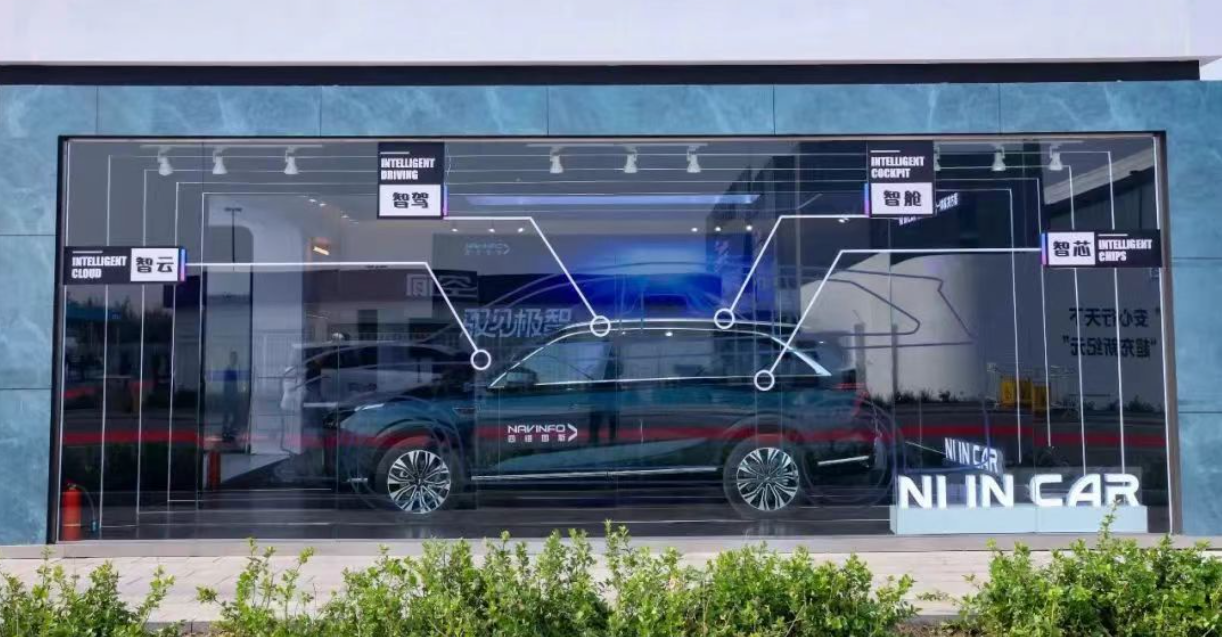
Image source: NavInfo
Meanwhile, Guide Infrared's forecast indicates a return to profitability, with projected net income of 700 million to 900 million yuan for 2025, compared to a loss of 447 million yuan a year earlier. During the period, deliveries of previously delayed model projects resumed, and a foreign trade contract for a complete equipment system was accepted and delivered overseas. Additionally, rapid demand release for infrared chip applications drove a sharp revenue increase, boosting profits in tandem with sales volume.
By growth rate, commercial vehicle makers are leading this profit surge. Foton Motor projects net profit of approximately 1.33 billion yuan for 2025—an increase of 1.25 billion yuan, or roughly 1,551% year-on-year. Its non-recurring net profit hit 820 million yuan, a turnaround that adds 1.03 billion yuan compared to the previous year.
Foton attributed its turnaround to the steady execution of strategies focused on internationalization, new energy, and intelligence. The company capitalized on structural market opportunities like the "trade-in" policy and accelerated localized overseas production. Total sales reached 650,000 units for the year, up 5.85%; new energy vehicle sales jumped 87.21% to 101,200 units; and overseas sales climbed 7.27% to 164,500 units. New product contributions continued to rise, while marketing innovations and aftermarket businesses emerged as fresh profit drivers.
This confirms a shift in the underlying logic of automotive competition: electrification is the entry ticket, intelligence is the great divide, and globalization is the ultimate test.
Parts suppliers are also riding the wave of industry optimism. Asia-Pacific (Yatai) released its 2025 forecast, projecting net profit attributable to shareholders of 468.45 million to 574.91 million yuan—a year-on-year increase of 120% to 170%. The company credited sustained growth in the auto sector—particularly the surge in new energy vehicles—for driving revenue gains as it pushed technological innovation and market expansion. Furthermore, improved lean management measures reduced costs and boosted efficiency, lifting overall competitiveness and driving steady performance growth.
Viewed from the vantage point of February 2026, the backdrop of this autonomous driving rally is no longer mere sentiment. With vast market potential aligning with profit inflection points among top players, the sector is completing a transformation from a "concept play" into a "growth track."
For investors, the real test lies ahead: distinguishing the beneficiaries of a cycle from the survivors of a revolution as L3 penetration rates leap.


