



"This year, some foreign Tier 1 suppliers are going to have a very hard time in China," an insider at one such firm frankly stated. "Their European headquarters haven't 'woken up' yet, but the European automakers operating here certainly have." That remark cuts to the heart of the survival dilemma facing many foreign parts manufacturers in the country.
As the industry races toward electrification and intelligence, competition has spread from automakers to every link in the supply chain. And for foreign Tier 1s, the pressure goes far beyond simple price wars.
Image Source: 699pic.com
Market Intensifies, Pressure Mounts on Foreign Tier 1s
Current profit margins across the auto industry are leaving suppliers deeply anxious.
A domestic automotive interior supplier told Gasgoo that the industry's overall profit margin hovers around 4.4%. Over the next three to five years, that figure will likely slide further, potentially settling at 3% or even 2%. "The price war in interiors is particularly brutal," the source added, noting that many peers have already seen margins dip below 3%.
Adding to the headache are the escalating demands for annual price reductions from automakers. Whether it's traditional OEMs, joint ventures, or new energy players, requests for cuts exceeding 10% are commonplace, squeezing already razor-thin margins even tighter.
The industry shakeout continues. According to the source, some interior suppliers have already exited the market in 2025 due to operational difficulties. Starting in 2026, the components sector is expected to see a wave of departures. "Eventually, top-tier suppliers will swallow up the market share, further consolidating their scale."
Image Source: 699pic.com
To survive, many are branching out. "It's not just interiors; peers across the supply chain are seeking new paths," the source said. "Some are entering the robotics sector, trying to use profits from other businesses to offset losses—or meager earnings—in the auto sector."
An executive at a joint-venture electronics firm offered a bleaker assessment based on market fundamentals. The company believes that China's passenger car market will face severe pressure in 2026, driven primarily by weak consumer confidence and increasingly picky end-users regarding vehicle character.
Brand consolidation is accelerating, with market share concentrating among top automakers. "The top five OEMs currently hold about 30% to 35% of the market, but that is expected to rise to 50% to 60% by 2030," the executive noted. This consolidation among automakers will inevitably force a similar shakeout across the supply chain.
For foreign enterprises, the pressure is even more intense. "To put it bluntly, in the Chinese market today, foreign brands—whether in cost or technology—find themselves slightly disadvantaged compared to local firms."
Amid the wave of "local substitution," technological breakthroughs by domestic brands have allowed local suppliers to break through rapidly, leveraging flexible service and cost advantages. Even foreign automakers are increasingly extending olive branches to them, directly challenging the traditional dominance of foreign Tier 1s.
"Now, when foreign automakers hold supplier conferences or tenders, the share of foreign Tier 1s is getting smaller and smaller," the insider from the foreign Tier 1 lamented.
The facts bear this out. Gasgoo has observed that more foreign brands are "eyeing" local suppliers. BMW, Mercedes-Benz, and Audi are increasingly emphasizing the strength of China's supply chain, and news of local suppliers winning orders from foreign brands has become commonplace.
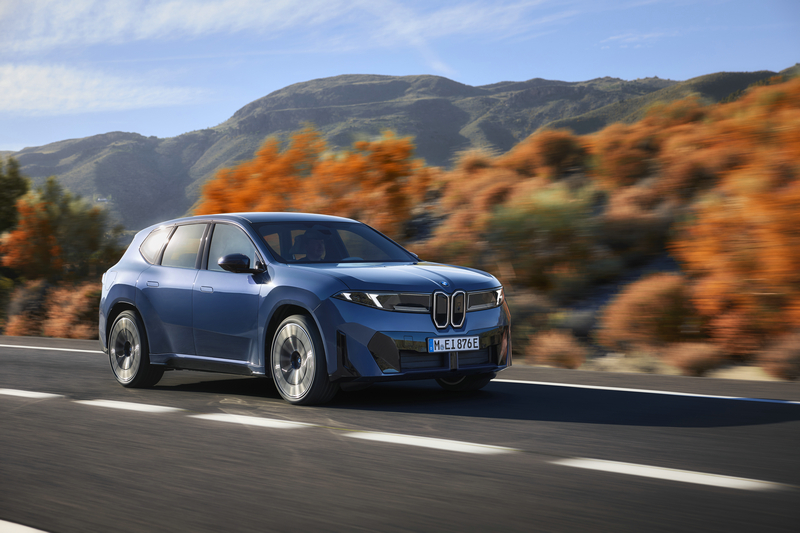
Image Source: BMW Group
Recently, for instance, Baolong Automotive's new IBS battery current sensor won a contract from a domestic joint venture, with a six-year lifecycle and mass production set for September 2026. In December 2025, RoboSense secured a front-loading production contract for a best-selling model from FAW Toyota, totaling nearly one million units over five years. That same November, MINIEYE won projects from a joint venture and a luxury brand under a globally renowned automaker, with a total lifecycle value of about 320 million yuan and deliveries starting in early 2026.
Breaking the Deadlock Requires More Than Price Cuts
When discussing the plight of foreign Tier 1s, many assume it's simply because they "can't beat local suppliers on price." That is not the case.
"Many overseas executives think it's a price issue, and plenty of Chinese employees have been led to believe the same," the Tier 1 insider said bluntly. "But the core problem is actually response speed."
He emphasized that while some foreign automakers in China have aligned their R&D pace with local firms, certain foreign component manufacturers here still rely on the slow, bureaucratic processes of their European or American headquarters. "This is precisely why many in the industry believe 2026 will be exceptionally difficult for foreign Tier 1s."
For automakers, supplier response speed is critical. "Development cycles are shifting to 12 to 18 months. If you can't keep up, you'll be dropped—even if your price is right—in favor of domestic suppliers," the source admitted. Chinese suppliers offer better prices and faster reaction times, so now, whether it's a Chinese or foreign firm, everyone is ramping up their use of Chinese suppliers.
To escape this trap, foreign Tier 1s must abandon the single-minded belief that "price wins." They need to shift their core competitiveness from cost control to overall capability improvement. Reaction speed and local autonomy are the two keys to breaking through.
Price competition is ultimately a low-level game. With industry margins sliding, blind price cuts risk triggering a vicious cycle of "shrinking profits, compromising quality." Reaction speed, however, determines whether a supplier can adapt to China's fast pace—from iterating tech solutions and responding to after-sales issues to navigating policy changes. Efficiency at every link can make or break a partnership.
Notably, many suppliers are actively pushing the industry from "competing on price" to "competing on value."
Qian Xiangzhong, Vice President of Customers at Valeo Group, recently stated clearly in an interview with Gasgoo and other media: "Valeo does not engage in price wars. We won't do loss-making business for short-term growth; the company has minimum margin requirements. Our price index remained basically stable in 2024 and 2023. In most regions globally, we haven't lowered prices—we've even raised them due to tariffs, production volumes, and other factors. We negotiate pricing together with our OEM clients and suppliers."
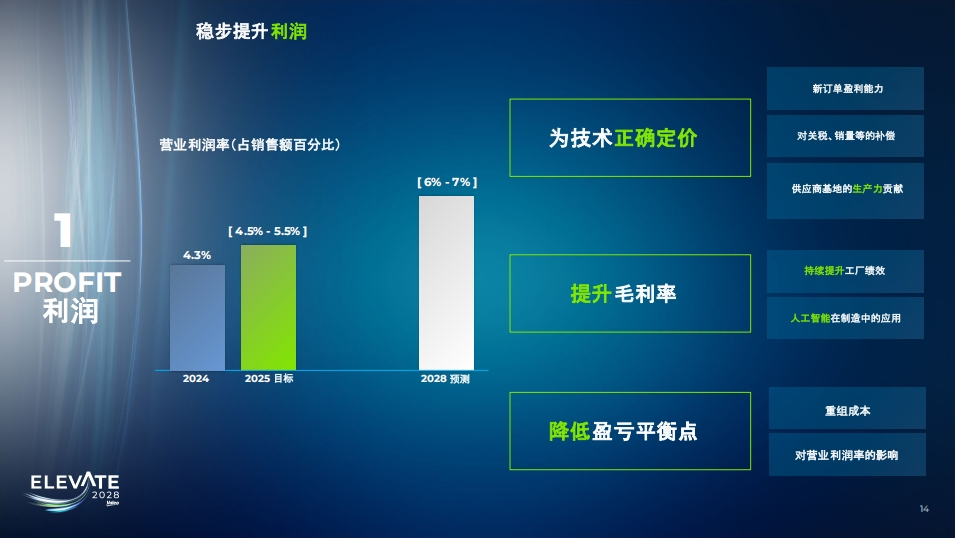
Image Source: Valeo
The executive at the joint-venture electronics firm also noted that his company has chosen a conservative path. "We're no longer blindly chasing sales revenue. We're focusing on healthy profit margins and cash flow. We want to survive, then return to our core products and technologies. We believe that as L3 autonomous driving rolls out, the requirements for product quality consistency and information security will rise. That is our long-term opportunity."
Local autonomy, meanwhile, is a crucial prerequisite for improving response speed.
Currently, some foreign Tier 1s' China teams lack core decision-making authority. Key links like product planning, technology selection, and pricing still depend on headquarters for approval, preventing them from quickly adjusting to the unique demands of the Chinese market.
In contrast, foreign Tier 1s that grant their China teams full autonomy not only integrate deeply into the local market and precisely capture OEM needs, but can also collaborate with local R&D forces to create customized products, maintaining strong competitiveness.
Therefore, foreign Tier 1s urgently need to push management reforms, empowering their China teams with more decision-making space so that localized teams become the core force in market competition.
Recently, after Gasgoo CEO and Editor-in-Chief Zhou Xiaoying published the article 《Foreign companies Are Losing Ground in China: Industrial-Age Playbooks Can’t Win in a Digital-Age Battle》, many senior executives at foreign firms in China liked and shared it with their overseas management. This underscores the urgent need within these companies to convince overseas leadership to delegate power.
Empowerment: Local Teams Take the Lead in Breaking Through
Not all foreign Tier 1 suppliers are stuck in a dilemma.
Some have already stood out amidst fierce competition, thanks to a deep understanding of localization and full authorization. Their common trait is granting their China teams immense autonomy in R&D, decision-making, and operations, allowing them to adjust strategy quickly based on market needs.
Zhang Yilin, CEO of Schaeffler China, previously told Gasgoo that headquarters grants the China region significant autonomy. "In China, our pursuit of new technology, efficiency, and cost is far higher than in other markets. So we established our own system here years ago, rapidly building capabilities to solve problems on our own. We actively use local resources and rely on ourselves."
Gasgoo noted that in late September 2025, a three-in-one electric drive assembly line, independently developed and manufactured by Schaeffler's smart equipment team in China, completed pre-debugging and was shipped in 10 batches to Europe. It is set for delivery to a top European automaker's production base in Hungary.
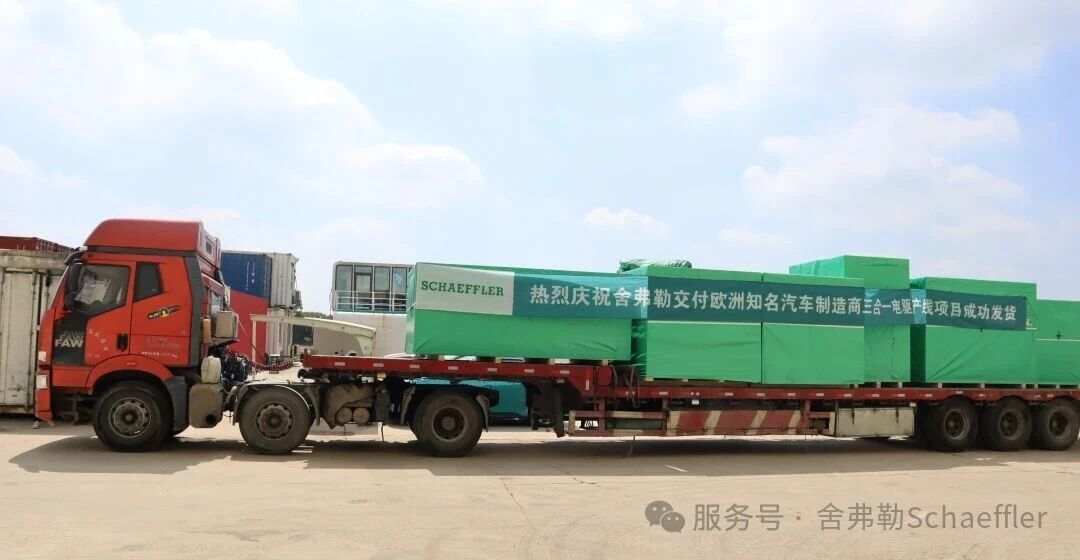
Image Source: Schaeffler
This achievement not only demonstrates the R&D and manufacturing prowess of the China team but also proves that empowered local teams can create core products with global competitiveness, achieving a leap from "serving China" to "empowering the globe."
Thanks to localized decision-making, Valeo's localization strategy has also yielded significant results. Gu Jianmin, Valeo China's CTO, previously revealed that the company's R&D cycle in China has been drastically shortened. "Take headlights: the fastest development of a headlamp module takes just 7 months, with a regular cycle of 8 to 10 months. In Europe, it takes 18 to 24 months."
In terms of product innovation, key products like Valeo's new smart heat pump and five-in-one power electronics module were either developed by the China team or launched in China first before being promoted globally. Technical platforms such as the Shenzhen factory's production line design and 7KW on-board charger/DC converter are also already in use globally.
Regarding customer structure, Chinese automakers' share of the OEM market reached 68% in the first half of 2025. Correspondingly, 50% of Valeo's current sales in China come from Chinese automakers, a figure set to rise to 65% in future mass production orders.
Such success stories are becoming more frequent. Behind them lies a profound awakening among foreign enterprises to the realities of the Chinese market, and the full unleashing of their local teams' value.
The uniqueness of China's auto market lies in the fact that the pace of technological iteration, shifts in consumer demand, and policy adjustments all lead the world. Local teams, on the front lines, are far more sensitive than overseas headquarters to new tech trends, latent customer needs, and changes in industry policy.
In market research, local teams can quickly pinpoint specific user demands for functions like smart cockpits and autonomous driving. In R&D, they can optimize solutions based on local characteristics like Chinese road conditions and driving habits. In customer service, they can respond instantly to sudden OEM needs and after-sales issues. This "zero-distance" advantage can only be fully leveraged with guaranteed autonomy.
Giving China teams more autonomy is essentially about letting professionals handle professional matters, achieving a precise match between corporate resources and local market needs. When local teams can allocate resources and make decisions quickly, foreign Tier 1s can combine their technological accumulation and global supply chain advantages with China's flexibility and innovation. This allows them to build a unique core barrier in the high-end competition of "value," securing a foothold amid the wave of global supply chain restructuring and achieving sustainable development.
Conclusion
The plight of foreign Tier 1s is the inevitable result of overlapping forces: global supply chain restructuring, China's rapid transformation, and fierce industry competition. Price wars are just the trigger; the root causes are insufficient response speed and a lack of local autonomy. Sliding industry margins and accelerating brand consolidation only make this survival battle harder.
For foreign Tier 1s, 2026 is both a challenge and a turning point. Only by breaking traditional management shackles and acknowledging the uniqueness and innovation of the Chinese market—either by delegating power and keeping pace with local R&D, or by anchoring technological barriers and adhering to healthy operational baselines—can they shift from "passively chasing" to "actively breaking through."
Meanwhile, local suppliers, while enjoying the dividends of substitution, must also navigate margin pressure and cross-sector competition. Ultimately, whether foreign or local, only those who adapt to the market and cultivate value will secure a solid position in the reconfigured supply chain landscape.


