Gasgoo Munich-The rugged off-road market is shifting from aduopoly to a landscape dominated by one superpower with several strong contenders.
The "superpower" is Fangchengbao, whose sales exceeded 30,000 units in May. By contrast, Tank's sales slipped to just 17,000 during the same period. Fangchengbao actually overtook Tank in full-year sales back in 2025, though the margin was razor-thin then. Now, the gap has widened significantly.
Beyond the leaders, the second tier is reshuffling. The Beijing duo are holding their ground: Beijing Off-road is securing the mainstream entry market with models like the BJ40, available in internal combustion and extended-range versions, while the 212 brand targets hardcore enthusiasts with classic retro styling and pure mechanical off-road pedigree. Meanwhile, the JETOUR Traveler continues to gain volume in lower-tier markets with accessible pricing, and the Haval Raptor is courting younger buyers with lightweight plug-in hybrid off-road positioning.
Even more noteworthy is that the segment's high premiums are still drawing in new players. In June, STELATO, under Huawei's Harmony lntelligent Mobility Alliance, announced plans to launch the STELATO G9, a luxury rugged SUV priced around 500,000 yuan.
Clearly, the era when Tank enjoyed the category's dividends alone is over. A deep competition centered on new-energy rugged off-roaders is now fully underway.
Market Shift
Before the Tank brand arrived, off-roading was a niche pursuit in China. High fuel consumption, poor comfort, and steep prices formed a triple barrier that kept the vast majority of families away.
At the time, imports ruled the roost. Models like the Prado and Wrangler monopolized the market above 250,000 yuan, while icons like the G-Class stood unchallenged in the million-yuan segment. Domestic brands offered almost no mature off-road products with body-on-frame construction. With few options available to consumers, sales in the off-road segment languished at low levels for years.

Image Source: Tank Brand
The arrival of the Tank 300 filled a void for domestic professional rugged off-roaders around 200,000 yuan, transforming "boxy" vehicles from toys for enthusiasts into cars for ordinary families. Early demand outstripped supply to such an extent that some regions saw markups on delivery—a rarity in the history of domestic brands.
Wang Meng, a player in the off-road modification sector, noted that the Tank 300 gained high recognition in off-road circles for its value and performance. Some owners even sold their imported off-roaders to switch to it.
In 2024, Tank’s share of the domestic rugged off-road market approached 50%, underpinning the bulk of sales for domestic brands, with the Tank 300 making the largest contribution. Bolstered by Tank and others, the rugged off-road segment experienced three consecutive years of rapid expansion, climbing from roughly 500,000 units in 2023 to 750,000 in 2024, and reaching 900,000 units last year.
But the market is shifting, and Tank’s first-mover advantage is eroding. First, its electrification pivot has been sluggish. The rollout of Hi4-T plug-in hybrid versions across the Tank lineup lagged behind competitors, causing the brand to miss the early window as users switched from internal combustion engines to new energy.
By the time Fangchengbao built a differentiating edge in both city commuting efficiency and off-road power output with its DMO hybrid architecture and electric four-wheel drive, Tank’s plug-in hybrids arrived late—and the technological gap had already widened.
Second, its iteration on intelligence has been relatively conservative. Faced with new trends like high-level driver assistance and electric four-wheel drive, Tank failed to establish a differentiated competitive edge.
Crucially, the sector has transitioned from expansion to a zero-sum game, with growth narrowing. From 2023 to 2025, the year-on-year growth rate for rugged off-road SUVs fell from 50% to 19%. Industry monitoring indicates that market sentiment has cooled significantly heading into 2026.

During the high-growth phase, the pie kept getting bigger, allowing both early movers and latecomers to grab a slice. But once growth slows, gains by new players usually come at the expense of incumbents' market share. Tank’s loss of momentum is happening right at this inflection point where the market shifted from "baking the pie" to "slicing it."
Competitors are seizing this opportunity to flood the market, accelerating the diversion of existing users. For instance, Fangchengbao’s retail sales hit 235,000 units in 2025, triple the previous year. Compared to the overall market expansion during that period, Fangchengbao alone generated more growth than the entire segment added.
The competitive landscape is clarifying by price segment. In the 150,000 to 200,000 yuan entry market, the Beijing BJ40 has held its ground with dual internal combustion and extended-range versions, while the all-new 212 targets niche circles with a retro hardcore focus. The JETOUR Zongheng series, meanwhile, is leveraging affordability to capture growth in lower-tier markets.
The 200,000 to 400,000 yuan mid-range market is the primary battlefield where Tank and Fangchengbao clash, and competition is fiercest here. Under the weight of increasing rivals and slowing overall growth, Tank’s sales have taken a hit. Tank sold 230,000 units in 2025, roughly flat year-over-year, allowing Fangchengbao to overtake it.

Tank Brand Sales Since 2022 (Q2 2026 includes forecast data)
Pressure intensified further in 2026, with Tank’s cumulative retail sales for January through May reaching 77,000 units—a 6.3% year-on-year decline that dropped its market share to 30%. Monthly sales of its flagship Tank 300 fell back to just over 7,000 units, while the Tank 400 and Tank 500 also trended lower.
Tank’s loss of share is not due to a single product issue, but rather the combined result of lagging electrification and intelligence transitions, a crowded track, and the rise of formidable competitors.
Viewed broadly, the rise of domestic brands represented by Tank has accelerated the marginalization of imported internal combustion vehicles. In the premium market above 300,000 yuan, models like the Tank 700, Yangwang U8, and M-Hero series continue to grow. Foreign off-roaders, meanwhile, are struggling to adapt to China's upgrade cycle due to slow iteration, weak intelligence features, and high energy consumption.
Powertrain Restructuring: Hybrids on the Rise
Beyond the change in leadership, another key variable driving this sector's evolution is a massive shift in powertrain choices.
Five years ago, the domestic rugged off-road market was still the domain of traditional internal combustion vehicles—an era where "mechanics reigned supreme." Rigid frames, four-wheel drive, and three differential locks were the gold standard; high fuel consumption and slow infotainment systems weren't considered flaws. Thirteen or fourteen liters per 100 kilometers in the city was standard, and 15 or 16 liters for large-displacement models was perfectly normal. Owners back then simply didn't buy these cars to save gas.
Today, however, consumer demand is diversifying. The China Passenger Car Association (CPCA) notes that off-roading, camping, and road trips have become typical use cases, driving a year-over-year increase in the share of off-road SUVs and creating a new growth engine for the market.
For the vast majority of users, daily driving involves city commuting and short trips, with extreme off-roading being a low-frequency need. As usage requirements shift, so do powertrain preferences. Users no longer want a pure off-road machine; they want an all-rounder that serves as a daily commuter during the week and an off-roader on weekends.

Consequently, domestic rugged off-roaders that balance both roles—especially hybrids—are surging in popularity. Data from Bitauto Research shows that the penetration rate of new-energy off-roaders exceeded 40% in 2025; by the first quarter of 2026, that figure had risen to around 50%.
This means that for every two rugged off-roaders sold, one is a new-energy vehicle. Back in 2023, that ratio was less than 30%.
The shift toward new energy is even more pronounced among top-selling models. Industrial data from Gasgoo shows that from January to May 2026, cumulative sales of the Tank 500 New Energy reached 12,000 units—nearly 3,000 higher than its internal combustion counterpart. Sales of the Tank 400 New Energy were nearly triple that of its gasoline version during the same period. Meanwhile, the extended-range version of the Beijing BJ40 surpassed the sales of its internal combustion version within just a year of launch.
Consumers have already cast their votes with their wallets. In the rugged off-road category, new energy has shifted from an early-adopter novelty to the mainstream—a transformation that has outpaced many industry insiders' expectations. Yet this shift is not a victory for a single technological path, but rather the result of plug-in hybrids, extended-range electrics, and pure electrics each finding their own niche and leveraging their respective strengths.
Plug-in hybrids currently represent the largest volume route. Offering both gasoline and electric power without range anxiety, they satisfy the need for low-energy city commuting while supporting long-distance travel. Both Tank’s Hi4-T and Fangchengbao’s DMO follow this path. The advantage of plug-ins lies in their independence from charging infrastructure: drive like an EV if you have a home charger, or like a hybrid if you don’t, offering strong scenario adaptability.
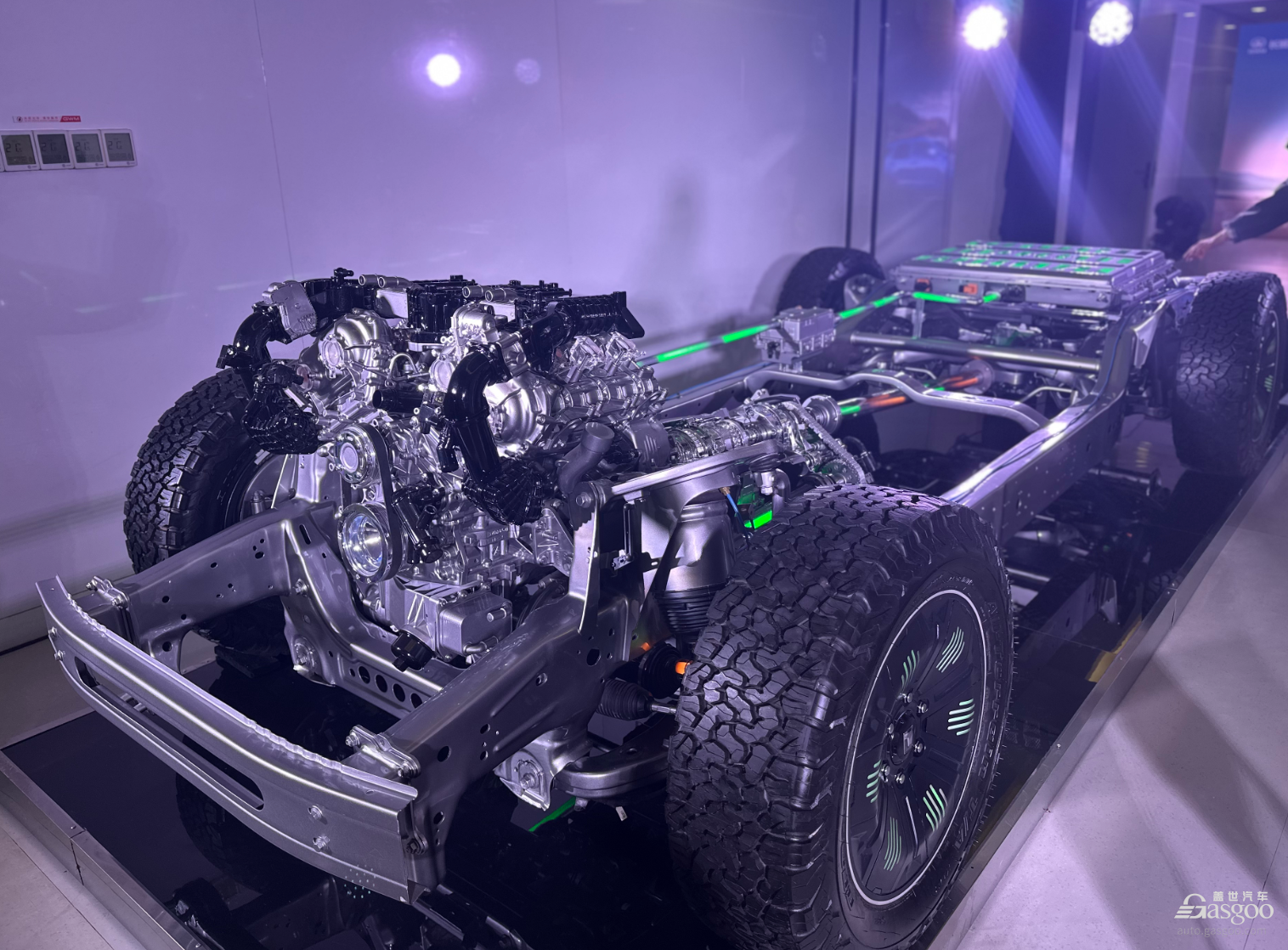
Extended-range electrics primarily target the 150,000 to 250,000 yuan entry market, offering a lower purchase threshold. The extended-range version of the BJ40 boasts a combined range of over 1,300 kilometers on a full tank and battery.
Pure electric rugged off-roaders, constrained by charging infrastructure and range loss in low temperatures, have currently landed only in small batches on select high-end models and remain a distance from mass adoption.
In the short term, plug-in hybrids and extended-range electrics will remain the mainstream solutions. The reason is simple: they directly address the user's core dual demands—off-road capability and daily economy. These two requirements were contradictory in the internal combustion era: off-roaders couldn't be fuel-efficient, and fuel-efficient cars couldn't handle off-roading. But plug-ins and extended-range vehicles have resolved this conflict through a division of labor: electric drive for commuting, fuel power for off-roading.
The economics tell the story best. Plug-in hybrids can run on pure electricity for daily commutes, consuming about 20 kWh per 100 kilometers. With home charging, that costs less than 0.2 yuan per kilometer. Assuming 20,000 kilometers of driving annually, energy costs come to just 3,000 or 4,000 yuan. That alone saves 15,000 to 16,000 yuan compared to a gasoline off-roader. For a household with an annual income of 200,000 to 300,000 yuan, that difference of over 10,000 yuan significantly influences the purchasing decision.
Beyond economy, electric propulsion brings performance upgrades. The response speed and burst power of electric four-wheel drive outperform traditional mechanical systems, with the instant peak torque of electric motors offering clear advantages in climbing and escaping tricky terrain. Traditional mechanical four-wheel drive requires engine revs to build and torque to multiply, creating a delay; electric four-wheel drive delivers maximum torque the moment the pedal is pressed, reacting faster on muddy roads or steep inclines.

On the intelligence front, domestic new-energy rugged off-roaders generally come standard with high-level driver assistance, large-screen cockpits, and vehicle-to-load (V2L) power output. Imported gasoline off-roaders, by contrast, often feature outdated configurations and lagging experiences. For instance, V2L is incredibly practical for camping, leading many users to choose plug-in hybrids specifically for this feature. Wang Meng also noted that compared to imported off-roaders, "China-branded" off-roaders are "better suited for the Chinese market."
This comprehensive superiority in product strength is directly reflected in market results. Data from the China Association of Automobile Manufacturers (CAAM) shows that domestic brands' share of the rugged off-road market rose to 70% in 2025. The Toyota Prado was the only imported model to crack the top ten in sales that year, but its annual retail volume was just over 20,000 units—a massive contraction from its peak.
The sluggish electrification transition of foreign brands has caused their presence in this segment to continue fading.
High Margins Attract New Players
Once a trend is established, it attracts new pursuers. Despite the shift to a zero-sum game, the rugged off-road segment retains strong appeal for new entrants due to high product differentiation, strong user stickiness, and high per-vehicle profit margins.
In the mainstream family SUV and sedan markets, the price war has squeezed profits razor-thin. A family SUV priced between 100,000 and 150,000 yuan might generate a gross profit of only a few thousand yuan—or less. Rugged off-roaders are different: strong product differentiation and high user loyalty make them less susceptible to extreme price wars, resulting in per-vehicle margins significantly higher than ordinary models. For automakers, this segment offers strategic value by contributing both profit and brand prestige.
Financial data from Great Wall Motor shows that in 2024, its gross margin reached 19.5%, with a net profit of 13,000 yuan per vehicle—significantly higher than the average for most domestic brands. As a high-margin core pillar, the Tank brand lifted Great Wall’s overall average selling price and gross margin, helping the company hold the line on profitability during the price war.
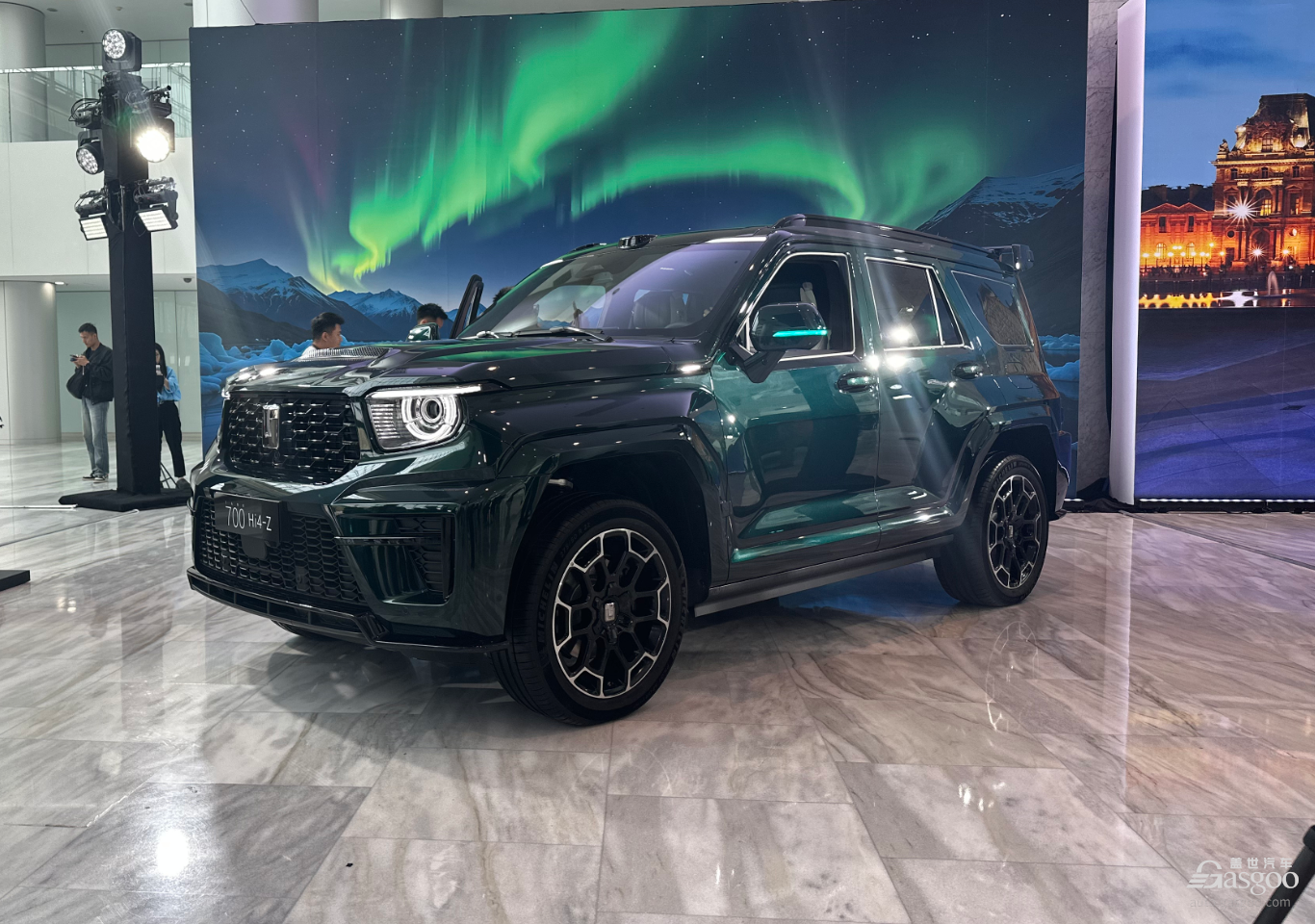
Even as Tank's sales growth slowed in 2025, Great Wall Motor’s gross margin remained around 18%, once again demonstrating the long-term value of the rugged off-road segment to the industry.
For this very reason, new players continue to enter despite the white-hot competition. The most closely watched heavyweight launch this year is the STELATO G9, jointly developed by Huawei and BAIC. Positioned as a luxury tech-focused rugged SUV around the 500,000 yuan mark, it is scheduled to launch in the third quarter and will be Harmony lntelligent Mobility Alliance’s first boxy off-road product.
This positioning targets an underserved market: users with both deep pockets and off-road needs. Richard Yu, Huawei's executive director and chairman of the Consumer BG, stated that traditional rugged off-roaders have solid mechanical credentials but lag in intelligence and comfort. High-end urban luxury SUVs focus on refinement but lack professional off-road hardware. The STELATO G9’s strategy is "more rugged than luxury, more luxurious than rugged," attempting to bridge the gap between both segments.
Reports indicate the STELATO G9 will feature an 800V high-voltage platform, Huawei’s Xuling intelligent chassis, full-domain electric four-wheel drive, and standard Qiankun ADS 5.0 high-level driver assistance across all models, along with a debut of Huawei’s new self-developed electric motor.
Upon launch, the vehicle will enter the high-end 500,000 yuan segment, going head-to-head with competitors like the Tank 700 and the high-spec Leopard 8. Buyers in this price bracket demand higher standards in brand and experience, and STELATO’s Huawei backing could prove a decisive advantage.

Image Source: Harmony lntelligent Mobility Alliance
Beyond the STELATO G9, other automakers are accelerating their off-road layouts. Chery’s JETOUR continues to refine its product matrix between 150,000 and 300,000 yuan, leveraging affordability to broaden its user base. Dongfeng’s M-Hero has launched the new M817, lowering the price point to expand sales volume. Geely, Changan, and others have also completed their technical reserves and are waiting for the right moment to debut new products.
Based on product planning, the rugged off-road market is set for another wave of intensive new product launches from the second half of 2026 through 2027, covering multiple price segments from 150,000 to 600,000 yuan.
A flood of new products will siphon off existing users across different price ranges. The mid-range market will be the first to feel the impact: as more boxy plug-in hybrid SUVs appear in the 150,000 to 300,000 yuan range, budget-conscious consumers may abandon early models like the Tank 300 and Leopard 5 in favor of "light off-road" products that offer better value.
While these products make compromises on extreme off-road capability, they offer advantages in city commuting economy and daily driving comfort—precisely hitting the "heavy commuting, light off-road" usage scenario of most users.
With battles for market share on one side and expansion by new players on the other, competition in the rugged off-road segment is entering a phase of deep, multi-layered rivalry.
Summary:
Looking back at sales volume in this sector over the past three years—500,000, 750,000, and 890,000 units—the absolute scale is still growing, but the pace is slowing. As the market shifts from "baking the pie" to "slicing it," Tank’s stumble, Fangchengbao’s rise, and Huawei’s entry are not isolated incidents but inevitable products of the same trend. Once incremental growth peaks, every inch of market gain comes at the expense of a competitor's share.
In the long run, the rough-and-tumble competition relying solely on boxy styling and stacked mechanical hardware is no longer viable. The future core battle will be a comprehensive contest involving tri-electric technologies, intelligent chassis, high-level autonomous driving, full-scenario experiences, and brand operations. Amidst this battle for market share, only automakers that pinpoint their differentiation and balance off-road performance with daily practicality can hold their ground in a crowded field and avoid the quagmire of homogenization.