



Gasgoo Munich- As the new-energy vehicle industry pivots from "scale expansion" to "profitability first," the survival logic for startups is undergoing a fundamental shift. A retreat in capital and fierce market competition have made a model reliant solely on vehicle sales untenable. Profitability has now become the sole metric for measuring sustainable development.
In the fourth quarter of 2025, XPENG Chairman He Xiaopeng made a high-profile prediction: the probability of the company turning a profit that quarter was "five nines" (99.999%). That should have been a cause for celebration. Yet, looking at the full-year financials, the shadow of losses still hangs over this automaker—once hailed as part of the "Top 2 NEV NEV Startups" alongside NIO and Li Auto.
More concerning is the struggle to break into the high-end market, while low-end models deliver volume without profit. Coupled with soaring R&D spending, XPENG stands at a critical crossroads: relying on vehicle sales alone seems unlikely to lead to profitability.
Against this backdrop, a distinct path to transformation is emerging. From deep technical cooperation with Volkswagen to announcing that its second-generation VLA (Vision-Language-Action) model will debut with the German giant, XPENG is attempting to shed its label as a mere "automaker" and follow Huawei's lead by becoming a supplier of intelligent technology.
This business model pivot—from selling cars to selling software—paired with an aggressive expansion target of "1-million-unit overseas sales and 70% of profits by 2030," constitutes the core of XPENG's strategy for survival and breakthrough.
Yet, can emulating Huawei truly lead to profitability? Are overseas markets a blue ocean for profits, or simply another money-burning pit?
From Selling Cars to Selling Technology
The drive behind XPENG's strategic shift stems first from a structural dilemma in the domestic market. 2025 sales data reveal a dangerous imbalance: the MONA M03, with its budget-friendly pricing, accounts for nearly half of the brand's sales, serving as the absolute pillar for "guaranteeing volume."
However, low-end models cannot generate high profits, nor do they have the power to lift brand premiums. Meanwhile, the P7 and G9, tasked with "pushing high," have performed poorly. By the end of 2025, P7 sales had plunged 70% from their September peak, while G9 monthly sales have long hovered around the 1,000-unit mark.
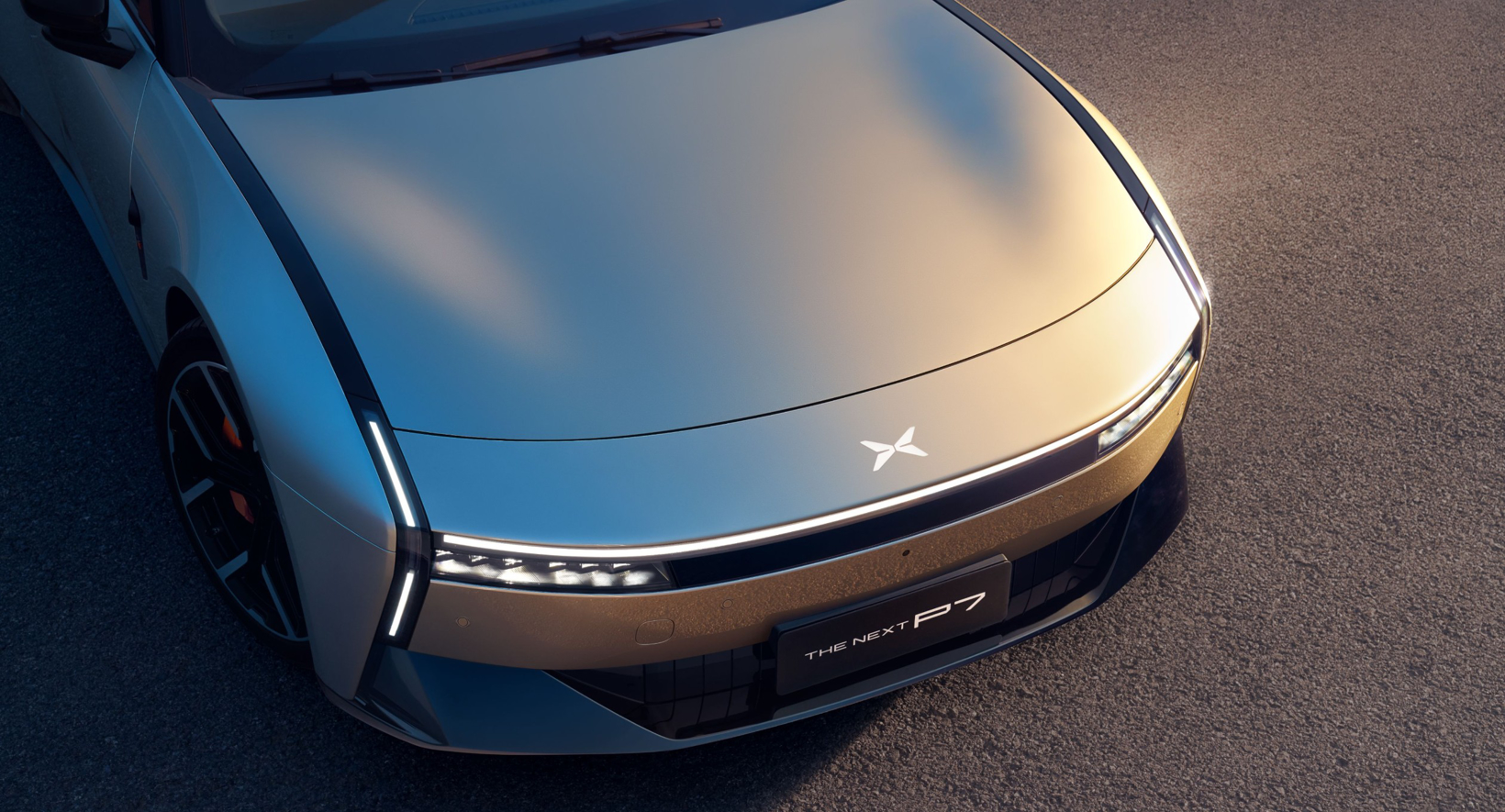
Image source: XPENG
This pattern of "low-end volume, high-end pressure" has trapped XPENG in the awkward position of having sales without profit. The only model performing decently is the MPV X9. While monthly sales climbed to 4,000 units after its refresh, the overall MPV market volume is limited, making it difficult to become a core pillar for long-term profitability.
The pressure on financial data further highlights the urgency of a profitability breakthrough. In late 2025, He Xiaopeng optimistically stated a 99.999% probability of a Q4 profit. But financial reports show a net loss of 1.523 billion yuan for the first three quarters of 2025. Turning a full-year profit remains an urgent target to conquer.
As an automaker with intelligent technology as its core competitive edge, XPENG's R&D spending remains high. In the third quarter of 2025 alone, it invested 2.43 billion yuan—a 48.7% year-on-year increase. The low gross margins of traditional vehicle sales struggle to cover such sustained R&D costs, leaving cash flow pressure a constant presence.
Even more alarming is the sharp decline in sales entering 2026. In February alone, sales dropped to just 15,000 units, falling below the 20,000-unit mark. This indicates that relying solely on vehicle sales, XPENG will find it difficult to achieve profitability.
Patience in the capital market has long been exhausted. In the past, startups could rely on continuous funding to sustain expansion, but now profitability has shifted from an option to a survival imperative. Facing high R&D costs—especially the continued spending on the second-generation VLA model and the in-house Turing chip—XPENG urgently needs new revenue streams to share the burden. The meager profits from car sales in a domestic market shrouded in the smoke of a price war can no longer support its long-term ambitions.
At this moment, the successful business model of Harmony lntelligent Mobility Alliance undoubtedly presents an enticing template. Data shows that Huawei's Qiankun Intelligent Driving has captured 27.8% of the urban navigation-assisted driving market, and exceeds 50% in the premium vehicle segment above 350,000 yuan.
More importantly, through technology licensing and software subscriptions, Huawei's Intelligent Automotive Solutions BU has achieved annual profitability. This positive feedback loop of "technology output—data feedback—model optimization" proves that in an era of thinning hardware margins, algorithms, data, and computing power can be packaged as high-margin commodities.
XPENG's early mover advantage provides a critical breakthrough for emulating Huawei. In February 2026, He Xiaopeng announced that Volkswagen will be the launch customer for XPENG's second-generation VLA model.
The significance of this signal goes far beyond the cooperation itself. It means XPENG's intelligent driving technology has entered the Tier 1 supplier procurement system of a leading global automaker, with its technical capabilities backed by real money from an international giant. Technology output has moved from concept to reality.
Commenting on this transformation, Cao Guangping, a partner at Chefu Consulting, likened XPENG's approach of "selling both products and technology" to a new form of "flying on two wings." He also noted that cooperating with foreign automakers represents a "new joint venture for new forces." Expanding market share in both domestic and international arenas is, in his view, the "new forces seeking multi-point strong support."
Mimicking Huawei?
XPENG's confidence in mimicking Huawei rests on its core bargaining chip: the technological leadership of its second-generation VLA model.
Traditional autonomous driving systems typically follow a three-stage logic of "visual input—language translation—action output." The intermediate "translation" stage not only consumes computing power but is also prone to information loss.
XPENG's second-generation VLA, however, achieves "end-to-end" direct output from visual signals to action commands. By eliminating redundant steps, the system reacts more agilely—much like a human driver's instinct—delivering astonishing performance in complex scenarios such as narrow roads.
Supporting this system is XPENG's in-house Turing AI chip and a massive data foundation. The maximum effective computing power reaches 2,250 TOPS, boosting model inference efficiency by 12 times.
Meanwhile, the model's parameter scale is 10 times that of mainstream solutions, and training data approaches 100 million driving video clips. This covers a vast number of long-tail scenarios globally, equivalent to 65,000 years of human driving experience.
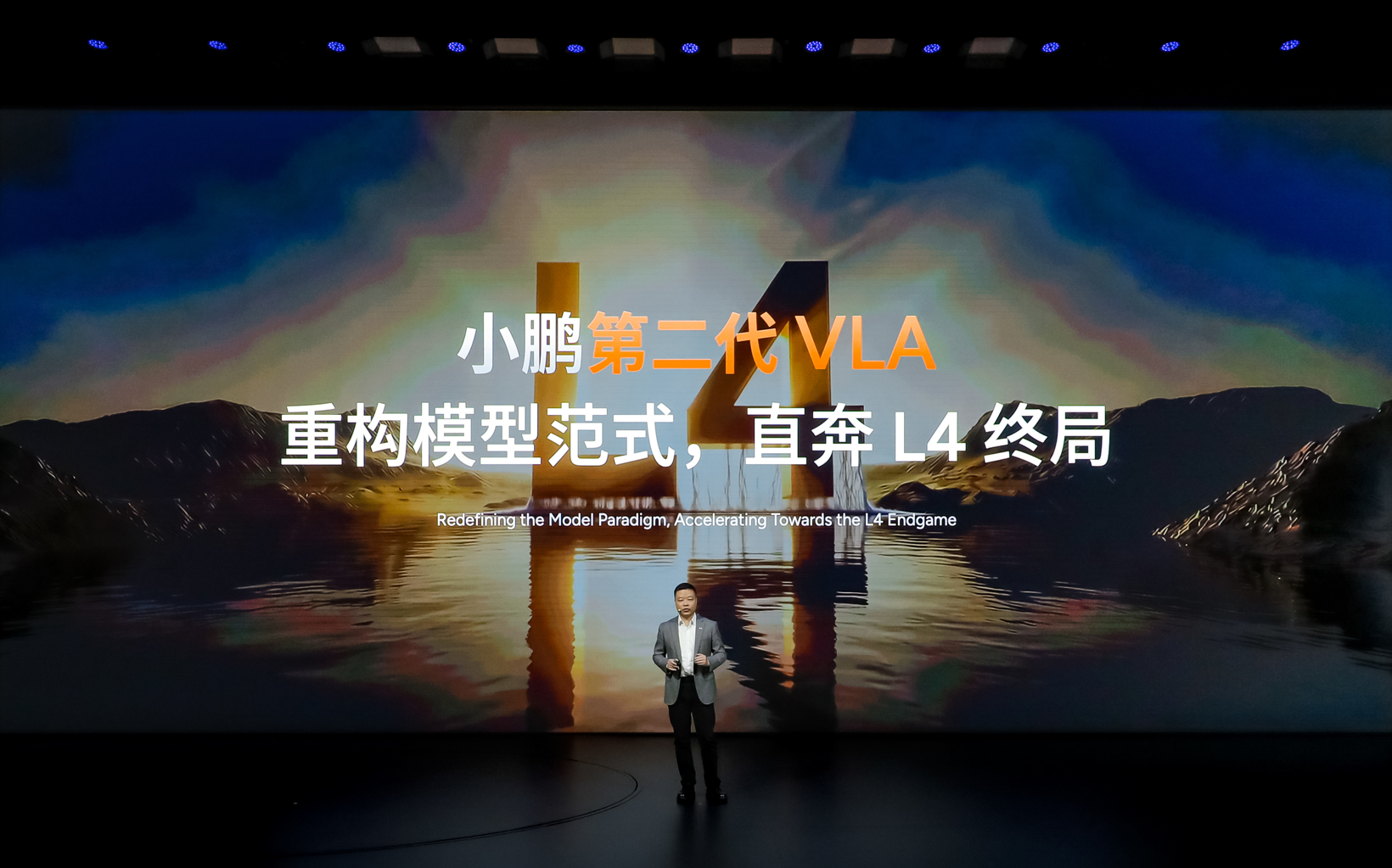
Image source: XPENG
More importantly, this VLA architecture is not just the brain of the car. It can also be adapted to other physical terminals like humanoid robots and flying cars. It is the core of XPENG's layout in the field of "embodied AI," opening up broader possibilities for technology monetization.
In terms of advantages, XPENG holds several strong cards. First is the immeasurable "lighthouse customer" effect. The Volkswagen order carries a demonstrative significance far surpassing any marketing slogan. It adds leverage to XPENG's negotiations with other overseas automakers, proving its technology has the capability to be exported as a "standard product."
Second is the attractive high-margin business model. Compared to capital-intensive, low-margin vehicle manufacturing, technology licensing and software subscriptions feature extremely low marginal costs. Once scaled, this will fundamentally improve the financial structure, creating a positive feedback loop of "stronger technology—more revenue—more R&D."
Finally, there is the potential for ecosystem synergy. When new businesses like robots and flying cars also rely on the VLA architecture, XPENG hopes to transform from an automaker into a unified physical intelligence platform supplier, securing long-term revenue through multi-domain software subscriptions.
However, the path to "becoming Huawei" is also strewn with reefs that cannot be ignored. The primary risk is high customer concentration. Currently, the halo of XPENG's technology revenue comes almost entirely from Volkswagen. Any change in the cooperation for any reason would deal a devastating blow to XPENG's revenue and confidence in its transformation.
Second is the unavoidable conflict of being both athlete and referee. Like Huawei, XPENG also manufactures cars. When the P7 and G9 compete directly with potential customers' models, how can other automakers be assured in adopting its driving solution? How can it balance internal resources between its own brand and external clients? This is a trust dilemma testing business wisdom.
Finally, there is the intense technological arms race. Giants like Huawei and Tesla are iterating rapidly in the intelligent driving field, and the window for technological leadership is fleeting. XPENG must maintain a sustained, significant generational lead to make customers willing to pay for "software," rather than viewing it merely as a replaceable hardware solution.
Fortunately, XPENG has already begun laying the groundwork to resolve these dilemmas. In 2025, it initiated contact with several overseas automakers regarding intelligent driving technology, planning to gradually reduce its dependence on Volkswagen.
At the same time, 2026 will see multiple substantial OTA upgrades for the second-generation VLA. By accumulating scenario data through frontier business deployments, it will feed back into model optimization, providing a more solid foundation for technology monetization.
Aggressive Overseas Sales Goals vs. Reality
If technology monetization is the core "qualitative change" of XPENG's transformation, then overseas expansion is the key "quantitative change" seeking to support profits.
He Xiaopeng has set extremely aggressive goals in an internal letter: double overseas sales in 2026, and achieve 1-million-unit annual overseas sales by 2030, contributing over 70% of profits.
The logic behind this is clear: the domestic market is trapped in a price war and specification battle, making it hard for high-end models to break through. In mature overseas markets, however, intelligent electric vehicles command stronger premiums, and the commercial value of Chinese intelligent driving technology is more easily recognized—the Volkswagen order is the best proof. Overseas, XPENG hopes to convert its technological advantages directly into profits.
To this end, XPENG has formulated an eight-character tactic: "Sharp Knife Breakthrough, Red Carpet Retention." For the "Sharp Knife Breakthrough," XPENG has designated Israel, Germany, Norway, Thailand, and France as five benchmark overseas markets, focusing on core demand areas for intelligent EVs. On the product front, it will launch six global star models covering the 100,000 to 200,000 yuan price range, landing in 25 European countries by 2026.
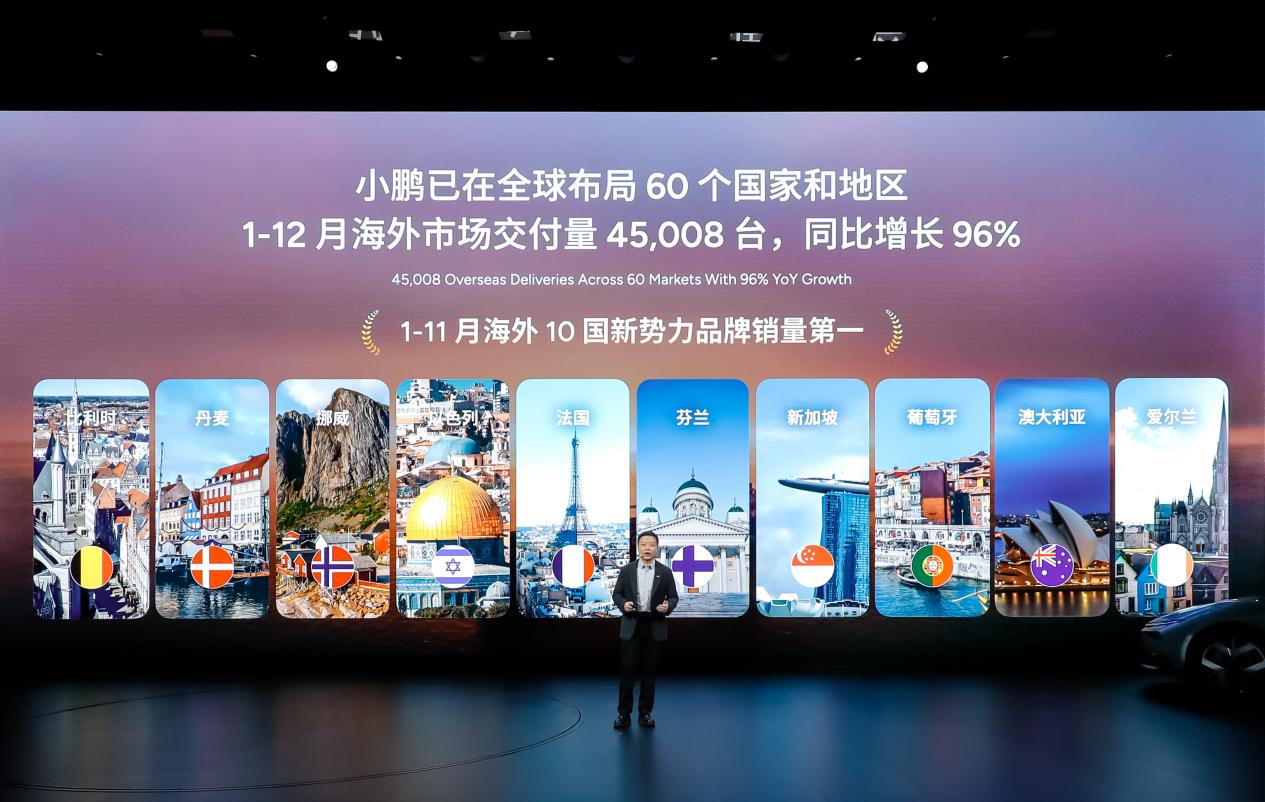
Image source: XPENG
XPENG's overseas sales target for 2026 is to double to 100,000 units, accounting for about one-fifth of the full-year goal of 550,000 to 600,000 units, achieving a dual output of "products + technology."
For the "Red Carpet Retention," XPENG plans to double its overseas network points to 680 by 2026, focusing on improving delivery times, service response speeds, and energy replenishment standards. It will also activate its Munich R&D center to optimize its intelligent driving system for European road conditions, building a full-chain overseas service system.
The overseas market offers three potential opportunities for XPENG. First, the global intelligent driving market is a blue ocean. Many traditional automakers face the challenge of intelligent transformation, where in-house development is long and costly. XPENG's second-generation VLA model is already in mass production, providing a "fast track" for their transformation, creating strong demand for technology exports.
Second, the mass production of frontier businesses brings a differential advantage. In 2026, XPENG plans to become the first tech company to achieve mass production of three frontier AI businesses: robots, flying cars, and Robotaxis. Overseas markets have high acceptance of frontier technology, and this layout will enhance the brand's technological attributes.
However, the path to overseas gold is fraught with challenges. First is the disadvantage of being a latecomer amidst strong enemies. Overseas, XPENG must not only face the deep brand moats and channel advantages of local giants like Tesla and Volkswagen, but also compete with Chinese peers like BYD and Geely, which have already established a preliminary global layout and possess stronger cost advantages. In brand awareness, channel construction, and compliance certification, XPENG is a chaser.
Second, this is a protracted war requiring continuous "burning of money." Achieving million-level overseas sales requires investing astronomical amounts in channel expansion, localized marketing, adaptive R&D, and even charging network construction.
This creates a cruel paradox for XPENG, which is still struggling for profitability and is in dire need of cash: developing overseas markets is to make money, but developing them requires burning large amounts of money first. Distant water cannot quench immediate thirst—it may even drag down an already strained cash flow.
Regarding XPENG's aggressive overseas expansion and current survival status, Cao Guangping also offered an analysis. He stated that adopting such a flexible strategy is not wrong within the limits of financial strength. Whether it is too aggressive depends on the support of core technologies, including "intelligence, battery breakthroughs, and hybrid moats."
Conclusion
XPENG's emulation of Huawei—shifting from "selling cars" to "selling technology," supplemented by aggressive overseas expansion—is an inevitable path to breakout amidst domestic profitability woes. It is also a multi-dimensional gamble about survival and the future.
XPENG's transformation is essentially a reshaping of its own genes. The success or failure of this transformation depends not only on whether technologies like its second-generation VLA can maintain a lead, but also tests its wisdom in handling complex business relationships and balancing the interests of multiple parties, as well as its organizational endurance and capital resilience in "burning money" to break through globally.
2026 is destined to be a critical year for XPENG's strategic execution, with the mass production of the VLA, the landing of robots and flying cars, and the acceleration of overseas expansion. Whether it can secure an entry ticket to the next era—perhaps the answer lies not far ahead.


