According to the Gasgoo Automotive Research Institute, China's ADAS supply chain underwent a rapid shake-up in Jan–Nov 2025. From lidar and forward cameras to automated parking and high-precision positioning, domestic suppliers have gained significant ground — not just breaking through in single categories, but establishing homegrown leadership across multiple key links. The rankings point to fast-maturing technology and capacity on the local supply side, and signal that "hardware self-sufficiency" in intelligent driving assistance is entering a full-on acceleration phase.
Air suspension supplier installation ranking
Tuopu Group, Jan–Nov 2025 installations of 402,910 units, market share 37.2%.
Konghui Technology, Jan–Nov 2025 installations of 322,600 units, market share 29.8%.
Baolong Technology, Jan–Nov 2025 installations of 237,493 units, market share 21.9%.
WEIBAK, Jan–Nov 2025 installations of 86,992 units, market share 8.0%.
Continental, Jan–Nov 2025 installations of 27,980 units, market share 2.6%.
Others, Jan–Nov 2025 installations of 4,033 units, market share 0.4%.
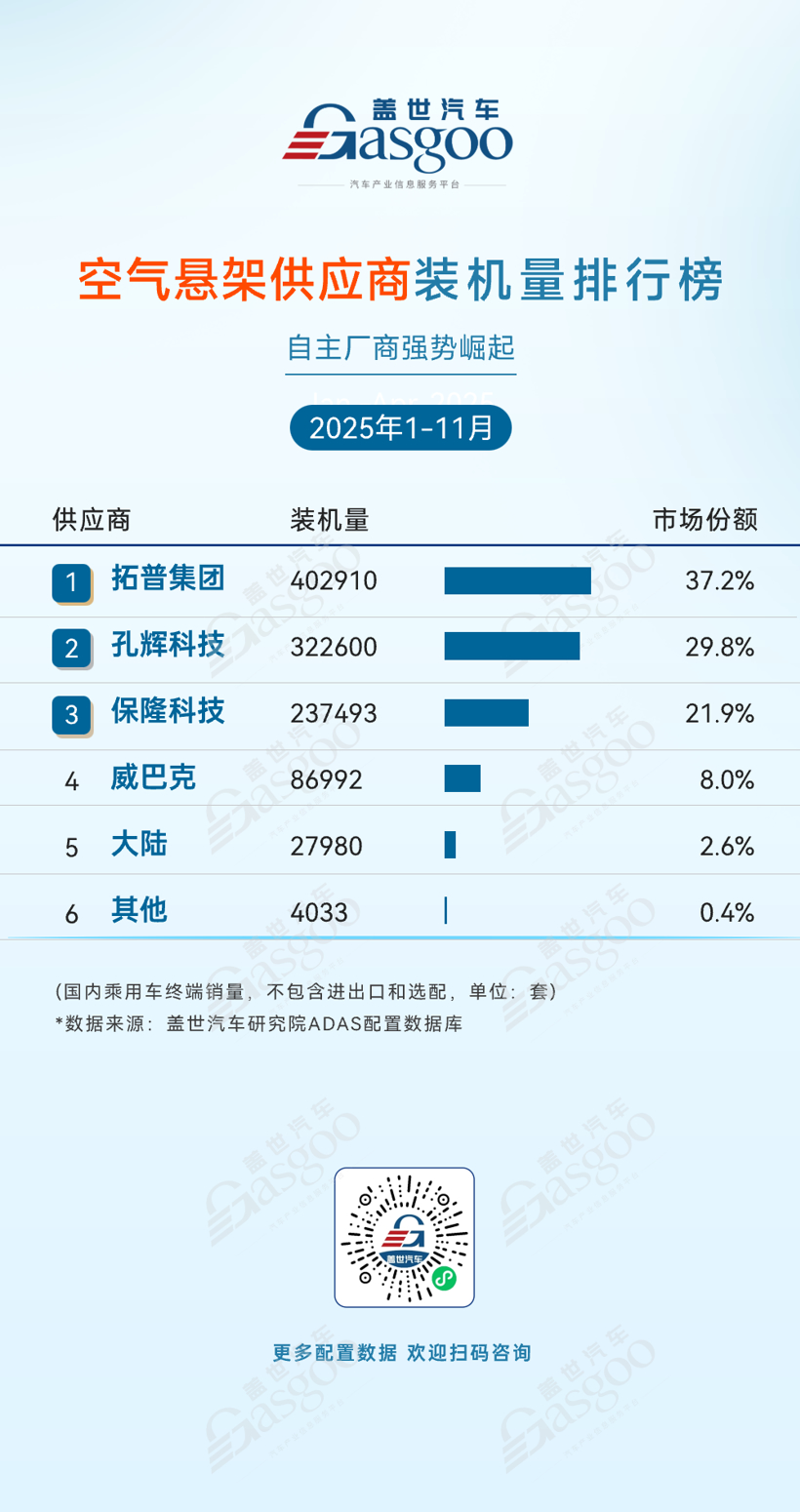
In China's air suspension supplier landscape for Jan–Nov 2025, domestic players are firmly in charge. Tuopu Group led with 402,910 installations and a 37.2% share — edging up from 339,343 units and a 36.4% share in Jan–Oct. Konghui Technology and Baolong Technology followed, and together the top three grabbed nearly 90% of the market, squeezing foreign suppliers such as WEIBAK and Continental, whose combined share was just 10.6%. The data underscores both the technological progress and manufacturing ramp of local suppliers, and a rising level of acceptance for domestic supply chains among China's passenger-car makers.
Lidar supplier installation ranking
Huawei Technologies, Jan–Nov 2025 installations of 1,156,799 units, market share 41.6%.
Hesai Technology, Jan–Nov 2025 installations of 943,979 units, market share 34.0%.
RoboSense, Jan–Nov 2025 installations of 489,447 units, market share 17.6%.
Seyond, Jan–Nov 2025 installations of 188,737 units, market share 6.8%.
Others, Jan–Nov 2025 installations of 247 units, market share 0.01%.
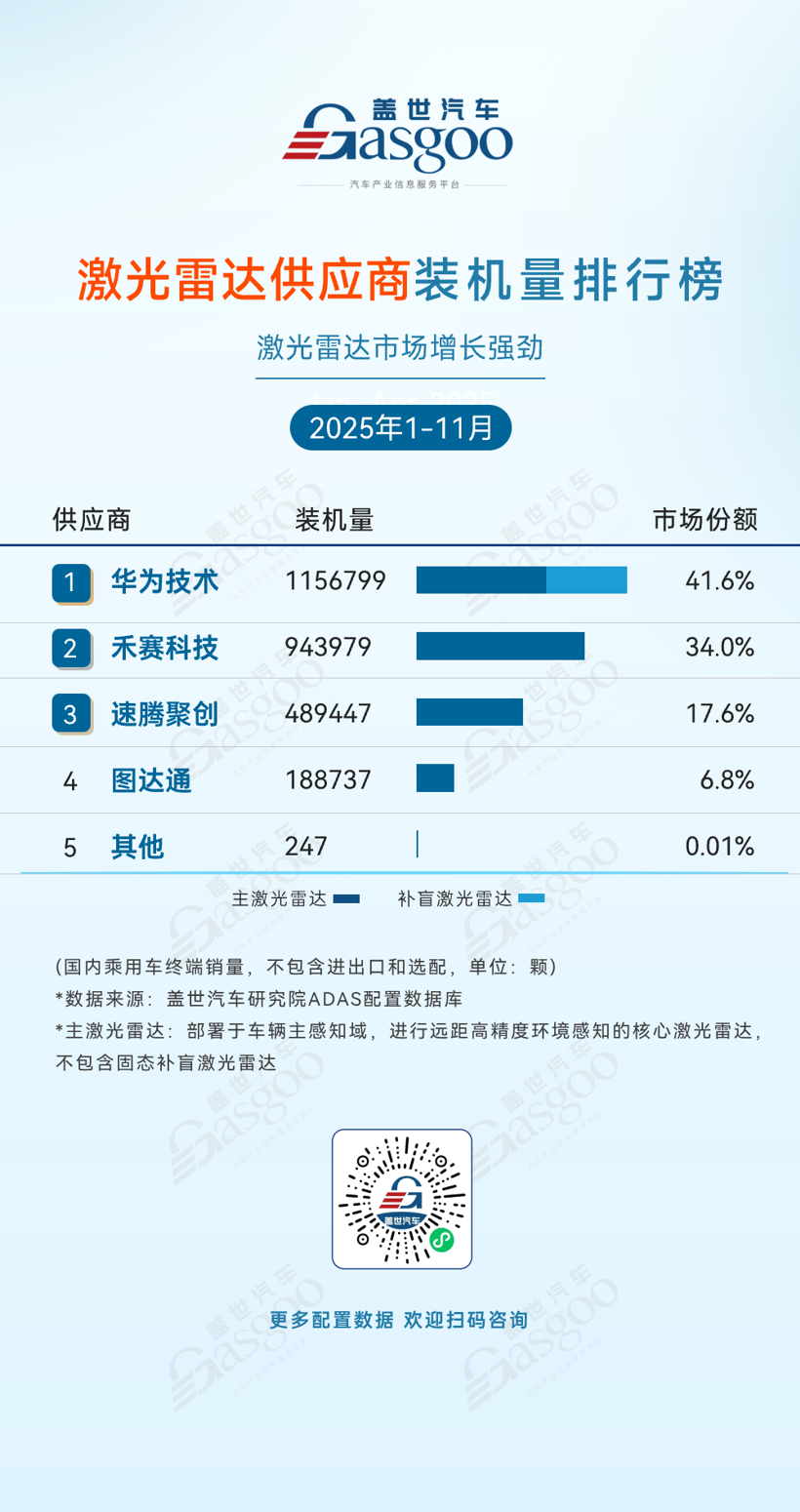
The lidar leaderboard for Jan–Nov 2025 shows a concentrated top tier dominated by domestic suppliers. Huawei Technologies ranked first with 1,156,799 installations and a 41.6% share, supplying both primary and blind-spot-filling lidars. Hesai and RoboSense followed, and the three together controlled over 90% of the market — a sign of their commanding lead. As a core sensing component for intelligent driving, lidar installations continue to rise quickly with the penetration of higher-level assisted driving. Meanwhile, China's supply chain has largely achieved technological and production self-sufficiency in lidar.
On-road ADAS supplier installation ranking
Bosch, Jan–Nov 2025 installations of 2,132,858 units, market share 15.3%.
BYD, Jan–Nov 2025 installations of 1,837,012 units, market share 13.2%.
Denso, Jan–Nov 2025 installations of 1,146,515 units, market share 8.2%.
ZF, Jan–Nov 2025 installations of 969,030 units, market share 6.9%.
Freetech, Jan–Nov 2025 installations of 826,894 units, market share 5.9%.
Huawei, Jan–Nov 2025 installations of 724,125 units, market share 5.2%.
Veoneer, Jan–Nov 2025 installations of 541,577 units, market share 3.9%.
Valeo, Jan–Nov 2025 installations of 536,658 units, market share 3.8%.
Tesla, Jan–Nov 2025 installations of 533,900 units, market share 3.8%.
Aptiv, Jan–Nov 2025 installations of 482,952 units, market share 3.5%.
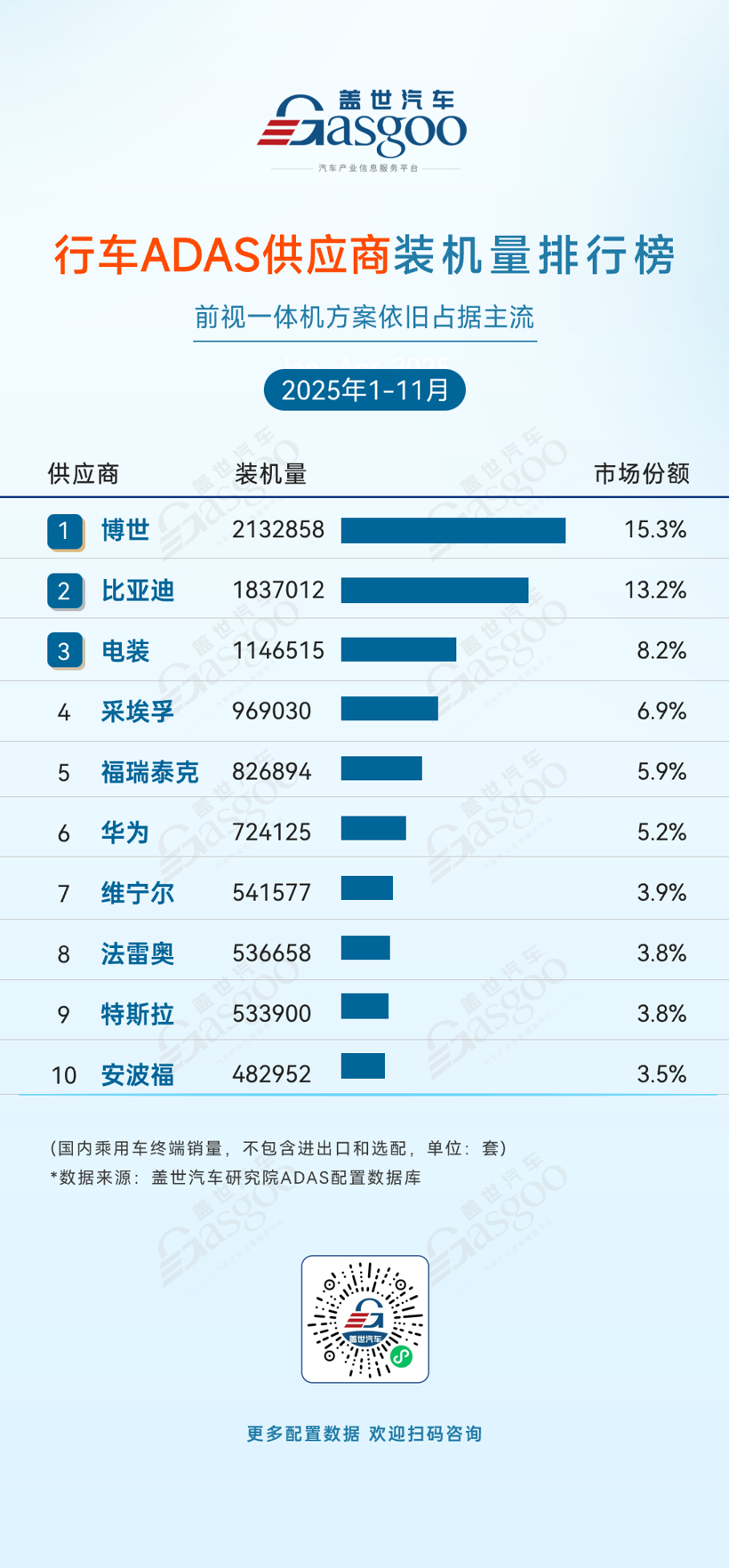
In on-road ADAS for Jan–Nov 2025, the pattern is clear: established foreign leaders hold steady while domestic challengers rise. Bosch led with 2,132,858 installations and a 15.3% share, down slightly from 15.9% in Jan–Oct. BYD climbed to second with a 13.2% share, the frontrunner among domestic suppliers. Foreign Tier-1s (Bosch, Denso, ZF) still occupy the top tier, reflecting their technical depth and supply-chain strength. Even so, the entry of Freetech and Huawei — alongside BYD’s high placement — shows that local suppliers, particularly with front-view one-box solutions, are scaling fast and winning broader acceptance.
Forward camera supplier installation ranking
Bosch, Jan–Nov 2025 installations of 1,893,118 units, market share 13.6%.
Sunny SmartLead, Jan–Nov 2025 installations of 1,278,355 units, market share 9.2%.
BYD Semiconductor, Jan–Nov 2025 installations of 1,180,924 units, market share 8.5%.
Denso, Jan–Nov 2025 installations of 1,149,668 units, market share 8.2%.
ZF, Jan–Nov 2025 installations of 961,792 units, market share 6.9%.
Baolong Technology, Jan–Nov 2025 installations of 907,583 units, market share 6.5%.
Freetech, Jan–Nov 2025 installations of 782,955 units, market share 5.6%.
Veoneer, Jan–Nov 2025 installations of 575,535 units, market share 4.1%.
OFILM, Jan–Nov 2025 installations of 553,235 units, market share 4.0%.
Tesla, Jan–Nov 2025 installations of 533,900 units, market share 3.8%.
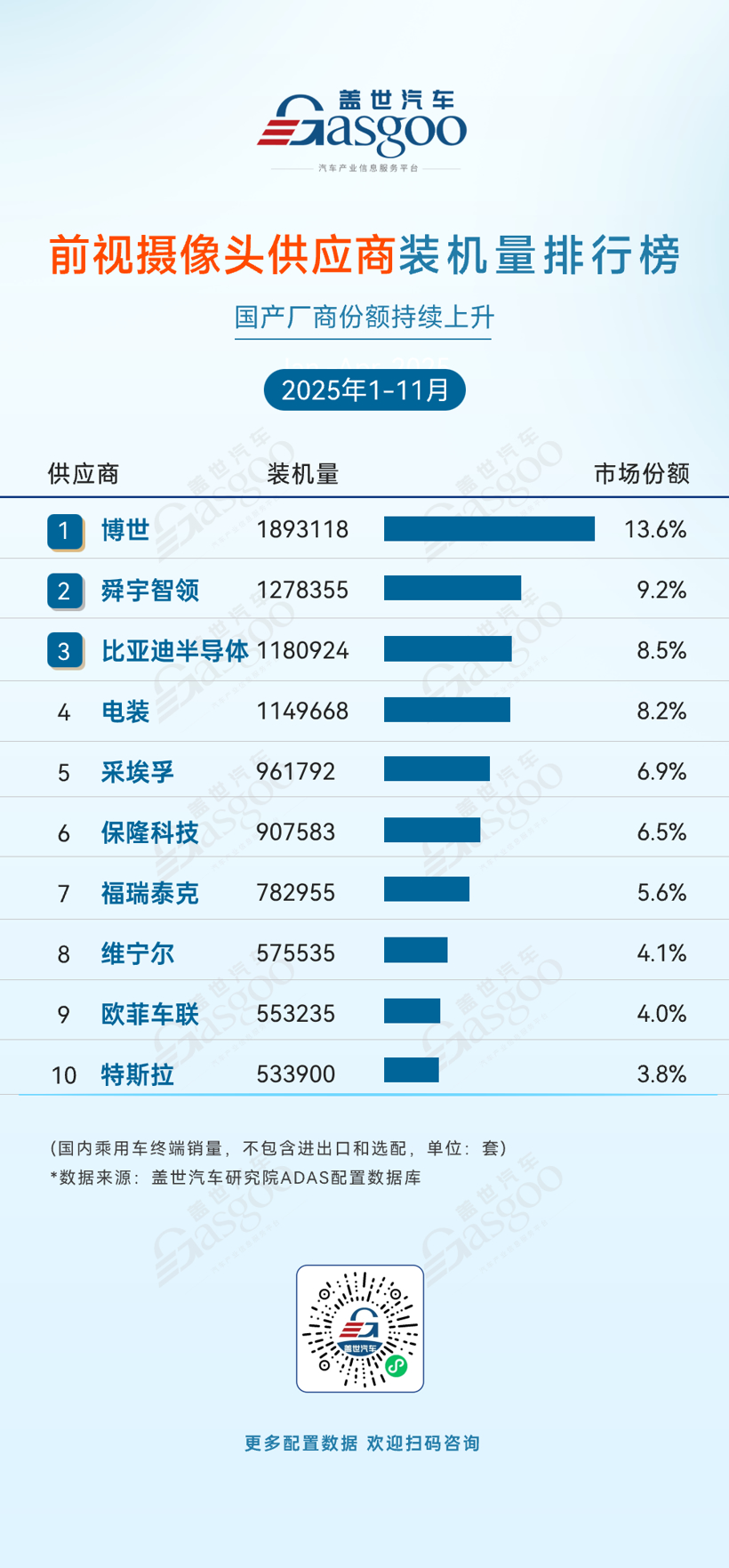
In forward cameras, Bosch stayed on top in Jan–Nov 2025 with 1,893,118 installations and a 13.6% share, slipping from 14.0% in Jan–Oct. Sunny SmartLead and BYD Semiconductor, both domestic, jumped into the top three with 9.2% and 8.5% shares, respectively — local players together now command nearly 20% of the market. While foreign suppliers (Bosch, Denso, ZF) still lead the pack, the presence of Baolong Technology and OFILM underscores improving competitiveness of Chinese forward cameras in maturity and cost control. With local share continuing to rise, supply-chain localization for this core ADAS hardware is accelerating, setting the stage for domestic firms to further squeeze foreign share.
Automated parking (APA) supplier installation ranking
BYD, Jan–Nov 2025 installations of 1,680,310 units, market share 21.7%.
Bosch, Jan–Nov 2025 installations of 991,807 units, market share 12.8%.
Huawei, Jan–Nov 2025 installations of 724,125 units, market share 9.2%.
Valeo, Jan–Nov 2025 installations of 685,410 units, market share 8.8%.
Leapmotor, Jan–Nov 2025 installations of 376,029 units, market share 4.8%.
Li Auto, Jan–Nov 2025 installations of 365,034 units, market share 4.8%.
Momenta, Jan–Nov 2025 installations of 360,956 units, market share 4.6%.
Xiaomi, Jan–Nov 2025 installations of 360,552 units, market share 4.5%.
XPENG, Jan–Nov 2025 installations of 348,395 units, market share 4.4%.
Tung Thih Electronic, Jan–Nov 2025 installations of 288,169 units, market share 3.8%
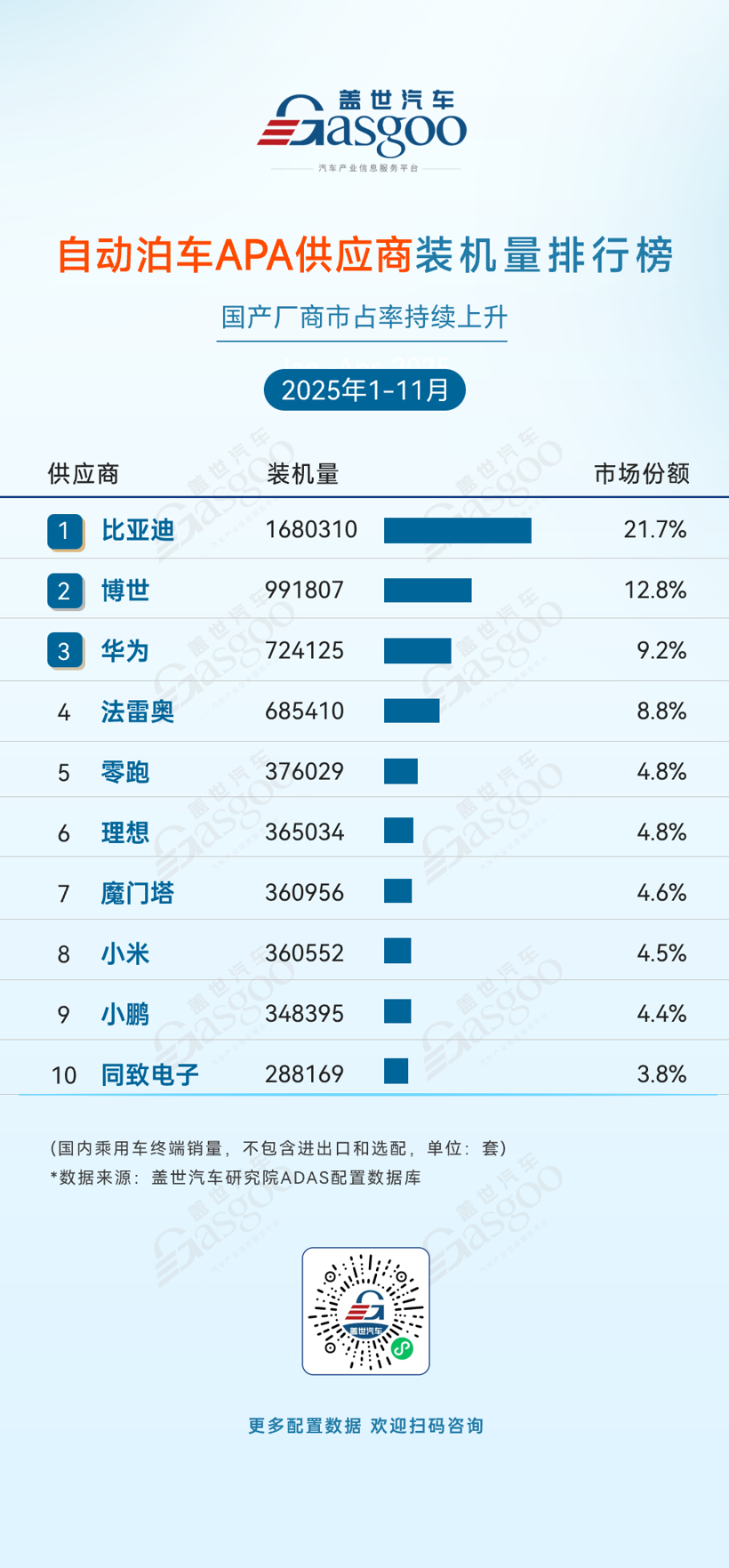
China's APA landscape in Jan–Nov 2025 shows domestic players out in front, powered by both in-house and third-party solutions. BYD led with 1,680,310 installations and a 21.7% share, reflecting the deep integration of its APA solution across its lineup and the scale that brings at the delivery end. Third-party suppliers such as Huawei and Momenta are competing head-to-head with automakers’ in-house systems from Leapmotor and Li Auto, collectively squeezing foreign firms like Bosch and Valeo — whose combined share is under 25%. The striking feature here is the diversity of domestic APA approaches: automaker-developed systems (BYD, XPENG) and universal third-party solutions (Huawei, Momenta) are both scaling, suggesting local APA tech is no longer reliant on a single path and now competes on adaptability and user experience.
HD map supplier installation ranking
AutoNavi, Jan–Nov 2025 installations of 1,175,989 units, market share 52.1%.
Tencent, Jan–Nov 2025 installations of 295,667 units, market share 13.1%.
Langge Technology, Jan–Nov 2025 installations of 281,557 units, market share 12.5%.
NavInfo, Jan–Nov 2025 installations of 133,358 units, market share 5.9%.
Others, Jan–Nov 2025 installations of 370,708 units, market share 16.4%.
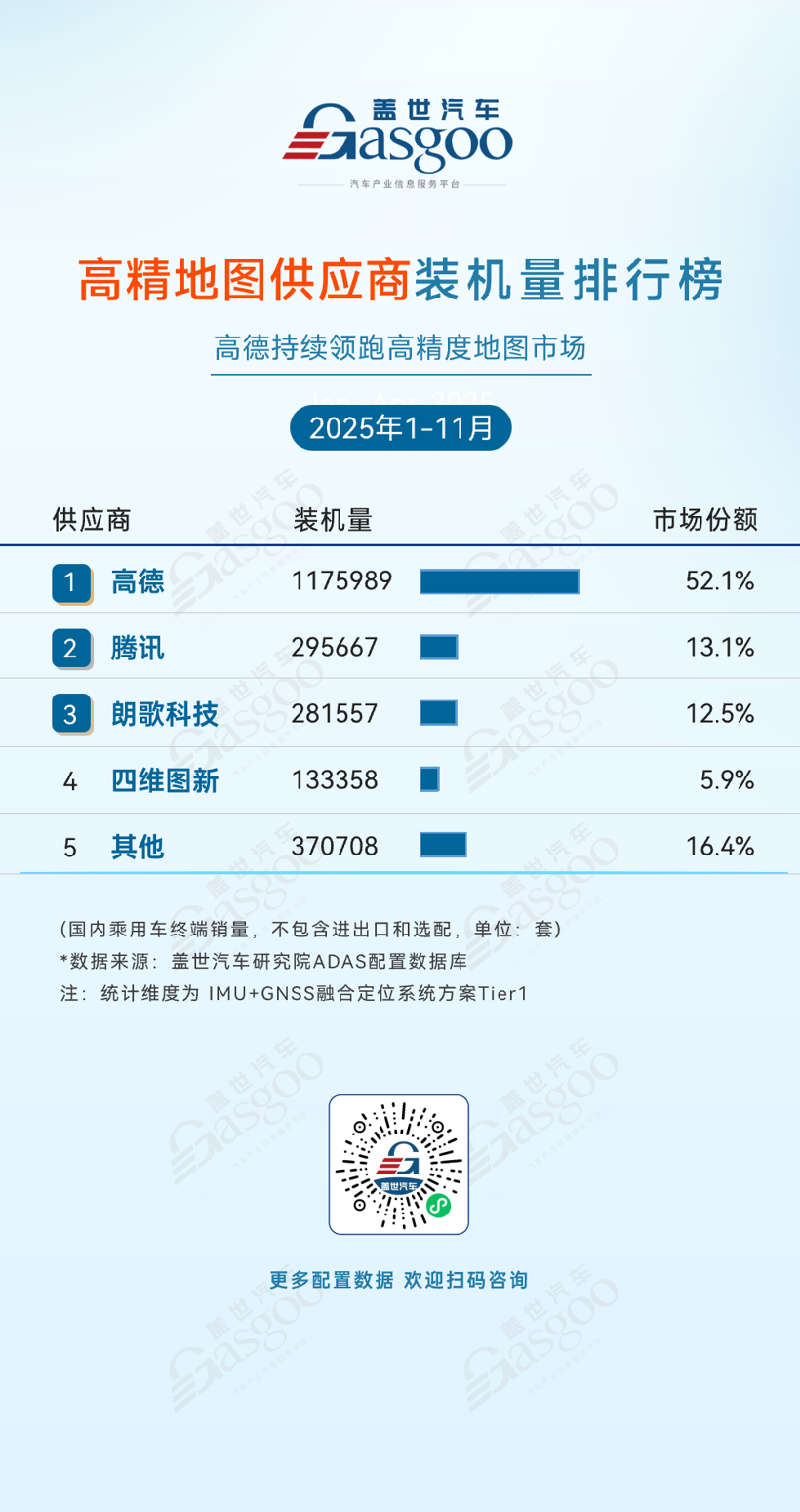
In HD maps, AutoNavi dominated Jan–Nov 2025 with 1,175,989 installations and a 52.1% share — more than half the market. Tencent and Langge Technology followed, each below 15%, leaving a "one dominant, many strong" pattern. AutoNavi’s advantage stems from deep technical know-how and broad data coverage, with solutions that slot into most mainstream automakers’ systems at scale. Even so, the rise of newer players such as Langge suggests the field isn’t locked; differentiation may emerge in specific use cases. AutoNavi’s lead is unlikely to be challenged soon, while competition will shift toward sub-metrics like map update cadence and how well functions mesh with assisted driving.
High-precision positioning supplier installation ranking
ASENSING, Jan–Nov 2025 installations of 2,389,308 units, market share 47.9%.
Huawei, Jan–Nov 2025 installations of 723,598 units, market share 14.5%.
Huace Navigation, Jan–Nov 2025 installations of 360,897 units, market share 7.2%.
XPENG, Jan–Nov 2025 installations of 248,539 units, market share 5.0%.
MCT, Jan–Nov 2025 installations of 160,082 units, market share 3.2%.
Others, Jan–Nov 2025 installations of 1,101,117 units, market share 22.1%.
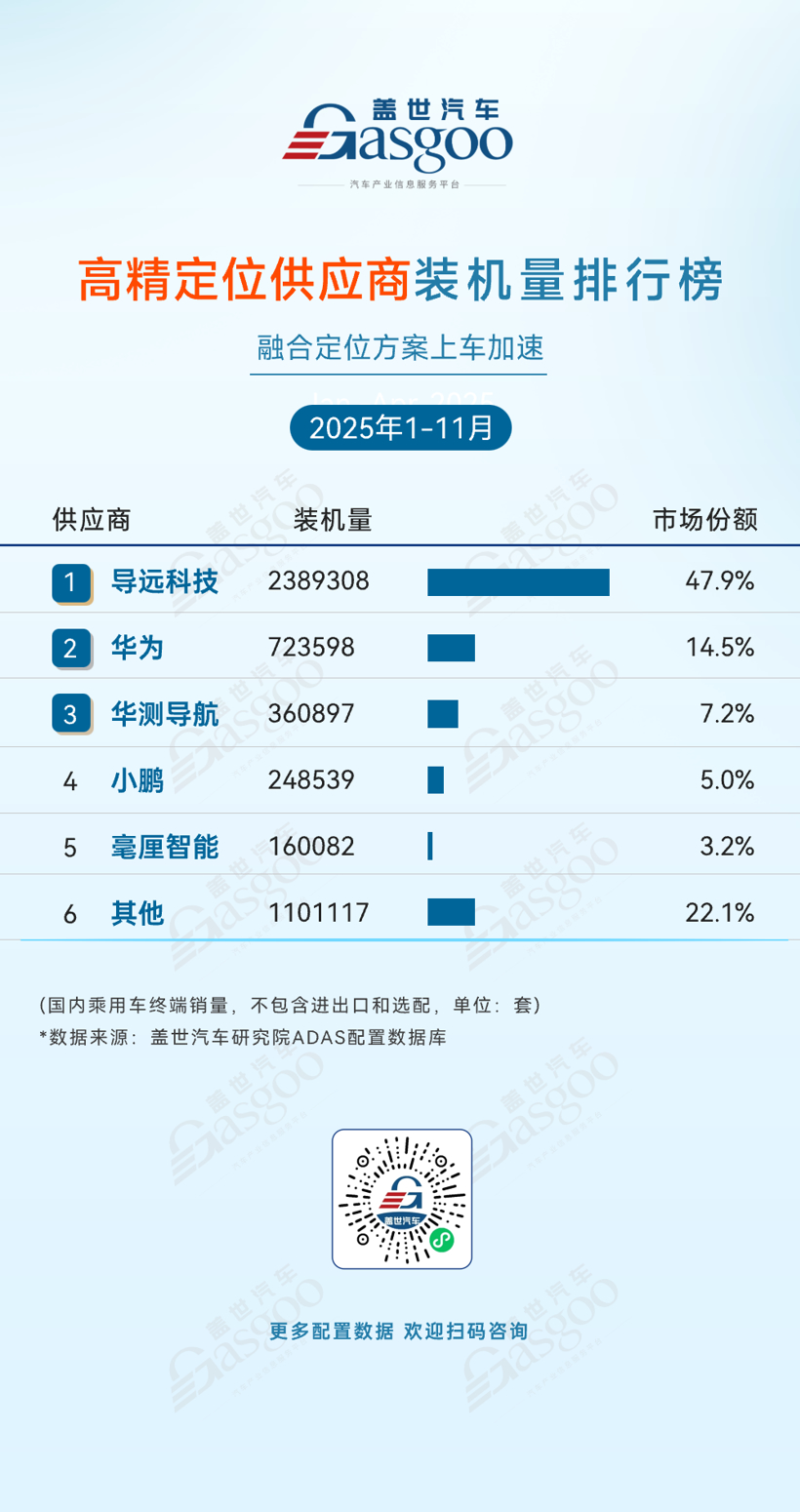
High-precision positioning shows a dominant leader and overall domestic control. ASENSING accounted for 2,389,308 installations and a 47.9% share — nearly half the market — supported by fast rollouts and strong system compatibility for its fused-positioning solutions. Huawei and Huace Navigation followed, with Huawei in second at 14.5%, highlighting the execution muscle of top tech firms in this field. As a core ADAS hardware stack, high-precision positioning has seen dual breakthroughs in both technology and market adoption among domestic suppliers. Next, competition will hinge on accuracy, cost, and scenario adaptability.