



News that Momenta offers interns a daily wage of 2,000 yuan has recently sparked industry buzz. Gasgoo reached out to the company for comment, and it did not deny the reports.
Momenta's hefty daily stipend for its Mstar interns serves as a striking signal that intelligent assisted driving is entering the "deep water" zone.
The core of industry competition is shifting rapidly from hardware to algorithms and data, making top-tier AI talent the scarcest resource. According to a report from a recruitment platform, the number of new job postings in the smart driving sector surged 28-fold year-over-year in the past year, with the average tenure for core talent at just 1.5 years.
In the battle for "the best brains," offering annual packages of 1 million yuan to top fresh graduates is no longer an isolated case.
This white-hot battle for talent directly reflects the industry's ultimate anxiety over defining future technology—and securing its right to survive.
L3 Competition Kicks Off: Tougher Times Ahead for the Smart Driving Industry
In September 2025, the Ministry of Industry and Information Technology of China and seven other departments jointly issued the "Work Plan for Steady Growth in the Automobile Industry (2025–2026)," explicitly proposing to "promote pilot projects for the access and road traffic of intelligent connected vehicles, and conditionally approve the production access of L3-level models." Subsequently, in December, the Deepal SL03 and BAIC Arcfox Alpha S successfully obtained conditional access licenses for L3 autonomous driving models. This was like firing a starting gun for the industry, signaling that China's automotive sector has officially entered the "deep water" and "fast lane" of intelligent competition following the wave of electrification.
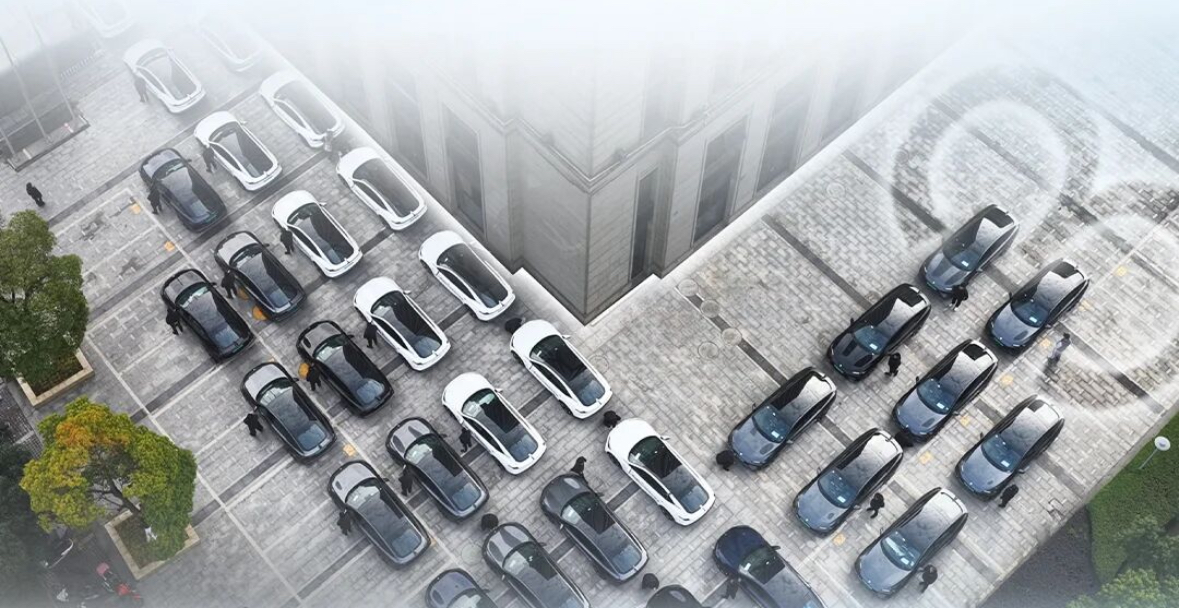
Image Credit: Deepal Auto
Electrification is the "first half" of new energy vehicles, while intelligence is the "second half"—this has become industry consensus. If the first half aimed to solve the car's "heart"—the powertrain system—then the "second half" of intelligence fights for the car's "brain" and "soul." The focus of competition has shifted from the hardware efficiency of powertrain systems to AI algorithms, software architecture, and data iteration capabilities centered on the "perception-decision-execution" loop.
Electrification forms the basic threshold for participation, but intelligence—especially intelligent assisted driving—has become the core battlefield determining product premiums, brand stature, and user loyalty.
This shift in focus has directly triggered changes in the R&D cost structure of automakers. Intelligent assisted driving R&D is increasingly becoming the largest chunk of budgets for many OEMs. Whether new forces or traditional giants actively transforming, all are pouring vast funds into algorithm teams, computing clusters, and data closed-loop systems.
According to information from Li Auto's second-quarter financial report, its annual R&D investment is expected to reach 12 billion yuan, with over 6 billion allocated to the AI sector—hitting its goal of "putting nearly half of R&D into AI" set at the start of the year. Leapmotor has also explicitly stated that it will invest more than 15% of its R&D expenditure in intelligence annually, planning to invest a cumulative 50 billion yuan between 2025 and 2030.
At the same time, a key trend is emerging: the costs of hardware like LiDAR and computing chips are falling, while the value of algorithm optimization capabilities and data assets is becoming increasingly prominent.
In the past, a car's competitiveness might have been defined by chassis tuning, engine parameters, or body craftsmanship. Today, its core competitiveness is increasingly reflected in the maturity of algorithm models, the speed of data-driven iteration, and the ability to synergistically optimize software and hardware.
This means that investing in top AI and algorithm talent is no longer just a simple expense; it can be seen as a strategic investment for the greatest future "cost reduction space" and the deepest "experience barrier." Possessing a team that can continuously optimize algorithms, fully release hardware potential, and efficiently utilize data will become a major engine for companies to control vehicle costs and boost profitability.
Furthermore, a "Matthew effect"—where the strong get stronger—is appearing in the intelligent assisted driving sector. According to the "2025 City NOA Automotive Assisted Driving Research Report" released by the China Association of Automobile Manufacturers, just two players, Momenta and Huawei's HI model, account for over 80% of third-party supplier installations for city NOA.
This result is partly due to the data-driven rules followed by intelligent assisted driving: superior algorithm talent can build smarter, safer driving systems, which can then be deployed on more vehicles to collect a steady stream of real-world data covering countless "long-tail scenarios." This massive data then feeds back and drives the rapid iterative evolution of algorithm models. Once this closed loop operates efficiently, it forms an insurmountable moat.
Therefore, industry leaders are all prioritizing the construction of large-scale, high-quality data acquisition and processing capabilities. Tesla, leveraging its massive global fleet, has seen its FSD system accumulate nearly 10 billion kilometers of driving mileage, providing ample "fuel" for its algorithm evolution.
In China, tech companies like Momenta are building a vast data ecosystem alliance through extensive cooperation covering over 15 OEMs and more than 130 mass-production models, aiming to spin their own scale "flywheel."
Su Qing, vice president of Horizon Robotics, predicts the industry will enter a "bitter period" in the coming years, where the main theme will be extreme engineering optimization and cost reduction under the end-to-end paradigm. This requires companies to have not only the right strategy and roadmap but also the financial foundation for sustained investment. According to relevant statistics, in the first half of 2025, the average R&D investment of 18 automakers was 5.114 billion yuan, an increase of 32.94% year-over-year. Among them, BYD's R&D investment reached 30.88 billion yuan, ranking first; Geely Auto saw the fastest growth in R&D investment, reaching 7.328 billion yuan, a 202.35% year-over-year increase. However, the sharp contradiction between R&D investment and short-term profitability is testing every company.
This means competition will shift from flashy feature launches to a more grueling contest of system stability, cost control, mass delivery rates, and user experience details. The battle in the deep water of intelligence is both a blitzkrieg of genius and inspiration and a war of attrition involving endurance, systems, and execution.
The Organizational Evolution in the Depths of the Smart Driving Industry
As the war over intelligence spreads from laboratories to mass-produced cars, the dimension of competition has expanded from single technical parameters to a systemic struggle involving organizational structure, business models, and talent ecosystems. The market is not a monolith; participants with different backgrounds have different strategic considerations. From tech "brain" suppliers spending freely, to new forces pursuing full-stack closed loops, to traditional giants eager to quickly "catch up," the future landscape of technical routes and business models is clearly taking shape.
Tech suppliers represented by Huawei and Momenta do not build cars themselves but aim to become the "Bosch" of the intelligent vehicle era—empowerers providing "foundational" solutions ranging from chips and algorithms to data closed-loops for the entire industry.
For tech companies, investing in talent is investing in industry standards. For example, Huawei's "Genius Youth" program, launched in 2019, recruits top students globally with top-tier compensation, precisely to build core algorithm reserves for the future. Momenta offering a daily wage of 2,000 yuan for interns in its "Mstar" program targeting top global universities is essentially an early investment in potential "technical seeds."
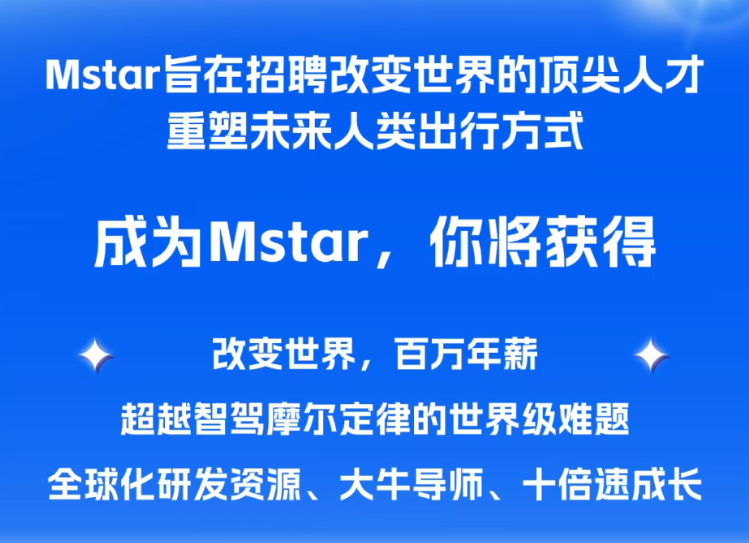
Image Credit: Momenta Talent
Regarding Momenta's Mstar recruitment program, the company told Gasgoo that Mstar is its top talent recruitment program aimed at hiring top talent who want to change the world. The candidates are primarily master's and doctoral students, and the recruitment directions focus mainly on end-to-end large model algorithms and training inference optimization.
According to official Momenta materials, the annual salary for Mstar campus recruits starts at "1 million yuan," while interns receive 2,000 yuan per day. A source close to Momenta also told Gasgoo that "core algorithm positions can get this, and with a performance coefficient of 1.6, the daily wage can reach 3,600 yuan."
Behind this strategy is the industry's consensus on the "data-driven" paradigm. Just as Momenta practices its "One Flywheel" strategy, to date, Momenta's cooperative mass-production models have exceeded 130. Wide deployment means massive, diverse data inflows, which in turn feed algorithms to form a "strong get stronger" flywheel effect. Vying for the talent that can build this "flywheel" is vying for the voice to define the next-generation intelligent driving architecture.
In stark contrast to the "empowerment" path, new forces represented by Tesla, XPENG, and Li Auto aim to build their own moats through self-research. Consequently, they display extreme aggression in the talent market. For instance, XPENG launched its "largest ever" AI talent recruitment drive in 2025, offering "annual salaries of 1 million yuan with no cap" to top fresh graduates, aiming to tackle frontier areas like end-to-end large models. Tesla, meanwhile, is continuing to push forward the localized recruitment and R&D of its Chinese FSD team to better adapt to China's complex road scenarios.
However, the path of full-stack self-research is fraught with strategic swings and trial and error, which directly triggers high-frequency turnover of core talent. A landmark event occurred in August 2025, when Tesla disbanded its "Dojo" team focused on AI training. This decision was interpreted as Tesla focusing resources more on applications like FSD and humanoid robots rather than the underlying computing platform.
This case shows that even industry benchmarks are dynamically adjusting their technical focus, and talent priorities will shift accordingly.
Facing the wave of intelligence, those with the greatest sense of crisis and urgency to act are traditional automotive giants like BYD, Geely, and Changan, as well as multinational brands like Volkswagen actively seeking change. They possess solid manufacturing foundations, supply chain capabilities, and cash flow, but have obvious shortcomings in software and AI algorithms. For these OEMs, the current goal for intelligence is very clear: quickly close the gap.
On one hand, they use high salaries to attract talent from new forces and tech companies to bolster internal self-research teams; on the other, they achieve external coordinated development through capital and organizational means such as strategic investment or establishing subsidiaries.
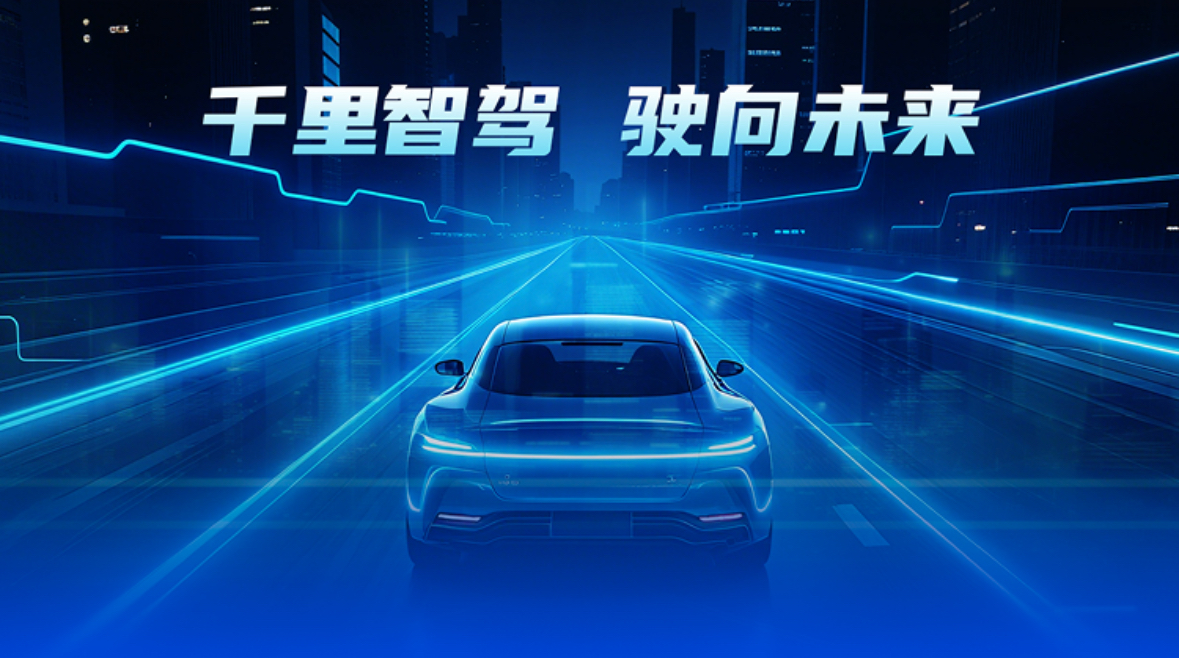
Image Credit: Afari Smart Driving
A typical case is Geely's deep integration of its smart driving team.
In June 2025, Afari Smart Driving Technology was established. Subsequently, in August, Geely integrated its smart driving teams. The ZEEKR smart driving team of about 1,300 people was merged into Afari Smart Driving Technology as a whole. It is reported that adding the nearly 1,000 people from the Geely Research Institute and about 500 from Megvii Mach, the total scale of Afari Smart Driving Technology approaches 3,000 people.
According to Afari Smart Driving Technology Recruitment, the company is currently hotly hiring for positions related to world model algorithms and end-to-end AI algorithms.
Afari Smart Driving Technology is jointly held by companies such as Mach-drive, Zhejiang Jirun Automobile Co., Ltd., and Ningbo Lotus Robotics Co., Ltd. From its inception, Afari Smart Driving was given a heavy responsibility: to become a powerful intelligent driving R&D platform within the Geely system.
One analyst noted: "This is a deep organizational restructuring of the smart driving team by Geely as a shareholder. Traditional giants like Geely hope to break free from constraints and enter the intelligent race 'traveling light' with a more flexible and agile approach."
The war for talent in the automotive circle has significance far beyond the struggle for human resources itself; it is a slice observing the competitive dynamics of China's automotive industry in the deep water of intelligence. Tech companies attempt to define the ecosystem with algorithms, new forces strive to define the experience with full-stack capabilities, and traditional giants attempt to redefine themselves through capital and organizational innovation.
The flow and pricing of talent reflect in real-time the temperature of changes in different technical routes, business models, and market confidence.
Future Winners Are AI Winners First
The "involution"-style competition in the auto industry has pushed its talent market to unprecedented heights. According to a report from Maimai Gao Pin, the number of new job postings in the smart driving and robotics sectors surged 28-fold year-over-year in 2025. It also points out that there is a shortage of talent in multiple core technical areas across smart driving and robotics. The supply-to-demand ratio for simulation application engineers is just 0.58, equivalent to two positions vying for one talent. The supply-to-demand ratios for algorithmic talents such as natural language processing, large model algorithms, AIGC algorithm engineers, and autonomous driving algorithms are all below 0.8.
This means talent in this field is relatively scarce, so salaries have risen accordingly. A person in charge at Voyah Auto once revealed that the market salary premium for algorithm engineers and other positions has exceeded 80%.
Driven by shifts in the market and technical routes, China's automotive industry is also experiencing a "talent migration."
A significant trend is that talent is flowing massively from new forces and tech companies to traditional OEMs like BYD, Geely, Chery, and Great Wall Motor. The latter, leveraging their solid manufacturing foundations, stable cash flow, and massive scale, are offering generous terms to launch a "counterattack" in intelligence.
At the same time, cross-border mobility is intensifying. Because large language models, embodied intelligence, and intelligent driving share commonalities in technology, talent is increasingly shuttling between the three major fields of automobiles, robotics, and the low-altitude economy. New forces like XPENG and Li Auto have also begun to establish robotics departments one after another; XPENG, in particular, also has the XPENG Aeroht flying car business. The technical boundaries between automobiles, robotics, and the low-altitude economy are further blurring.
This flood of talent reveals at least two profound changes:
First, the market landscape is undergoing a reshaping, with the offense and defense of "old" and "new" forces swapping places. Traditional OEMs are no longer passive chasers but are using their comprehensive advantages to launch counterattacks.
Second, the mode of competition is further evolving from "going it alone" in the past to "ecological alliances" today. The case of Geely and Qianzhi Intelligent Driving shows that competition has ascended to the reorganization of alliances at the capital and strategic levels. OEMs are no longer blindly pursuing closed full-stack self-research but are seeking a balance among self-research, investment, and cooperation.
All OEMs are engaged in a life-or-death race to transform into "tech companies." Whether it is NIO investing heavily in proprietary chip development or Great Wall Motor setting up R&D centers globally, actions point to one thing: the winners of the future will be the winners of AI technology first.
Conclusion:
The issuance of L3 conditional autonomous driving access permits means the war for automotive intelligence is entering a "hardcore" stage. Competition has escalated from hardware stacking to the ultimate battle for algorithms, data, and top AI talent.
From interns with a "daily wage of 2,000" to fresh graduates with "annual salaries of 1 million," from tech companies' "Genius Plans" to traditional giants' organizational "fission," all this noise confirms one fact: talent is the key ticket for crossing the deep water zone. The winners of the future will be the winners of AI.


