



In the fourth quarter of 2025, the pace of capacity expansion in China's power battery industry shifted away from the earlier breakneck pace, entering a steadier phase. According to a partial tally by Gasgoo, more than 15 new projects for batteries and supporting suppliers moved ahead during the quarter, with total investment topping RMB 60 billion and combined planned annual capacity exceeding 370 GWh.
Geographically, projects spanned core industrial provinces including Guangdong, Hunan and Anhui, while reaching further into overseas markets — a dual-track strategy of densifying domestic capacity and expanding the global footprint.
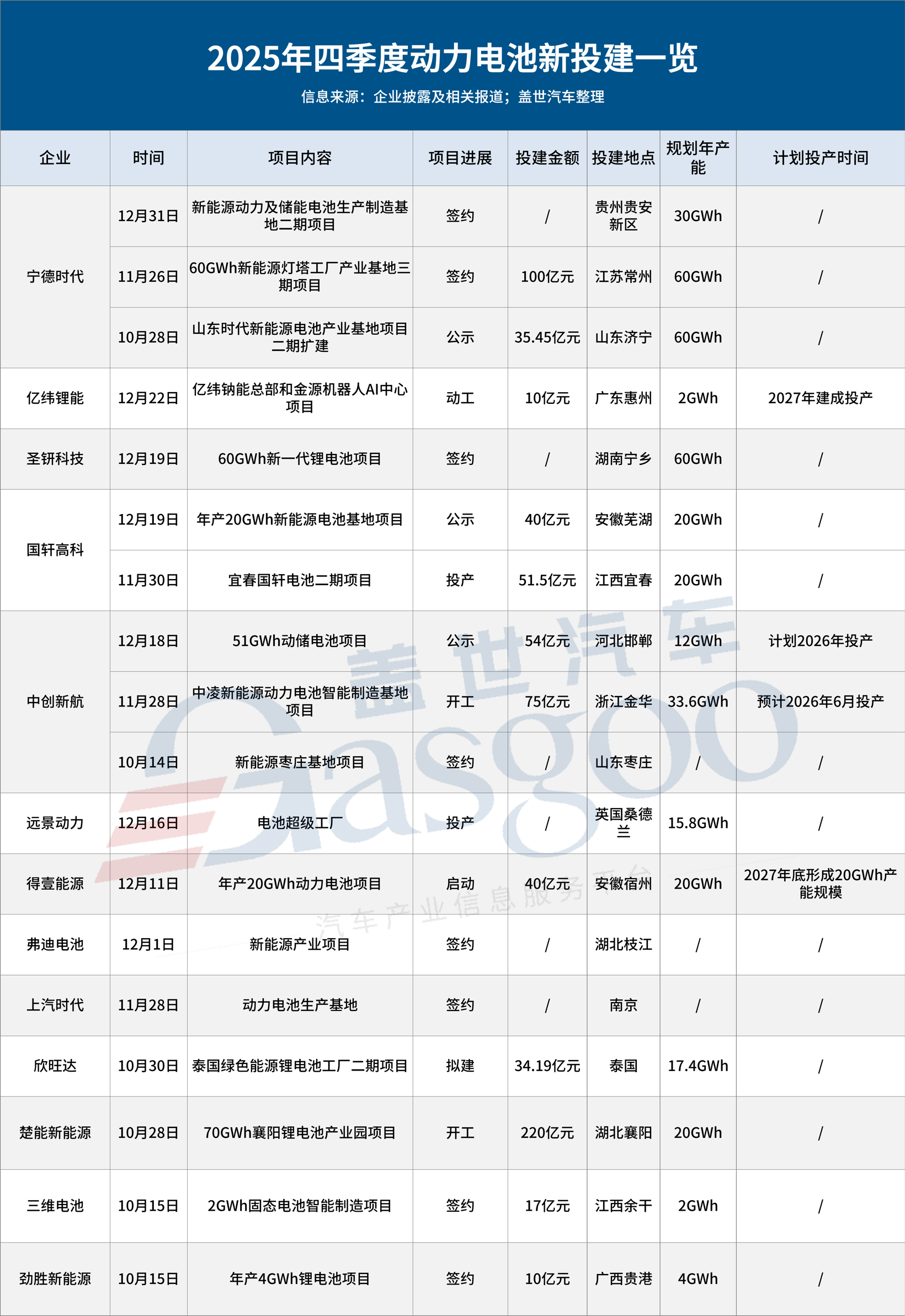
Signing, groundbreaking and commissioning accelerate across the full cycle
Q4's expansion carried a full-cycle pattern: contract signings for new projects, groundbreakings and, for some mature sites, commissioning. The links were tight and the cadence brisk.
Eight projects moved through signing or public disclosure in the quarter, with expansion steps most concentrated among CATL, CALB and Gotion High-tech — the core drivers of the Q4 wave.
CATL, in particular, lined up three major moves in one quarter. In October, Phase II of the Shandong Times New Energy Battery Industrial Base entered public notice, with planned investment of RMB 3.545 billion and annual capacity of 60 GWh, further shoring up capacity in North China. In November, the Liyang Times Lighthouse Factory Phase III (LY9) project in Jiangsu was signed, with investment capped at RMB 10 billion to add 60 GWh focused on the "Times LY9" large cylindrical cell. The move aims to strengthen its position in high-end batteries. Then on December 31, CATL signed a Phase II agreement with Gui’an New Area for 30 GWh of power and storage batteries; together with the 30 GWh Phase I, the site will achieve a 60 GWh scale effect.
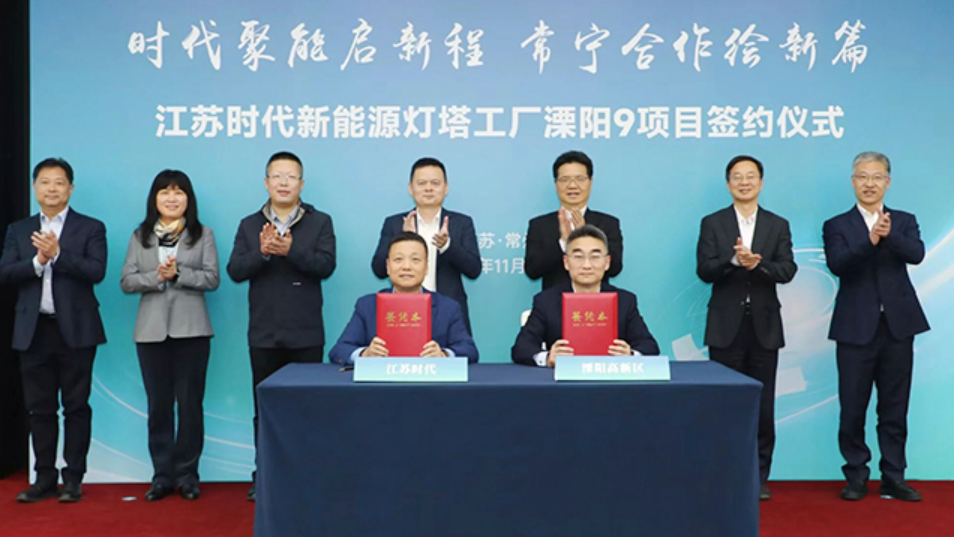
Image source: Changzhou municipal government website
CALB completed two project signings in Q4. In October, it agreed with Zaozhuang, Shandong to build a new energy industrial base, reinforcing its East China network. In December, a 12 GWh power-and-storage battery project in Handan, Hebei entered public notice, with total investment of RMB 5.4 billion.
Gotion High-tech, for its part, focused on densifying capacity within lithium battery clusters. In December, a 20 GWh base in Wuhu, Anhui entered public notice. As subsequent projects land, the company aims to further strengthen its supply-chain edge in Central China.
On the construction side, top players and key projects led the momentum, with three heavyweight projects breaking ground in succession. CALB’s project is especially noteworthy, advancing a co-expansion model tightly bound to an automaker.
On November 28, the Wuyi Zhongling New Energy power battery intelligent manufacturing base broke ground. The project is a joint venture between CALB and Leapmotor, deeply tying into OEM resources. It is expected to start production in June 2026, with annual output value set to exceed RMB 10 billion at full ramp — a demonstration of the "battery maker + OEM" co-expansion model.
Meanwhile, some projects have already moved into production, translating capacity into output quickly. Overseas, a key breakthrough arrived on December 16, when Envision AESC’s battery gigafactory in Sunderland, UK, began production. With planned annual capacity of 15.8 GWh, the plant marks an important milestone in Envision AESC’s global buildout and fills a gap in Europe’s domestic high-end power battery capacity — providing core support for its push into the region's EV market.
Technology and regional footprints advance on two fronts
As competition intensifies, sheer scale alone is no longer enough. In Q4 2025, some battery makers sought opportunities in niche technologies and targeted regions, steering capacity plans toward more diverse and higher-quality development.
On the technology side, solid-state and sodium-ion batteries remained central to next-generation pathways, with related expansion projects continuing to land. In solid-state, Sanwei Battery signed a 2 GWh project in Yugan, Jiangxi on October 15, with total investment of RMB 1.7 billion — accelerating the commercialization of solid-state technology.
As a complement to lithium-ion, sodium-ion batteries — offering lower material costs, better low-temperature performance and high safety — also saw expansion moves in the quarter. On December 22, EVE Energy broke ground on its sodium energy headquarters and AI center in Huizhou, Guangdong. Construction is slated to intensify in 2026, with completion and start of production in 2027, creating an integrated base spanning sodium-ion R&D and manufacturing as well as AI industrial robots.
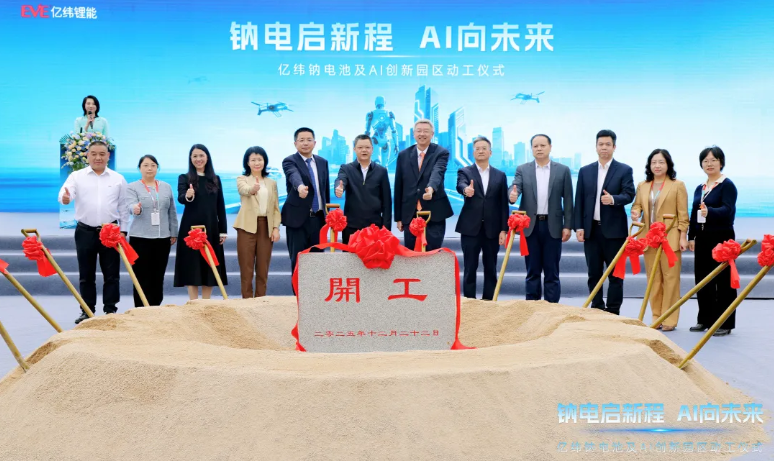
Image source: EVE Energy
The sodium-ion project carries total investment of about RMB 1 billion and planned annual capacity of 2 GWh, building an innovation platform that links R&D, pilot runs and mass production. It targets scaled applications in energy storage and AI data centers (AIDC), helping reduce the new-energy sector’s dependence on lithium.
Regionally, East China remains the first-choice expansion region, backed by mature NEV clusters, a strong talent base and convenient logistics. In Q4, Jiangsu, Zhejiang, Anhui and Shandong together landed seven projects with over 190 GWh in planned capacity. These moves are anchored around nearby, mature auto clusters to enable efficient "battery-to-vehicle" supply chain coordination, sharply cutting transport time and logistics costs and lifting the industry’s overall competitiveness.
Beyond East China and resource-driven areas, Central and Southwest China also saw new projects, further optimizing the domestic capacity map. Chuneng New Energy’s Xiangyang battery park will support the buildout of a Central China NEV cluster, while CATL’s Gui’an New Area project plugs a capacity gap in the Southwest, radiating into the Sichuan–Chongqing cluster. A more dispersed domestic footprint helps hedge regional supply chain risks, improves nationwide capacity allocation and better matches local demand.
Overseas expansion stood out as well. On October 30, Sunwoda launched Phase II of its Thailand green-energy lithium battery plant, with planned annual capacity of 17.4 GWh and total investment of RMB 3.419 billion. The project targets the fast-growing Southeast Asian EV market and leverages Thailand’s location to sidestep US and European trade barriers — enabling localized production and sales and rounding out its global capacity layout.
Overall, Q4 2025’s expansion wave is no longer about scale alone. It shows deeper alignment between technology roadmaps and market use cases. The phase extends the pursuit of next-gen battery technologies, while accelerating industrialization through concrete projects — pushing the sector into a higher-quality stage where scale, technology and scenarios advance in tandem.
Heading into 2026, as a large slate of new capacity comes online, competition normalizes and technology cycles speed up, the power battery industry is set to achieve high-quality growth through a more balanced supply-demand structure. Companies with differentiated strengths and global footprints are poised to keep leading the market.


