Gasgoo Munich-CATL Chairman Robin Zeng recently offered a cautious assessment of the commercialization timeline for all-solid-state batteries. When asked whether the technology could be installed in millions of vehicles by 2030, he was blunt: the chances are "very small." He revealed that internally, CATL rates the current technology readiness at just TRL4 — level 4 out of a possible 9.
This pragmatic stance from the world's leading battery maker stands in stark contrast to the relentless "mass production" declarations echoing across the industry, forcing the market to reconsider the realistic timeline for large-scale commercialization.
Why Zeng Is Cautious: Cost and Technology Are Key
In Zeng's view, the core barriers to equipping millions of vehicles before 2030 are performance and cost. "To reach that scale, cars have to be affordable enough," he said, noting that achieving this balance poses significant challenges on both fronts.

Image Source: CATL
Zeng's assessment is grounded in hard numbers. Current costs for all-solid-state battery cells run as high as 1.6 to 2.2 yuan per Wh — 3 to 5 times the price of mainstream lithium iron phosphate (LFP) batteries, which cost between 0.39 and 0.5 yuan per Wh. For a typical family EV with a 70kWh battery pack, switching to all-solid-state technology would add more than 80,000 yuan to the cost of the battery alone.
Technical hurdles are equally formidable. Zeng places the current technology maturity at TRL4, meaning only basic laboratory principles have been validated. The technical pathway is far from settled, and the route to volume production and commercialization "still has a long way to go." He highlighted a core dilemma known as the "solid-solid interface": because the solid electrolyte and electrodes are both rigid solids, they cannot achieve the intimate contact possible in liquid-based batteries.

Image Source: CATL
The industry currently relies on warm isostatic pressing at 6,000 atmospheres to address this, but the materials involved — cathodes, anodes, and copper or aluminum current collectors — have vastly different compaction densities. High-pressure processing easily leads to material misalignment and interface failure. Even if a sample works in the lab, it often fails to translate to mass production applications.
For this reason, Zeng argues that technological breakthroughs should be viewed as "event-driven" rather than "time-driven." Innovation cannot be scheduled, he insists; true commercialization will only arrive when the critical scientific and technical problems are actually solved.
'Mass Production' Declarations vs. Cautious Progress
Zeng's cautious assessment provides a benchmark from the perspective of an industry leader. Yet on the ground, 2026 is widely viewed as the "first year of mass production" for solid-state batteries, with top players like CATL, BYD, and Gotion High-tech releasing aggressive timelines.
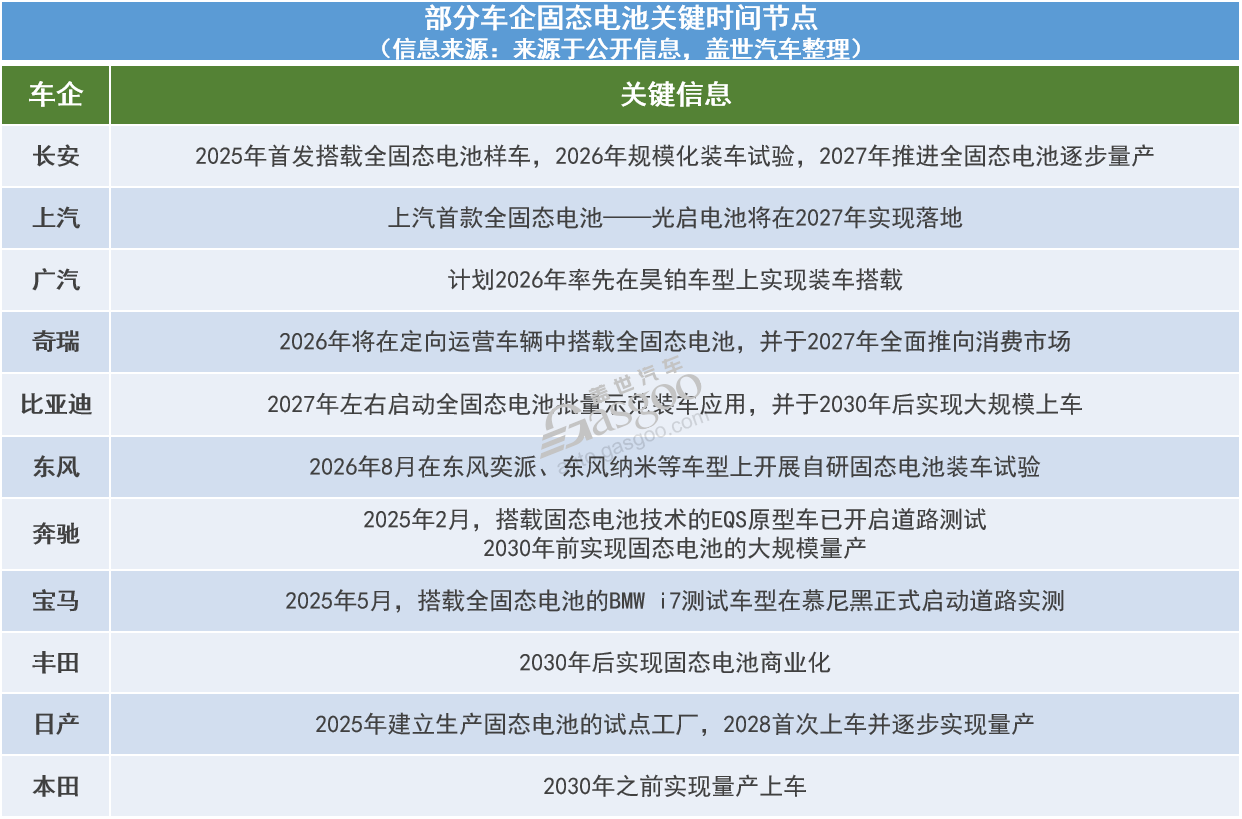
Looking at corporate roadmaps: CATL plans to achieve small-batch production of sulfide-based all-solid-state batteries by 2027. BYD's sulfide version has passed full automotive regulation verification by the China Automotive Technology and Research Center (CATARC), boasting an energy density of 400Wh/kg; a 2GWh pilot line in Shenzhen's Pingshan district is already operational, and a 20GWh mass-production line in Chongqing is set to begin construction in the third quarter. Dongfeng Motor, meanwhile, is taking a gradual "semi-solid first, all-solid later" approach, with its 350Wh/kg battery slated for installation in vehicles in the second half of 2026.
On the international front, Toyota has secured production approval in Japan and plans to launch small-scale production of solid-state batteries in 2026.
Yet, there is a fundamental difference between "small batches" and "mass adoption." Ouyang Minggao, an academician at the Chinese Academy of Sciences, stated publicly in early 2026 that large-scale volume production of all-solid-state batteries will "likely take another 3 to 5 years."
Tang Liming, Chief Strategy Officer of Geely Auto Group, also noted that solid-state batteries will "likely achieve batch and industrial application around 2030." The path from verification to volume production, he added, is blocked by three major hurdles: yield rates, costs, and supply chain maturity.
Industry researchers predict global shipments of solid-state batteries will hit 614.1GWh by 2030, accounting for roughly 10% of the total lithium battery market.
In terms of Technology Readiness Level (TRL), all-solid-state batteries remain at the initial stage of engineering validation (TRL4), with a long road ahead before large-scale commercialization. The critical challenges for industrialization right now are converging on a standard manufacturing process, optimizing production yields, and reducing the cost of core materials.
Conclusion
Zeng's coolheadedness and the industry's enthusiasm are not at odds; together, they sketch the true distance between the laboratory and the production line.
The substance of 2026's "mass production kickoff" may lie more in the scaling of semi-solid batteries. True implementation of all-solid-state technology still awaits solutions to critical scientific and engineering problems — and the rhythm of scientific breakthroughs never follows a calendar.