



"This is Yongzhou — we are champions." A congratulatory billboard put up by a netizen from Suzhou unexpectedly sparked a feel‑good online relay stretching across several Jiangsu cities and Yongzhou in Hunan — and handed quick‑moving brands a perfect stage to break out beyond their core audience.
As a torrent of traffic poured in after netizens across Jiangsu's "Thirteen Taibao" cities collectively cheered Yongzhou's Xiangchao title, GAC AION took the baton cleanly.
A GAC AION executive's response at a critical moment
It began with a straightforward sporting triumph. On December 27, 2025, Yongzhou won the final of the Hunan Provincial Football League (Xiangchao). The first congratulatory billboard from a Suzhou netizen ignited follow‑ons from Nanjing, Taizhou, Changzhou, Nantong, Kunshan and beyond, turning into an online phenomenon that crossed geographic lines.
Then came a twist in the feel‑good narrative. A business owner who had publicly promised before the match to gift cars if the team won later struggled to fulfill that pledge for business reasons, prompting some online skepticism. Although later information showed the owner had supported the team in its early days — and outlets including People's Daily urged the public to understand the goodwill behind the interaction — the episode left an unresolved public question about promises.
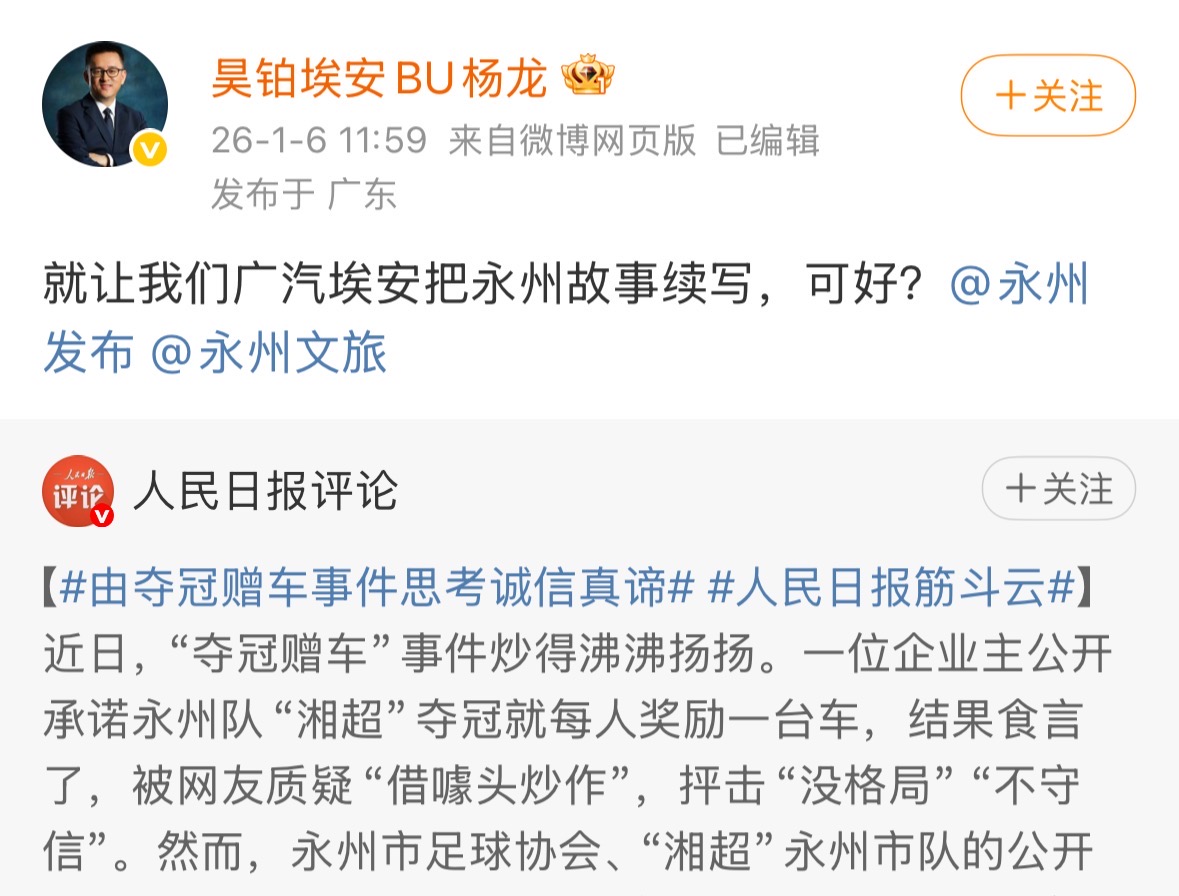
Image source: Weibo screenshot
At that delicate moment, Yang Long — vice president for sales and service at the HYPER‑AION BU — shared People's Daily's commentary and wrote on his personal Weibo: "Shall we at GAC AION keep the Yongzhou story going?"
The concise, open‑ended ask quickly resonated across social platforms and stirred speculation. Rather than sidestep the emotions left by the earlier episode, it adopted a "continue the story" stance — steering the conversation toward a more constructive future.
It felt less like a marketing stunt than a piece of public communication grounded in social sentiment.
"Continue" acknowledged the goodwill behind Jiangsu netizens' spontaneous actions and, implicitly, the public's hope for a tidy ending. That framing recast the brand, however briefly, from a commercial actor into a co‑author of the story — a move that reaches beyond conventional product promotion.
Speculation over how GAC AION would "continue" — gifting cars, sponsorship or other support — followed quickly. Regardless of the form, the discussion itself tightly bound the brand to this human, hometown‑flavored story.
Why AION has the confidence to capture this traffic?
Marketing that floats free of product and system strength is a castle in the air. GAC AION's confidence to take the baton rests on a steadily reinforced foundation of being a "great car for everyone."
For AION, that phrase is more than a slogan: it means standout value for money, accessible intelligent tech, firm safety commitments and durable reliability.
In December 2025, powered by models including the AION i60, GAC AION's monthly sales topped 40,000 units — its highest reading of the year.

Image source: AION
GAC AION’s quick response and ability to harness the traffic was no accident. Since the "Panyu Action," GAC has introduced IPD (integrated product development) to embed user needs more deeply across the product lifecycle. More recently, GAC Group restructured its self‑owned brands, forming the HYPER‑AION BU — an organizational shift aimed at sharpening market agility.
These system‑level builds form the bedrock for how the brand meets external opportunities and shocks.
Zooming out, AION's "event response" approach stands in meaningful contrast to Li Auto's systemized, long‑term sponsorship of the Jiangsu Football Super League ("Suchao").
The paths differ, but the core overlaps. Li Auto ties itself to Changzhou's local supply chain and city culture through deep, multi‑year sponsorships; GAC AION moves fast on sudden, high‑resonance social moments.
Both, however, look beyond simple exposure to truly inhabit a specific cultural or emotional circle — whether a geography‑rooted "city football" community or a cross‑provincial, empathy‑driven story online.
As attention grows scarce, the quality of traffic matters more than the volume. A public moment that sparks broad emotional resonance is worth far more than equivalent ad impressions. AION's response to the "Yongzhou story" is best seen as an effective conversion of high‑quality public attention.
That hints at a broader trend: to win hearts, brands need not only to transmit information, but to understand, respect and deftly participate in public narratives. In this case, GAC AION showed the craft of taking the baton. What gets written next is what the public is waiting to see.


