



Quality is earned through testing. When a newcomer brand declared at a launch that its new model had cleared more than 100,000 tests, the claim instantly drew industry-wide attention.
Two camps formed quickly: supporters saw a showcase of engineering muscle, while skeptics dismissed it as a meaningless numbers race — a marketing stunt, not substance.
So why has NEV testing fallen into a "battle of counts"? Are 100,000 tests the inevitable byproduct of an upgrading industry — or a false premise that flatters to deceive?
To answer that, the story needs to be read through the lens of electrification, intelligence and connectivity — and the logic behind those 100,000 tests pulled apart.

Image source: Shetu.com
100,000 tests: the "must-answer" of an industry in transition
"If you’d said 10 years ago that a car needs 100,000 tests, I would’ve thought it unrealistic. Today, as NEVs shift from mechanical products to E/E plus software, the surge in test counts is, frankly, inevitable," said Zhang Mo (a pseudonym), an engineer at a leading testing body, in an interview with Gasgoo.
That inevitability stems from a broadening of test dimensions.
In the era of internal-combustion vehicles, validation focused on mechanical systems — engine, transmission, chassis. Mandatory regulatory checks plus in-house controls typically totaled from dozens to just over a hundred items.
With NEVs, legacy tests remain — then battery, motor and power electronics add layers of dedicated validation. At the battery-pack level alone, many carmakers run 150–200 in-house tests. Gasgoo also learned the Shenzhen National Metrology Center can conduct more than 500 metrology-parameter "gauntlet" checks for batteries and charging systems, illustrating how breadth and depth are expanding exponentially.
"Take 'three-high' trials (high temperature, high altitude, high cold): today’s content is a different world from a decade ago." In high-cold testing, for example, ICE cars mainly assessed cold starts and cabin heating, Zhang noted, while NEVs must also verify low-temperature range, charging efficiency and the resilience of intelligent-driving sensors. "At -30°C, will lidar lose detection range? Will camera lenses fog from temperature differentials?"
An even bigger shift is the spread of intelligent connectivity.
Three-high tests for intelligent connected vehicles have moved from pure mechanical checks to integrated validation of function, performance and safety. Even just for automated driving, testing needs to cover multiple standards such as ISO 21448 (Safety of the Intended Functionality) and SAE J3016 (levels of driving automation). "We used to test whether a car could run; now we test whether it can run smart," Zhang said.
Consider extreme fog. Proving grounds build varied scenarios and require radar–vision fusion algorithms to maintain high recognition rates for stationary vehicles and pedestrians within a given visibility; otherwise it’s flagged as a SOTIF defect. Each scenario demands a dedicated test case — and the counts naturally climb.
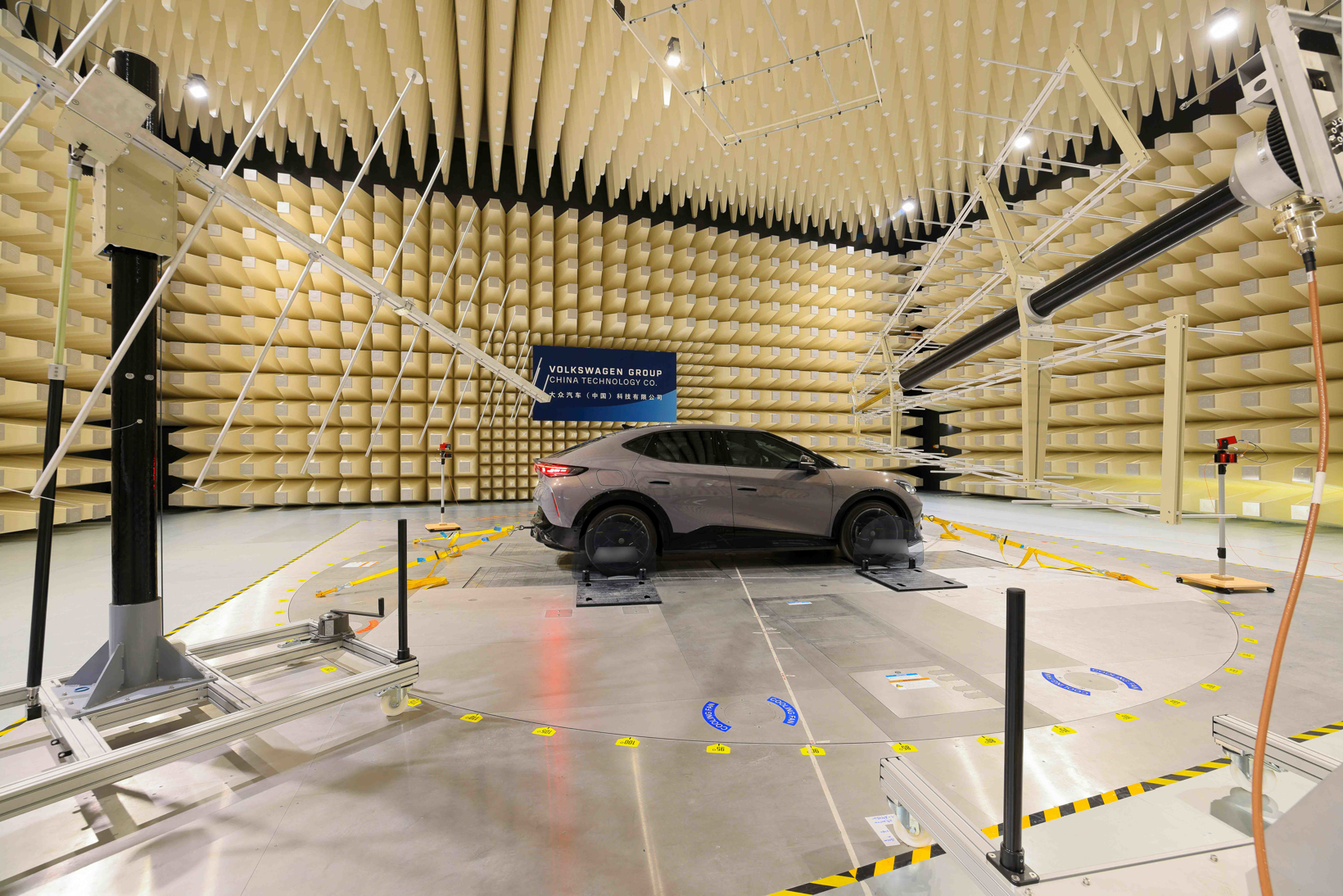
Image source: Volkswagen
The padding in "100,000 tests," though, often hides in how tiers are split.
Zhang explained that tests typically span four tiers: component, system, vehicle and simulation. A seat, for instance, might undergo 10-plus component tests such as frame rigidity and foam rebound; once assembled into a seat system, there are dynamic comfort and seat-belt anchorage strength tests; at the vehicle level, matching is checked across gravel and corrugated roads.
"If each tier’s checks are counted as separate projects — and simulation validation repeats them — 100,000 is within reach. In truth, that's a reflection of rising complexity," Zhang said.
A far-north cold trial run by a testing agency underscores the point. More than 10 mainstream intelligent-connected NEVs took part; across two dimensions — intelligent safety and energy efficiency — engineers set six evaluation modules with nine operating conditions, including fog safety, snow safety, sun-glare safety, range degradation resistance, charging efficiency and HVAC heating. "Consumers see safety and efficiency," Zhang added. "Behind that sit hundreds or thousands of parameter tweaks and data checks — the core reason counts have exploded."
What's padded — and what's truly hardcore?
Even with objective drivers, pseudo-testing is real. Zhang said he has seen reports with duplicate counting, loose standards and simulations disconnected from physical tests — the roots of the claim that "100,000 tests" is a false premise.
The most common padding is repetitive scenarios. One carmaker touted 50,000 automated-driving tests; unpacked, many were the same conditions at different speeds. On a straight road, for instance, running ACC adaptive cruise at 60 km/h, 65 km/h and 70 km/h was counted as three separate projects. "That's not probing functional boundaries — it's inflating the tally," Zhang said.
Truly valuable tests target extremes: high-temperature dusty driving; simulated turbo failure at high altitude. Those expose real weaknesses, instead of racking up data in routine conditions.
Another flashpoint is "simulation divorced from reality." As simulation spreads, many carmakers have moved large chunks of testing onto computers, but some ignore national requirements that correlation tolerances between simulation and real-vehicle tests must meet the mark. "A carmaker might model battery thermal runaway with ambient set at 50°C," Zhang said. "But under the sun in Turpan, Xinjiang, cabin temperatures can hit 65°C. Stellar simulation data won’t reflect the real world."
Double standards compound the problem. Corporate standards in passenger cars typically sit above industry norms, yet some firms promote strict standards externally while using looser ones internally. Zhang said one company claimed its battery passed a -40°C low-temperature range test; in practice, the car was left in a constant-temperature environment for two hours before starting — rather than mimicking an overnight outdoor park — which sharply reduces the test's relevance.
Hardcore tests, in Zhang's view, put limits front and center: heat the pack beyond 100°C to mimic thermal runaway; pierce a cell with a steel nail to validate safety. Those speak directly to extreme performance, not made-to-measure scenarios that yield pretty numbers.
More worrying is a disconnect between testing and user needs. Traditional auto tests revolve around mechanical parameters meeting spec; NEV testing must balance function and experience. Take wireless phone charging: beyond power, engineers need to verify compatibility with mainstream phone models and whether charging interferes with the car's systems.
Zhang has seen reports stuffed with objective figures — motor speed error at 0.1%, A/C cooldown rate at 2°C/min — while overlooking cockpit response latency and voice-control recognition accuracy, metrics users feel immediately.
As he put it: balancing objective data with subjective experience is the harder question. Many carmakers still chase numbers alone — completing 100,000 tests while users complain the car isn’t easy to use.
Breaking the deadlock: put testing back to its core value
Debating whether 100,000 tests are a false premise is less useful than asking how to make those 100,000 deliver value.
As China’s NEV market shifts from policy-driven to value-driven, testing should pivot from a numbers contest to targeted validation. The industry can move on three fronts.
First, build a core checklist to avoid wasting resources. Focus on scenarios users care most about: for northern users, -30°C start success rates and low-temperature charging speeds; for southern users, high-temperature range degradation and A/C cooling efficiency. Turn those into core items, instead of retesting trivialities.
Second, strengthen mutual recognition across tests. If a platform’s body rigidity has already been verified, subsequent models need not repeat it — concentrate instead on changes in the battery or intelligent systems. That shortens cycles while safeguarding quality.
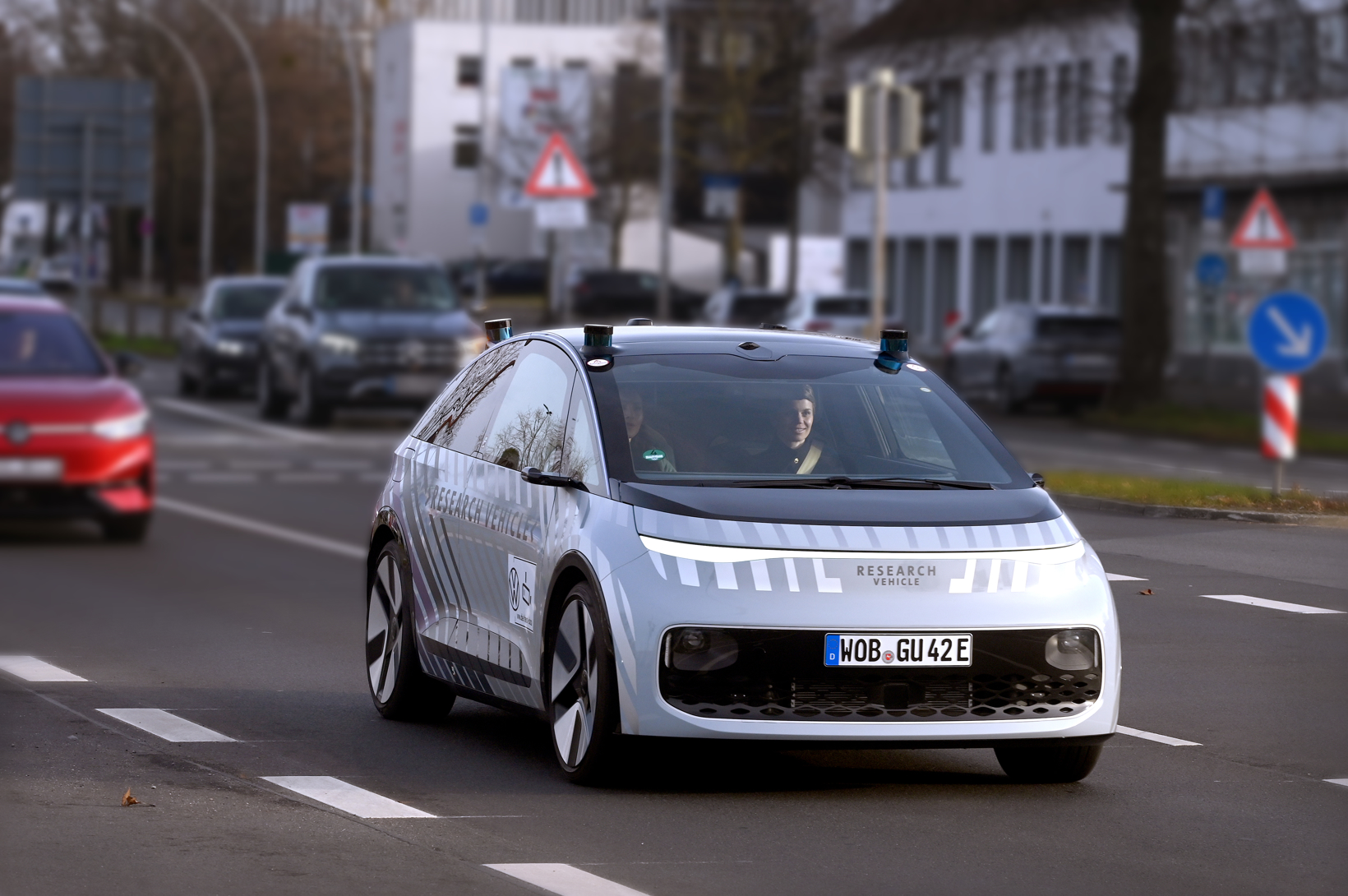
Image source: Volkswagen
Third, tighten the link between simulation and real vehicles to avoid a virtual–real gap. Under national standards, simulation must provide scenario lists and parameter bounds and prove correlation to real-vehicle tests. Gasgoo has learned that testing agencies have built Vehicle-in-the-Loop (VIL) platforms, plugging real cars into virtual scenes. They can mimic extreme weather and complex roads that are hard to recreate physically, while using real-vehicle data to calibrate models.
Zhang said, "For example, when testing motor efficiency at high altitude, we can simulate low pressure at 5,000 meters on the platform while a real car at the Golmud test site in Qinghai collects data in parallel. Cross-validating the two makes testing both efficient and credible."
Finally, build a stronger talent pipeline to address bottlenecks. Testing for intelligent connected vehicles requires cross-disciplinary skills — software engineers, algorithm specialists — and China faces a sizable talent gap. By the industry’s trajectory, test engineers must grasp mechanical principles and master skills such as Python-based data analysis and sensor calibration, and even conduct voice-control testing across languages like English and Thai.
Universities are now adding intelligent-connected testing tracks within vehicle engineering programs to train hybrid talent who know both cars and software. With the right talent in place, testing can truly "find faults," rather than go through the motions.
As solid-state batteries and Level 4 automated driving roll out, NEV testing will face fresh challenges — from low-temperature ion-conductivity checks to multi-vehicle interactions under vehicle–road coordination. The core logic won’t change: testing exists to build near-zero-defect products, not to serve a headline number.
If 100,000 tests are aimed squarely at user pain points, it’s not a false premise — it’s the path from a big industry to a strong one. NEVs should never test for testing’s sake; rigorous validation should ensure a car starts reliably in winter and drives safely in fog. That’s where the true value of those 100,000 tests lies.


