



The final week of February 2026 offered a revealing glimpse into the shifting balance of technological power between China and Germany, as Chancellor Merz led an economic delegation to Beijing.
In Beijing, Merz settled into the back seat of a new-generation Mercedes S-Class to experience a navigation-assist driving system co-developed with Chinese tech firm Momenta. His verdict: "stunning."
Almost simultaneously, BMW Chairman Oliver Zipse signed a memorandum of understanding with CATL in Beijing, focusing on cross-border battery passport data and supply chain decarbonization.
Just weeks earlier, in January, FAW-Audi announced that its new Q5L would offer Huawei Qiankun smart driving system, marking the first internal combustion SUV globally to feature the technology.
Viewed in isolation, these are merely localized moves by three German luxury automakers. Together, they paint a broader picture: the luxury camp, led by BBA, is collectively pivoting to Chinese tech firms, ceding control of core technologies—smart driving, cockpits, and battery digitization—to Chinese partners.
This is no simple supplier switch; it is a profound strategic realignment. When the German chancellor personally endorses the fruits of collaboration between his country's automakers and Chinese tech firms, the signal is unambiguous: in the second half of the global auto industry's intelligence race, German luxury cars have made their choice for survival.
Luxury Is No Longer Defined Solely by Germans
Five years ago, few would have believed a volume model like the Audi Q5L would carry a Huawei system. Even fewer imagined that the core algorithms for a brand icon like the Mercedes S-Class would be written by a Chinese team.
Yet reality is rewriting the rules of the game faster than expected.
The Audi-Huawei partnership actually began before the new Q5L. Last summer, their first collaboration—the Q6L e-tron, built on the PPE platform—hit the market with a remarkably high installation rate for Qiankun smart driving. By year-end, the Q5L Qiankun edition launched and quickly became a top seller in its segment. These market trends are proving a point to Audi headquarters: China's premium users are willing to pay for effective smart driving, regardless of whether the system comes from Germany or Shenzhen.
Mercedes has followed a similar path. An early investor in Momenta since 2017, the automaker has deepened a decade-long bond beyond capital into "joint product definition." A newly upgraded MOU expands this to full-stack tech iteration and localized optimization. Significantly, the rear entertainment system in the new S-Class is entirely managed by Chinese R&D. That was once unthinkable—user experience for the flagship model was the exclusive preserve of German headquarters. But the landscape has shifted. It is not that Germans are willing to let go. They are forced to admit that in China, the world's largest auto market, user understanding of intelligent experiences has outpaced their own.
BMW is equally proactive. Beyond its battery passport work with CATL, it announced plans to develop smart applications with Huawei based on the HarmonyOS ecosystem. It also plans to integrate DeepSeek's AI into its next-generation domestic models. During his visit, Zipse was blunt: "China is not only the world's largest auto market but also a hotbed of innovation driving industrial transformation." Coming from the BMW chairman, this is a landmark admission—the former technology exporter is now rooting itself in China to absorb its innovative nutrients.
Sales Volatility and the Anxiety of a Widening Tech Gap
The collective turn toward Chinese tech firms by German luxury automakers looks like openness, but it is essentially a strategic rescue forced by market realities.
Data from Gasgoo Institute shows Audi's 2025 sales in China reached 583,800 units, down 2.74% year-on-year. Mercedes sold 472,800 units, a 19.77% decline, while BMW moved 536,200 units, slipping 14.2%. Collectively, the German big three sold over 1.81 million units in 2024, but that figure fell below 1.6 million in 2025—an annual loss of more than 200,000 vehicles.
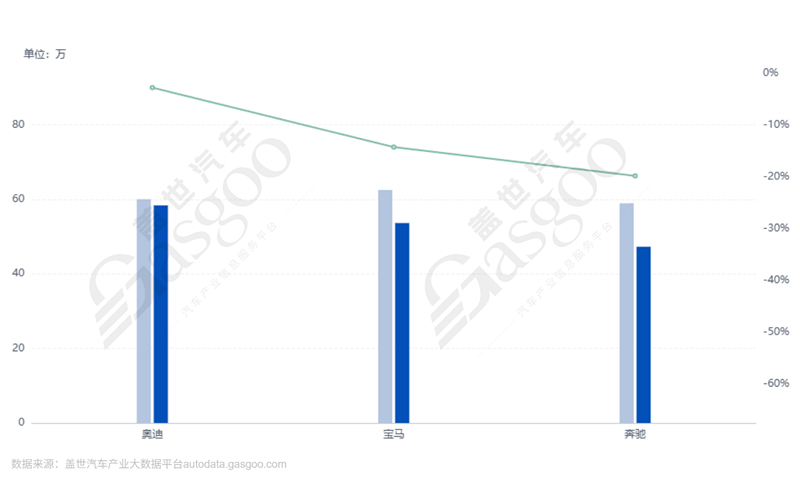
BBA sales trends in China over the past two years
Meanwhile, the overall Chinese luxury market has not shrunk significantly. In fact, domestic luxury new-energy vehicles have seen substantial sales growth.
Behind this shift is a fundamental migration of user values. Data shows young buyers today prioritize smooth infotainment and reliable city NOA functions, placing brand history and mechanical engineering second. For them, the luxury of leather and wood trim pales in comparison to a smart driving system that can deftly navigate mixed traffic.
The traditional strengths of BBA—engines, transmissions, chassis tuning—have seen their appeal diluted among young domestic users in the electric and intelligent era. Their weaknesses, conversely, are the strengths of Chinese tech firms.
According to Li Wenguang, president of Huawei's Intelligent Driving Solution Product Line, cumulative R&D investment in Qiankun has reached 50 billion yuan. As of December 31, 2025, Qiankun systems were installed in 1.4 million vehicles. Jin Yuzhi, CEO of Huawei's Intelligent Automotive Solution BU, announced that by the end of 2026, over 80 models will carry the system, with cumulative installations expected to reach around 3 million.
Huawei's HarmonyOS Intelligent Mobility fleet has begun rolling out the latest Qiankun ADS 4.1 update. Officially, ADS 4.1 strengthens safety with new eAES anti-sandwich capabilities to predict rear-end collision risks. It also optimizes human-machine driving, offering precise assistance on sharp turns and at intersections. If the driver becomes incapacitated, the system can automatically pull over and call for rescue.
Momenta has achieved similar success. In the current domestic market, aside from the Huawei ecosystem and brands with in-house systems, the vast majority of manufacturers have partnered with Momenta on assisted driving.
Put simply, the data Huawei and Momenta have accumulated on China's complex roads is something German automakers can never match through closed-track simulation.
A deeper gap lies in development efficiency. Chinese teams can tweak algorithms and push OTA updates multiple times a week. BBA's process, waiting for German headquarters approval, can take months. In the era of software-defined vehicles, a time lag measured in months can determine life or death in the market.
For owners of luxury combustion vehicles with ownership cycles of five to eight years, intelligence is no longer fixed at delivery but must be upgradable. This concept is a major breakthrough for traditional luxury brands, yet without it, combustion cars risk being marginalized in the intelligent era.
From Market for Technology to Technology for Market
To understand the logic behind BBA's pivot, one must look beyond specific tech deals to the historic reversal of Sino-German automotive relations.
Forty years ago, when Volkswagen entered China, the underlying logic of joint ventures was "market for technology"—China ceded market share in exchange for German tech transfer and localized production. It was a one-way flow: Germany exporting, China learning.
Today, as Mercedes hands core driving algorithms to Momenta, Audi reconstructs electrical architecture with Huawei, and BMW partners with CATL on battery data, the flow has completely reversed.
This is not simple procurement but a systemic effort by German automakers to integrate into China's tech ecosystem, moving from taking orders to leading core development. The Audi-Huawei collaboration even involves reconstructing the underlying PPC platform. This level of embedding means Chinese tech capability is now part of the DNA of German luxury cars. Zipse's assertion that "any company aspiring to global competitiveness must be rooted in China" acknowledges a fact: on the tech tree of intelligent EVs, China has grown the sturdiest branches.
Chancellor Merz's test ride in the Momenta-equipped S-Class was symbolic, marking high-level German approval of this tech transfer model. His astonishment was not mere politeness; he knows the core algorithms and data training were largely Chinese. The CEOs of Mercedes, BMW, and VW accompanied Merz. Their meetings with Chinese entrepreneurs like Geely's Li Shufu and Leapmotor's Zhu Jiangming in Hangzhou sent a clear message: the German auto industry needs Chinese tech empowerment.
This empowerment is spreading across the supply chain. Toyota's bZ7 became the first D-segment sedan with a Huawei HarmonyOS cockpit and Momenta driving tech. Honda partnered with Momenta, as did SAIC-GM for the Buick Electra L7. VW invested 2.4 billion euros in a joint venture with Horizon Robotics in 2023. In these deals, Chinese tech firms have shifted from "options" to "must-haves" in the global smart driving supply chain.
The impact of this role reversal is profound. China's auto industry once relied heavily on foreign core components, and the use of international suppliers was a selling point for domestic brands. Now, on the new high ground of electrification and intelligence, companies like Huawei, Momenta, Horizon, and CATL are the technology definers.
Reconstructing Market Prospects by Leveraging Chinese Tech
As foreign automakers entrust smart driving and cockpit capabilities to Chinese firms, they gain more than just a technological patch—they acquire strategic elasticity for future competition.
The Audi Q5L offering Huawei Qiankun as an option from March means this mainstay combustion SUV can compete on intelligence with new EV rivals. Mercedes plans to roll out co-developed driving systems across nine new models in 2026, including the long-wheelbase GLC EV and the new S-Class. This speed of deployment will help Mercedes quickly close the gap in intelligent experience perception.
From a user perspective, these collaborations are ushering in an era where combustion and electric vehicles offer equal intelligence.
For years, advanced driving was seen as the domain of EVs. Audi's partnership proves combustion cars don't have to exit the stage; they can still lead if they embrace openness. For the massive base of luxury combustion users, this means they don't need to switch brands to experience high-end driving tech. Maintaining that stickiness is strategically vital for BBA.
Technologically, the involvement of Chinese firms will accelerate the evolution of foreign brands' features. The ability to continuously learn driving habits and road data via large models is something traditional automotive engineering cannot provide.
Globally, BBA's partnerships are creating spillover effects. Some foreign brands are already quietly looking to introduce Chinese tech solutions to Europe and the US. The global supply chain is being backfilled—where China once learned from the world, the world now needs Chinese tech. Solutions validated in China could soon appear in cars bound for Europe and North America, extending the influence of Chinese tech firms beyond their borders through global distribution channels.
These collaborations may redefine the very meaning of luxury. In the combustion era, luxury was defined by cylinder count, chassis tuning, and materials. In the intelligent era, it is being reinterpreted as the fluidity, safety, and human-centricity of the experience. FAW-Audi blends German mechanical heritage with Eastern digital wisdom; Mercedes combines rigorous safety standards with Momenta's AI innovation.
This fusion model is shaping the value standard for the next generation of luxury cars.
In Summary
When the German chancellor marvels at the results of collaboration between his country's automakers and Chinese tech firms, and when BBA collectively hands core R&D to Chinese teams, it is more than a business choice. It is a microcosm of the shifting power structure in the global auto industry.
Chinese tech firms have proven over a decade that they can not only meet local demand but also empower top global luxury brands. BBA's choice shows that in the unwinnable race of intelligence, swallowing pride and embracing the strong is a more rational survival strategy than stubborn isolation.
In the coming years, as foreign models equipped with Huawei Qiankun, Momenta solutions, and CATL batteries hit the market in force, Chinese tech capabilities will face a global test. If this new model of cooperation withstands market scrutiny, BBA's collective turn will be recorded as a pivotal turning point in the transformation of traditional luxury brands. Conversely, if it fails to halt the slide in market share, it will signal that the central position of German luxury cars in the global industry is irreversibly fading.
But one thing is certain: Chinese tech firms are no longer supporting actors in the auto industry. They are becoming protagonists in defining the future of mobility.


