Gasgoo Munich- On March 9, autonomous driving company WeRide announced an expanded strategic partnership with Farizon New Energy Commercial Vehicle Group, the commercial vehicle arm of Geely Holding, according to a post on WeRide's WeChat account.
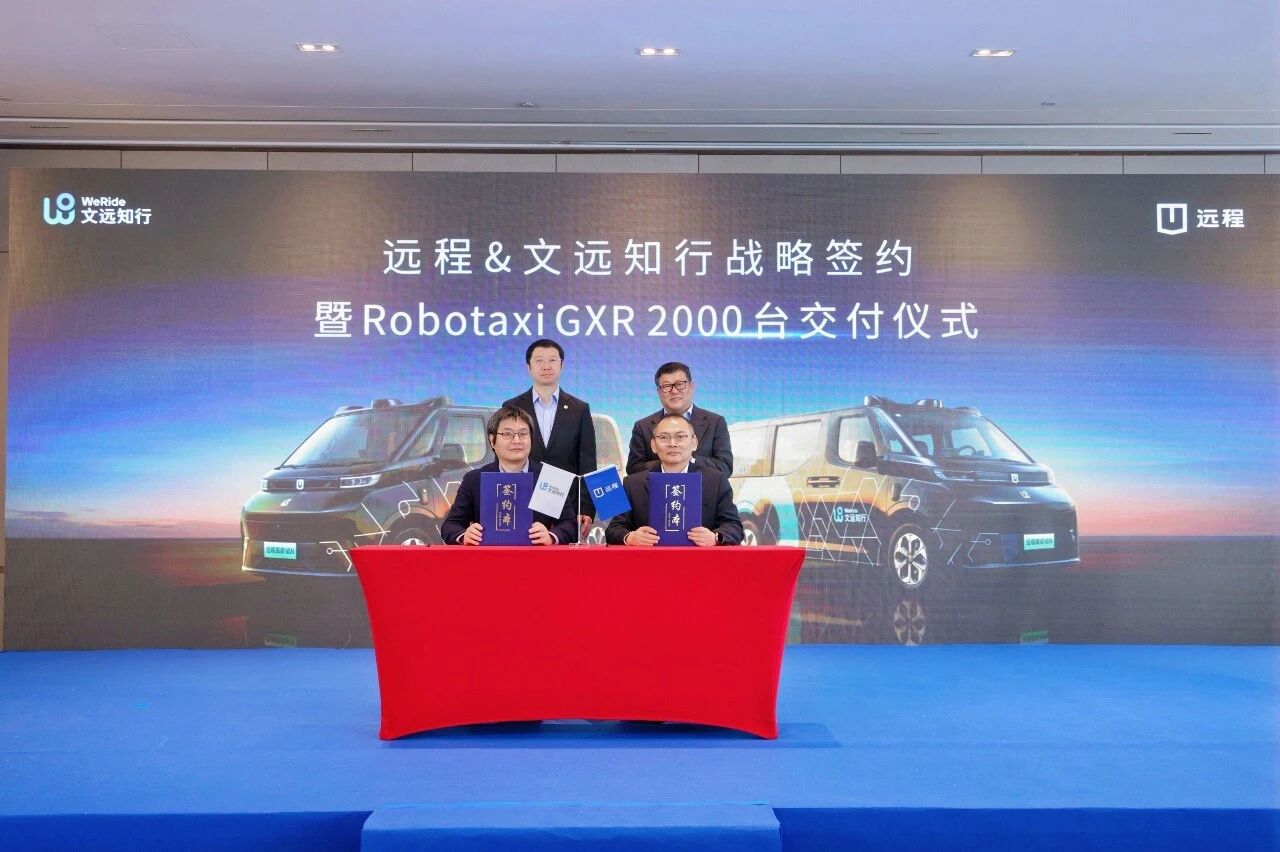
Image source: WeRide
Alongside the agreement, the two companies launched an upgraded production-ready Robotaxi GXR model, and revealed plans to deliver around 2,000 units in 2026. The vehicles are expected to be deployed across both domestic and international markets, marking a step toward large-scale global commercialization of Robotaxi services.
Mass production of the upgraded Robotaxi GXR is scheduled to begin in the third quarter of 2026. The delivery roadmap signals an acceleration in WeRide's commercialization efforts. As of January 2026, the company reported a global Robotaxi fleet of 1,023 vehicles. With the planned addition of 2,000 Robotaxi GXR units, the total number of active Robotaxis operated by WeRide worldwide is expected to exceed 2,600 this year, forming part of the company's longer-term ambition to deploy tens of thousands of vehicles globally by 2030.
Compared with the previous generation, the new Robotaxi GXR is equipped with WeRide's latest autonomous driving platform, GEN8. The system is built around the company's in-house Sensor Suite 8.0, designed to enhance safety, operational consistency, and long-term reliability in autonomous fleets. A high-resolution LiDAR unit capable of generating significantly denser point-cloud data—reportedly improving detail by up to seventeen times—extends detection range to as far as 600 meters. The longer sensing horizon allows the vehicle to identify road conditions earlier and allocate substantially more reaction time for decision-making in high-speed scenarios. According to the company, the sensing system is also designed to maintain stable perception in challenging weather conditions such as heavy rain or dense fog, supporting round-the-clock autonomous operation.
The partnership with Farizon is also expected to improve manufacturing efficiency. Leveraging the company's drive-by-wire AI chassis architecture as well as its established supply chain and production management capabilities, the Robotaxi GXR's assembly cycle could be shortened dramatically—from roughly one hour per vehicle to less than ten minutes. WeRide said the updated model is also designed to reduce overall vehicle costs by about 15%, reflecting ongoing efforts within the Robotaxi sector to bring down deployment expenses.
The latest strategic upgrade builds on a Robotaxi model that has already been tested in real-world operations. In October 2024, WeRide introduced the Robotaxi GXR, a next-generation production Robotaxi developed on Farizon's Super VAN model. Within four months, the vehicle entered fully driverless commercial service in Beijing, followed by similar operations in Guangzhou in August 2025.
Today, the Robotaxi GXR fleet is operating fully driverless services in Guangzhou, Beijing, and Abu Dhabi, while public Robotaxi operations are running in Dubai and Riyadh. The company also plans to launch fully driverless services in Dubai later this month. Meanwhile, trial operations of the Robotaxi GXR in Singapore are expected to transition to public service on April 1, expanding WeRide's presence across additional global markets.