



Gasgoo Munich- The large five-seat SUV segment is becoming one of the most crowded battlegrounds in the industry.
Industry estimates suggest nearly 20 large five-seaters are set to hit the market this year alone: the Voyah Titan X8, ZEEKR 8X, Dongfeng Nissan NX8, Chery Fulwin T9L, and the Lynk & Co 900 large five-seat edition.
Spanning the 130,000 to 400,000 yuan price bracket, new models are flooding in. Automakers are filling this lane at a breakneck pace.
"The winds shifted fast in 2026," one industry insider observed. "The competitive focus of the auto market has pivoted from large six-seaters to large five-seat SUVs."
Beneath the surface frenzy of new product launches, a set of data reveals a structural imbalance in the industry. In 2025, pure-electric powertrains accounted for just 6.4% of the large five-seat SUV market. By contrast, the pure-electric penetration rate in the large three-row SUV segment hit 37.4% that same year, with sales outpacing extended-range vehicles for several consecutive months.
The irony is stark. On the battlefield of large six-seaters, pure-electric models have relegated extended-range alternatives to the background. Yet in the large five-seat arena, pure electrics are virtually invisible.
Is it really that consumers don't want large five-seat EVs? The answer likely lies on the supply side.
"Across all price points, pure-electric models already account for 28.8% of five-seat SUVs," NIO founder William Li told a media briefing for the Onvo L80 presale. "Doesn't that suggest the penetration rate for large five-seaters is far too low? Is it that consumers aren't choosing them? Certainly not."
When a broader category approaches a 30% pure-electric share while a core niche remains stuck in the single digits, the root cause is hardly demand. According to Li, it comes down to a lack of choice.
The Supply-Side Mismatch Behind 6.4%: Why Are Large Five-Seat EVs "Silent"?
Looking back at product strategies over the past few years, the large five-seat EV SUV segment was a battlefield mainstream automakers systematically bypassed.
From 2022 through 2024, growth in the large five-seat new-energy market was captured almost entirely by extended-range (EREV) and plug-in hybrid (PHEV) models.
Models like the Li Auto L7 and L8, the AITO M7, and the BYD Tang overwhelmingly embraced the route of carrying a fuel tank. Leveraging the flexibility of gasoline and electricity—and the then-immature charging infrastructure—they quickly won over families.
This strong supply bias created a self-reinforcing perception: large five-seat users need extended range because they suffer from range anxiety.
But the evolution of the large three-row SUV market has already declared that logic bankrupt.
"Before the Onvo L90 launched last year, large three-row SUVs were dominated by extended-range models, with pure-electric sales at just one-fifth the volume," Li told reporters including Gasgoo. "But after the Onvo L90 and NIO ES8 hit the market last September, the dynamics shifted fast. From September through March, pure-electric large three-row SUVs outsold extended-range models for seven straight months. This March, the pure-electric penetration rate in the segment hit 37.4%—the highest among all powertrain types."
The divergent trajectories of these two segments reveal a supply-side problem, not a lack of demand. Large three-row SUV users were once labeled as too afraid to go electric, but when products backed by robust charging and battery-swapping networks—and superior EV technology—actually arrived, their votes shifted.
So, why were pure-electric large five-seaters collectively absent between 2022 and 2024?
A reasonable industry inference is that automakers strategically prioritized six-seaters during that period. With their "2+2+2" layout, six-seat SUVs perfectly matched the travel needs of multi-child families, while offering higher price points and profit margins than five-seaters.
Industry data shows that in 2024, families with children accounted for 78.66% of new passenger car purchases in China. Those with two or more children made up 33.49%, a demographic that directly fueled the explosive growth of the large six-seat segment over the past three years.
Given limited resources, shifting R&D budgets and production capacity toward higher-margin six-seaters was a rational business choice.
Yet deep shifts in demographics are now undermining that logic.
In 2022, China's population shrank for the first time in nearly 60 years, a decline that has continued annually. By 2025, new births totaled just 7.92 million—a drop of more than 50% from the peak in 2016.
Family structures are regressing to three or four members, and the growth of multi-child families is narrowing year by year.
"Extended-range large five-seat SUVs did see massive growth in 2022, 2023, and 2024," Li noted, "but in 2025, that segment fell by 8%."
This indirectly confirms that large vehicles offering no qualitative leap in experience are finding it harder to persuade users to trade up.
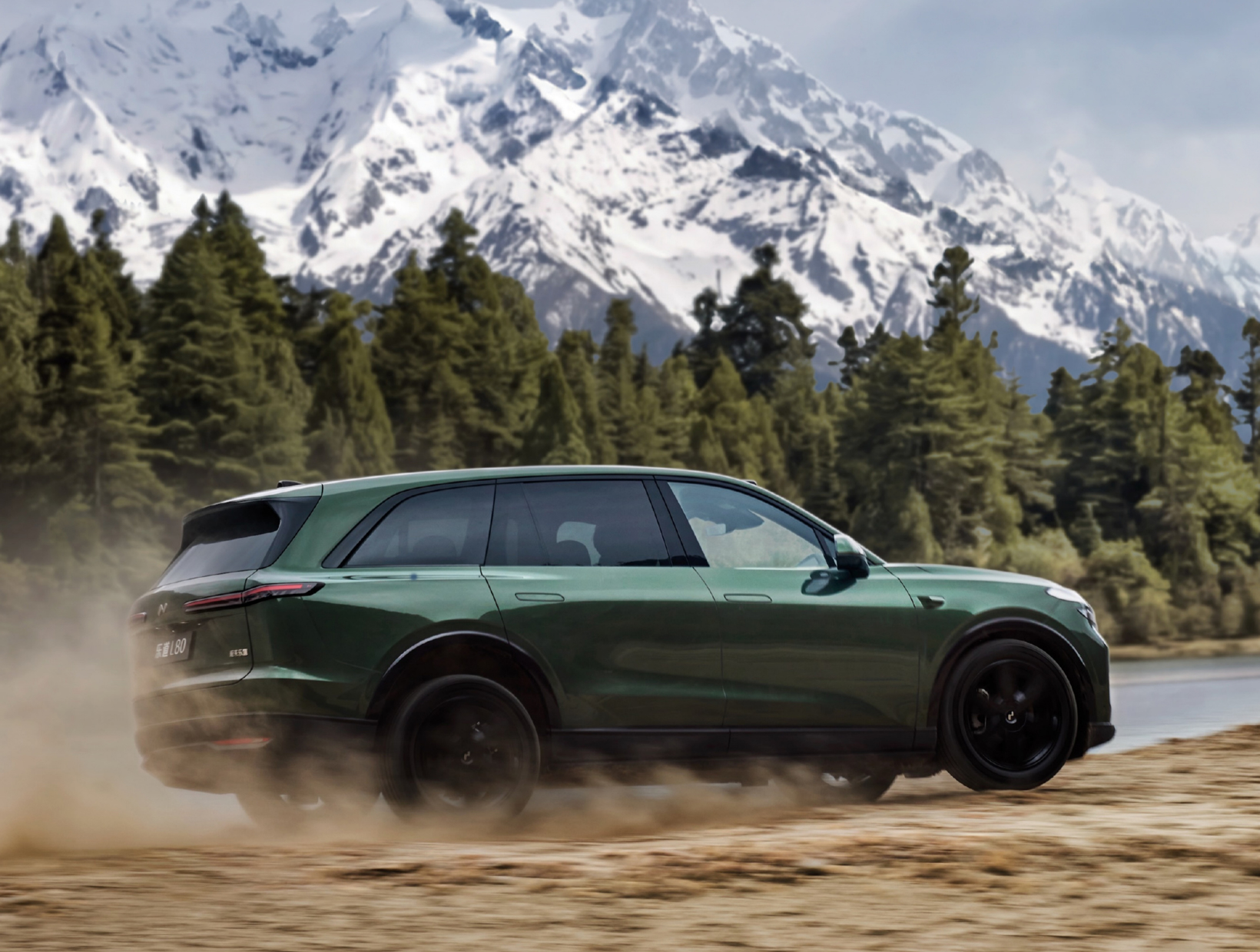
Image Source: Onvo
The 6.4% penetration rate of large five-seat EVs is essentially the result of misaligned industry priorities. A temporary vacuum in supply happened to coincide with a "time lag" in family vehicle demand that was just beginning to surface.
With nearly 20 products now flooding into the segment, automakers are filling a gap—and fighting for a window of opportunity.
Scenarios or Specs? Two Paths for the Large Five-Seater
With nearly 20 large five-seat SUVs launching within the same window, a new question emerges: where should differentiation truly be built?
Right now, the industry is offering two starkly different answers.
One path is spec-driven, continuing the approach the EV sector has relied on for years: bigger battery packs, longer range, and increasingly aggressive acceleration figures.
Several upcoming models are pushing this logic to the limit. The pure-electric Voyah Taishan X8 offers 98 kWh and 120 kWh battery packs with corresponding ranges of 603 km and 727 km. The pure-electric version of the XPENG GX full-size flagship SUV carries a 110 kWh pack and a CLTC range of 750 km. The BYD Datang EV is equipped with a 130.2 kWh pack, aiming for a CLTC range approaching 950 km.
The other path attempts to shift the competitive focus back from specs to usage scenarios.
At the Taishan X8 presale, Voyah Chairman Lu Fang publicly voiced his divergence from the spec-first approach. "We hope users won't focus too much on parameters, as specs can create anxiety," he said. "The focus should remain on the comprehensive experience of the vehicle. With products and marketing becoming increasingly homogenized, the way out for automakers is to return to real user needs—replacing 'parameter anxiety' with 'scenario experience'."
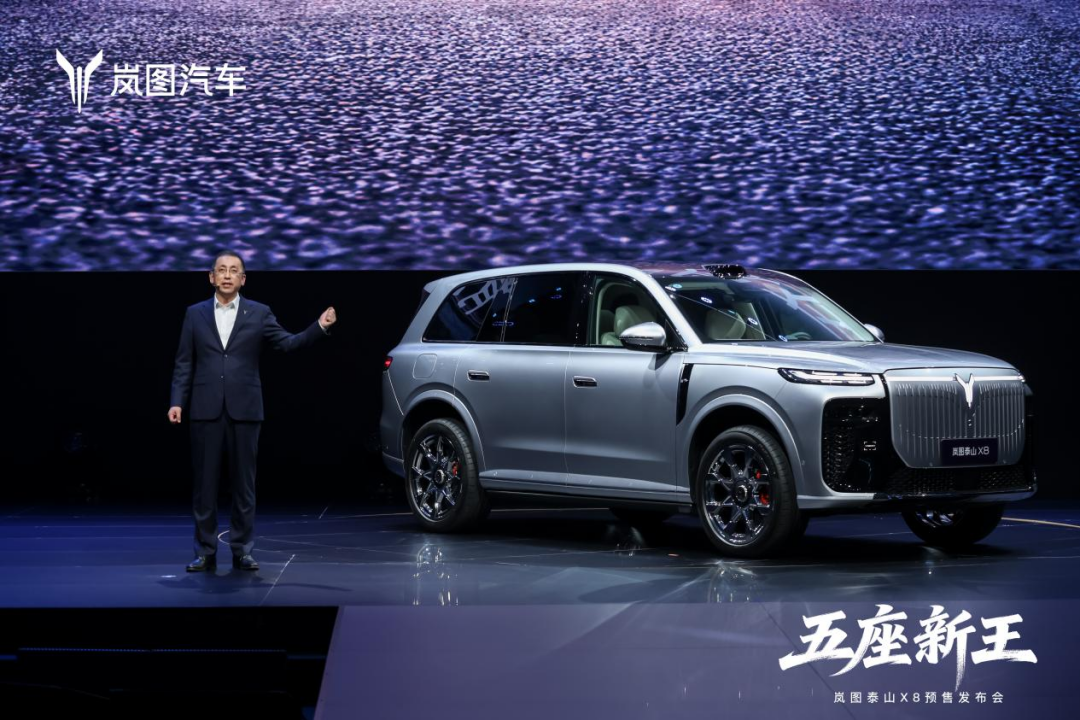
Image Source: Voyah
The Onvo L80 falls into this camp. It positions the vehicle as a "dual-cabin mini RV," featuring a 240-liter intelligent electric front trunk (frunk) and a 1,200-liter rear trunk with a lowered floor. With the second-row seats folded, cargo capacity expands to 2,600 liters with a maximum depth of 2,200 mm—plenty of space to fit a large bed.
The core narrative of its product logic goes beyond the traditional metric of seating space, shifting the competitive axis from "how many people it can seat" to "how many lifestyles it can accommodate."
The divergence between these two paths reflects, to some extent, the shifting value anchors within China's auto industry.
In the early stages of EV adoption, the specs race made sense; range and acceleration were the most direct ways to dispel consumer doubts. But when core parameters hit the point of diminishing returns—where the real-world difference between a CLTC range of 800 km and 950 km is negligible for most users—continuing to stack specs becomes an "arms race" that is cost-ineffective and offers little perceptible benefit.
Onvo has stuck with ternary lithium batteries—a move that seems contrary to cost control but is actually a strategic trade-off of short-term expense for long-term value. Li quantified the added cost for consumers, framing it as "spending 10,000 yuan more for a lighter body and more space," thereby translating a technical debate into user value. This confidence is backed by the battery-swapping ecosystem, where better recycling value and long-life R&D help amortize the initial costs.
This is a "luxury" achievable only by leveraging a battery-swapping network.
Ultimately, the Onvo L80 is not about the trade-offs of individual parts. It packages battery technology, the replenishing network, spatial innovation, and the business model into a holistic solution—all aimed at reaching a tipping point for a qualitative leap in user experience.
Some industry analysts point out that while the Onvo L80's CLTC range is not top-tier in the current market, "this divergence over range is essentially not a battle over battery packs, but a difference in how companies understand product strength and the endgame of new energy vehicles."
The scenario-based route is essentially a bet that once charging infrastructure is dense enough, marginal range anxiety will fade. At that point, the imagination and practicality of "what can be done" inside the vehicle will become the value variable users perceive most acutely in daily life.
Of course, the scenario-based approach is not without cost. Scenario-driven design implies higher R&D investment, more complex supply chain management, and challenges in parts matching and quality control during mass production.
This tests not just an automaker's creativity, but its true engineering prowess and capability in scaled manufacturing.
Who Can Survive the "Crowd"?
The intensity of market competition is already clear from the price distribution.
In the large five-seat segment, the Chery Fengyun T9L kicked off presales at 139,900 yuan, becoming the first to pull the entry price for new-energy large five-seaters below 140,000 yuan. The Dongfeng Nissan NX8 positions itself as a "200,000-yuan class mega five-seater." The Onvo L80 enters the mid-range at 245,800 yuan (or 159,800 yuan with BaaS battery leasing). The Voyah Taishan X8 targets the high end with a range of 302,900 to 389,900 yuan. The ZEEKR 8X starts at 356,800 yuan, with some configurations exceeding 500,000 yuan.
From 140,000 to 500,000 yuan, models are densely packed, with features and configurations bleeding across price brackets in a classic free-for-all.
In such a crowded arena, the "new-model effect death valley" has become a systemic risk hanging over every product.
Li repeatedly invoked this concept in interviews, highlighting the overlay of multiple structural pressures in today's auto market: a relentless stream of new models, with over 100 debuting at the 2026 Beijing Auto Show alone; breakneck technological iteration, where "a single chip update marks a generational difference"; "pulsed" social media traffic that spikes at launch and then fades rapidly; and the psychological gap of a "disguised price hike" when presale perks expire, often causing sales to plummet months after launch.
The Onvo L90 itself saw sales slide from over 10,000 units per month to just over 1,000 in the second half of 2025. This "death valley" curve is not an isolated incident but a common dilemma for the product lifecycle across the entire industry.
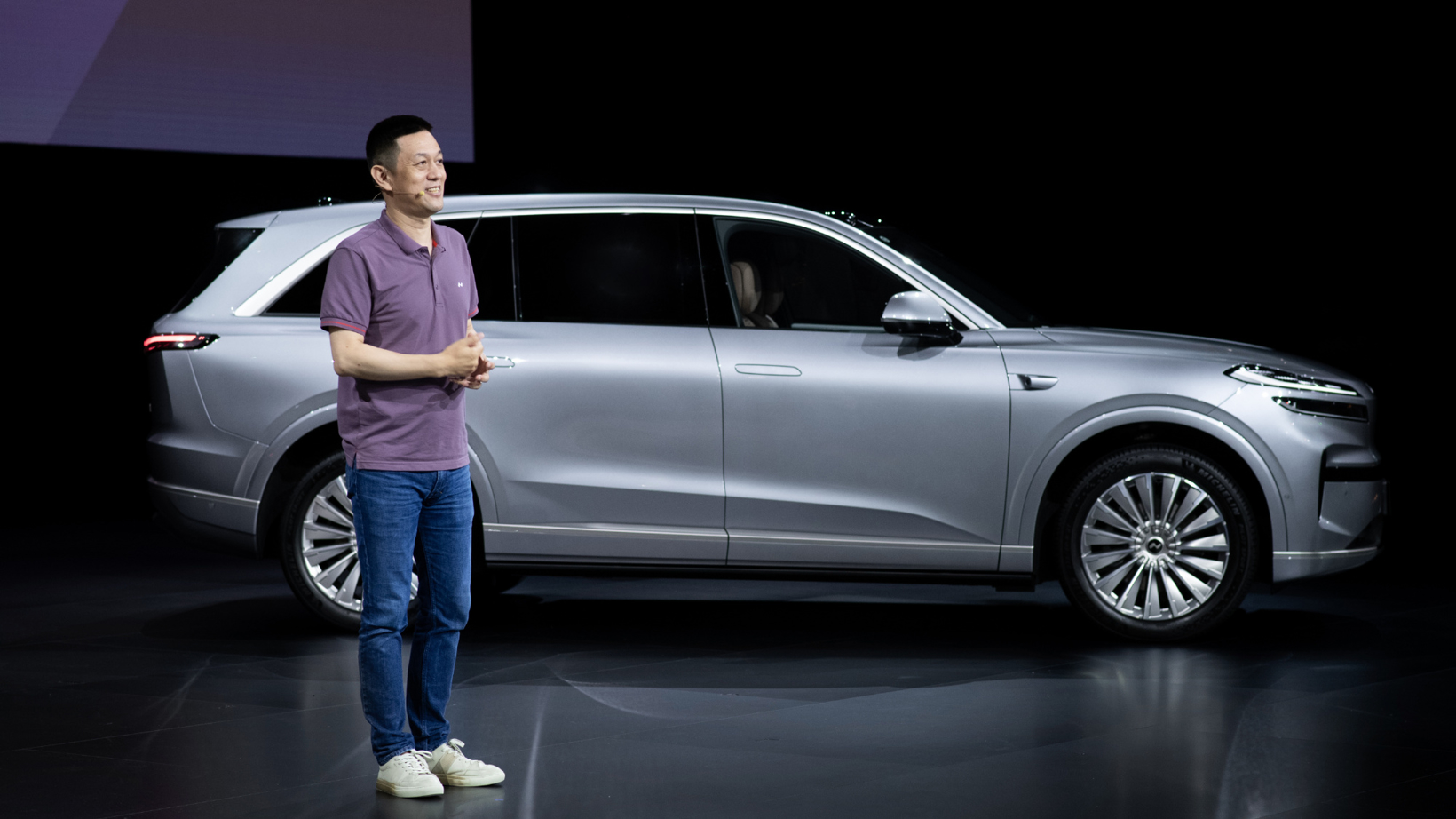
Image Source: Onvo
Even more tricky than the rhythm of publicity is the real pressure on costs.
Since the start of 2026, the supply chain has been under sustained cost pressure: lithium carbonate prices have doubled, rebounding from a low of about 75,000 yuan per ton in 2025 to roughly 160,000 yuan per ton. Supplies of automotive-grade memory chips are tight. Geopolitical conflicts have pushed up petroleum-related raw material costs. And in the tire industry, multiple companies have issued price increase notices as costs for core materials like natural rubber, synthetic rubber, and carbon black rise across the board.
Under the weight of these compounding cost pressures, the room for automakers to balance product pricing with maintaining gross margins has narrowed further.
Under this pressure, some companies are pursuing a volume strategy, using aggressive pricing to ramp up sales quickly and dilute manufacturing costs. Others are anchoring themselves in the mid-to-high-end segment, attempting to maintain profit margins through brand premiums and differentiated configurations.
For the large five-seat EV camp, there is an additional long-term variable to contend with: the purchase cost of ternary lithium batteries remains consistently higher than that of lithium iron phosphate (LFP) batteries. With the industry share of LFP installations soaring to 81.2% in 2025, leaving ternary lithium with just 18.7%, choosing the latter means adding thousands—or even tens of thousands—of yuan in cost per vehicle.
Whether this investment can be fully recouped through user experience, brand recognition, and long-term residual values remains an open question.
An even greater test lies in distribution channels.
Channel coverage for many automakers in first- and second-tier cities is nearing saturation. Yet the lower-tier markets needed to sustain volume growth for large five-seat SUVs are precisely where brand awareness and charging infrastructure are weakest.
The results of infrastructure investments—densifying battery-swapping networks, expanding stores in third- and fourth-tier cities, and coordinating online reach with offline service—may not materialize within the lifecycle of a single model. But they will determine which brands ultimately survive this elimination race.
Looking across the industry, large five-seat EVs are starting from a penetration rate of just 6.4%, leaving undeniably vast room for growth.
Large three-row SUVs went from a pure-electric share of under 20% to surpassing extended-range vehicles in less than a year. This suggests that as long as the product is right, consumers are far more willing to switch powertrains than the industry expects.
But replicating that curve won't be easy. The intensity of competition in the large five-seat segment far exceeds that of the large three-row segment a year ago. Back then, the pure-electric large three-row arena had only two real disruptors: the Onvo L90 and the NIO ES8. Today, the large five-seat arena is a brawl involving nearly 20 models.
This isn't a gamble by a single brand, but a collective sprint by the entire industry into a category that has been overlooked for too long.
Behind the 6.4% market void, some see opportunity—others see a trap.
Ultimately, the brand whose product can truly cross the tipping point of a qualitative leap in user experience will earn the right to define the rules of the game for this segment going forward.
As for the answer, the second half of 2026 will begin to reveal the outline.


